
Hacks & Buildsradiobluetoothiothardware
nktbuilds Heard a Coin-Sized Bluetooth Tag 12 km Away With a €60 Grid Dish That Only Listens
Two Augsburg engineers pointed a 24 dBi grid antenna from one hill to another and caught three Bluetooth packets in 13 minutes from a tag sending at +8 dBm, with no added transmit power.
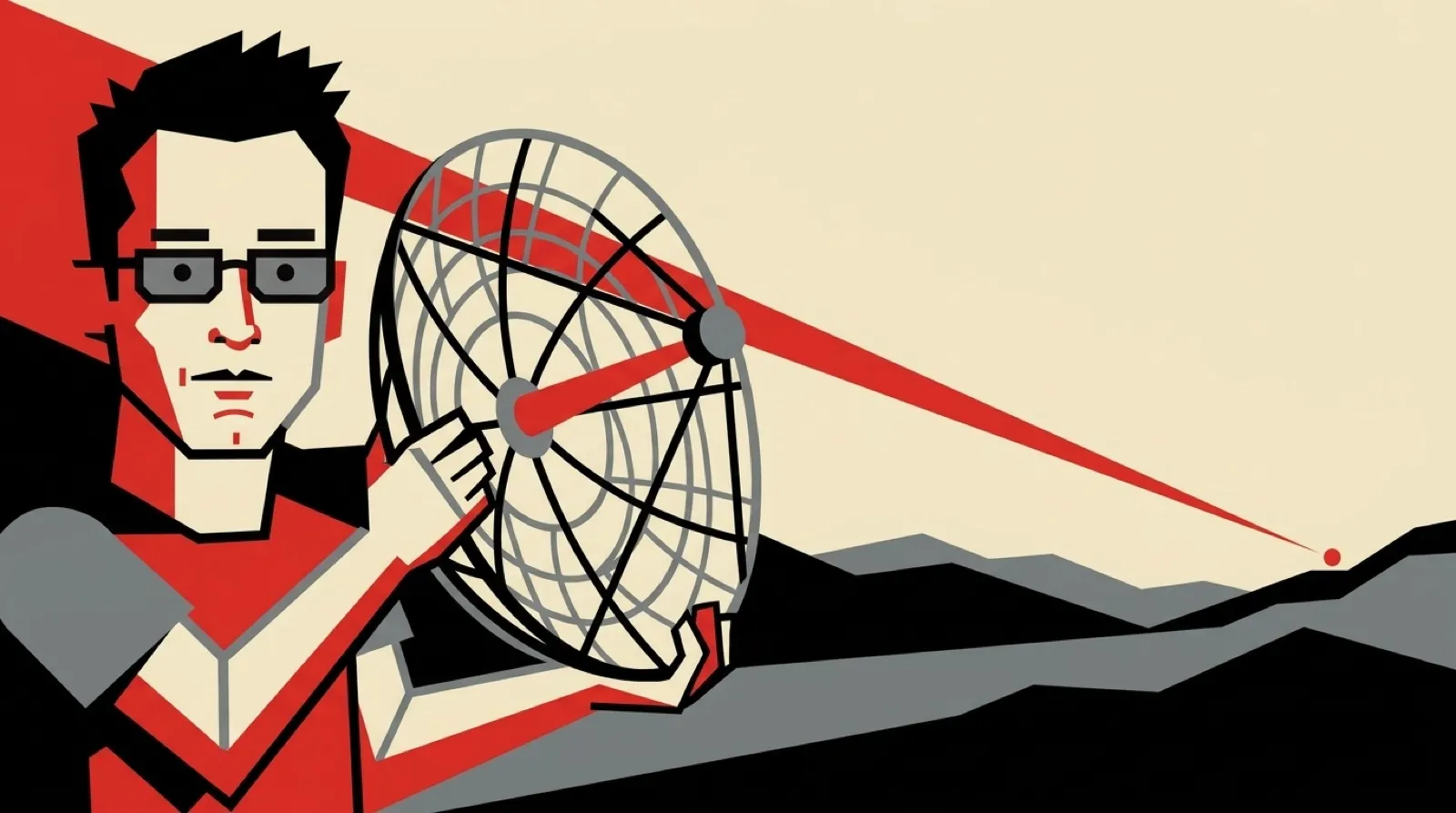
The build starts with a legal rule. “So, step one is to make sure we don’t end up in jail,” one of them says in the video, and that shapes everything after it: “The tag transmits, and the dish only listens.”
The dish is a 24 dBi grid antenna that “arrived as a flat stack of parts and a big bag of bolts,” with no instructions. The mast is a wooden handle from Bauhaus, two clamp brackets and a lot of cable ties. The screwdrivers came from a supermarket set where, by their count, “None of them works, but yeah. Lean startup.”
On paper it was easy. The tag sends at +8 dBm, “about 6 mW,” through a +3 dBi antenna. The dish adds 24 dB, the cables cost 2, and Bluetooth’s Coded PHY long-range mode drops the receiver’s floor to −104 dBm. That leaves 137 dB for the distance to eat. Twelve kilometres of free space costs 122 dB, so the budget had 15 dB to spare and, in their math, “doesn’t run out until nearly 70 km.”
Then they tried 500 metres down the road behind the office. The math said −61 dBm. The log said a median of −89, with dips to −99. “The real world had taken 28 dB before even left the car park.”
The ground was eating it. Both antennas stood 1.6 m up, and the radio path needs a clear tube of air around it, the first Fresnel zone, which the video puts at almost 8 m across at 500 m and 38 m across at 12 km. Aiming by eye failed so fast that a red-dot sight came up within minutes, mostly as a joke about whose eyes to aim for.
Play the video on YouTubeSo they went up. One engineer biked to a lookout tower with the tag while the other set up the dish on a hill across town, and both pointed by digital compass at a horizon full of trees. Then nothing happened for long enough that the tag holder “was genuinely ready to head down the stairs pack my bag and just write the whole thing off.”
Then: “Oh Daniel, I received one sample.” The first packet read −102 dBm, 2 dB above the floor. Free-space math had promised −89, so the tree line cost about 13 dB of the 15-dB margin, and the link held on what was left. They estimated the distance on the spot at 13 km. What they don’t have yet is a mount that holds the link every day instead of three times in 13 minutes.
The video’s own conclusion goes further than the stunt. “Bluetooth in the newest version with coded PHY is just at least in certain scenarios on the same level as Laura,” they say, meaning LoRa, the usual pick for long-range maker links, while using less energy for more data. That’s a claim worth watching on real deployments, where a gateway on a rooftop listens to sensors that never needed a new radio. The test to watch for next is the one they skipped: a permanent mount, a clear line of sight, and a packet count measured in hours instead of minutes.