
Hacks & Builds3D printingLEGOHack Clubopen hardware
StudPrint is an open-source 3D printer with a frame, motion system and extruder that are 92% classic LEGO bricks
The 92% counts parts in a bill of materials, the extruder needed non-LEGO gears after the bricks wouldn't grip filament, and the build log says it took 59.25 hours.
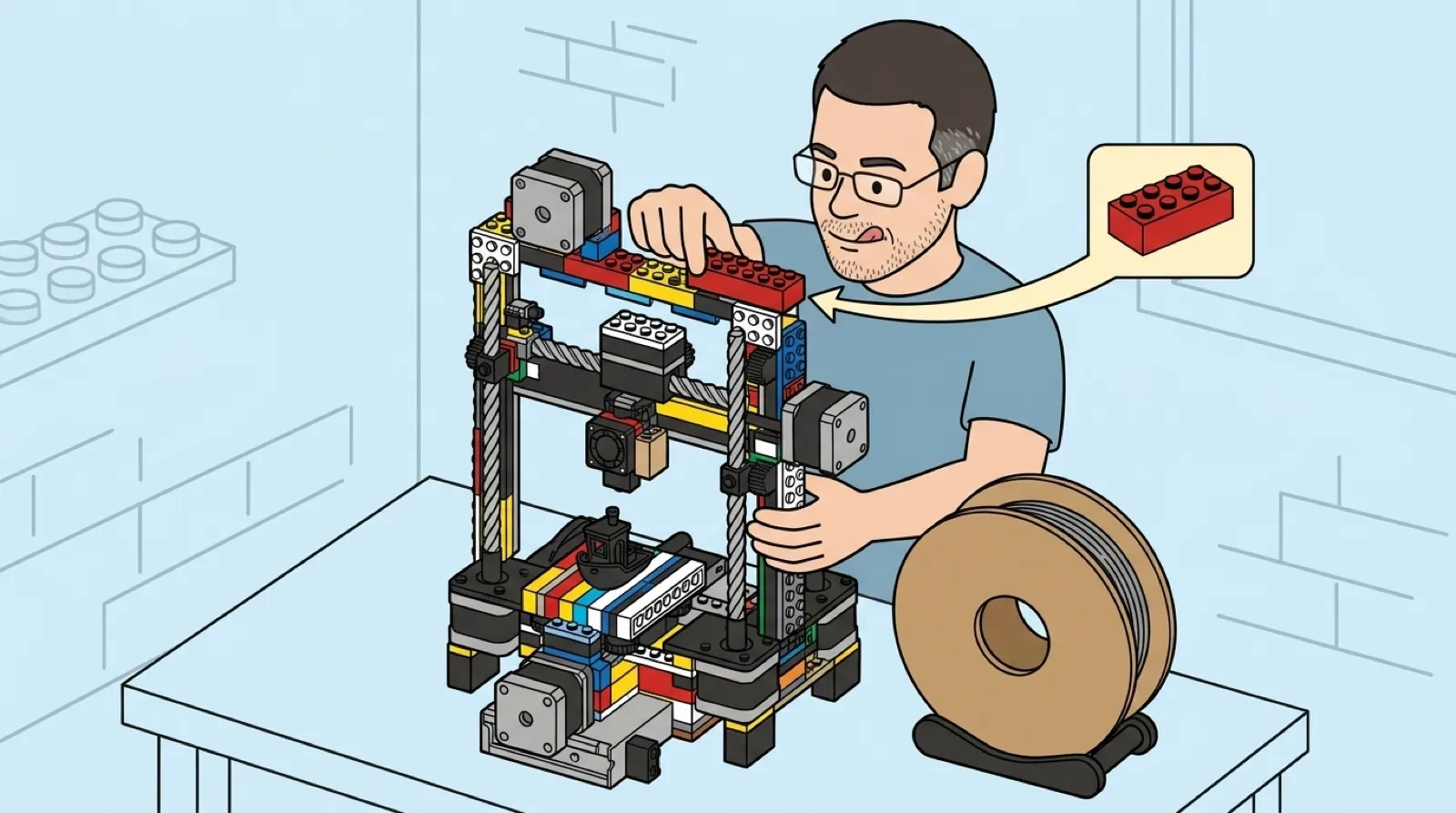
Somebody built a 3D printer out of the thing a 3D printer is usually used to make fun of. The GitHub project is called StudPrint, and its README says “the frame, motion system, and extruder are made out of 92% LEGO bricks.”
The 92% is a count of parts. According to the README, it comes from counting LEGO components and dividing by the total components in the bill of materials, taken from the SolidWorks drawings. It is not a weight, and it is not a cost. The maker is the AdamTuraj account on GitHub, and the rule was classic bricks and parts that interface with them, no Technic wherever possible. The non-LEGO remainder is mostly what you would guess: “some parts, especially the custom mounts for steppers, electronics, and other hardware,” which can’t be made from classical bricks.
The reason for all this is a prompt. The README says the project “started as a response to a Hack Club YSWS called Infill.” Infill asks participants to design a 3D printer from scratch, describes the funding as a $350 grant for parts, and ends with an instruction to keep tuning “until you get a perfect benchy from it!” The maker wrote: “Having grown up with LEGO, I decided to make the entire printer out of it.”
The build journal shows where bricks and physics disagreed. It totals 59.25 hours. The first day went well, with the X axis and stepper mounting going fairly smoothly. Then the play showed up, and in a LEGO printer that is not the fun kind. The Y axis had some “up play,” and the toolhead had too much rotational play, which an extra wheel at the bottom of the X rail fixed. The top of the Z axis worried the maker because there is only so much you can stiffen with plastic that is designed to come apart.
The extruder is where the 92% earned its asterisk. LEGO wheels could not grip the filament well enough, and friction from the bowden tube and hotend made extrusion impossible. The journal says so plainly: “it was just unrealistic to use LEGO wheels and expect consistent extrusion.” The redesign uses BMG dual extruder gears and a springed tensioner, with LEGO still making up the frame around them.
One more fix finished it: rotating the extruder 90 degrees to give the bowden tube room to compress. Then Klipper went on, filament went in, and the printer produced a Benchy in about 1.25 hours.
The cost is a loose number by the maker’s own admission. The README says “LEGO cost will vary depending on local availability, and the BOM cost is only a rough estimate,” that prices are from the day the sheet was made, and that some parts may go out of stock because the BOM will not be maintained. The license is the CERN Open Hardware Licence (CERN-OHL-S-2.0), and the CAD, gallery and BOM sit in the repo.
The most useful part of this repo might be the journal. A finished open-hardware printer is a nice picture, and a log of what failed at hour 20 is a map. Any builder who picks up the CAD files gets the sequence of problems along with the answers, which is rarer than the design itself.
What it might lead to is more projects that start from a constraint instead of a spec. Infill’s prompt produced a printer that nobody would design on purpose, and a design nobody planned is where the interesting failures live. The next person with a bin of bricks has a starting point and a list of places it will flex.
Fifty-nine hours of building bought one Benchy.