
Home Assistant's $69 Box Plugs Old Stereos, TVs and Solar Inverters Into Your Smart Home Over RS-232
Nabu Casa, the company behind Home Assistant, built a puck that Ethernet can power and that sits next to the old gear. It plays audio and proxies Bluetooth too, but it can't stream Bluetooth audio, and the power supply and cables cost extra.
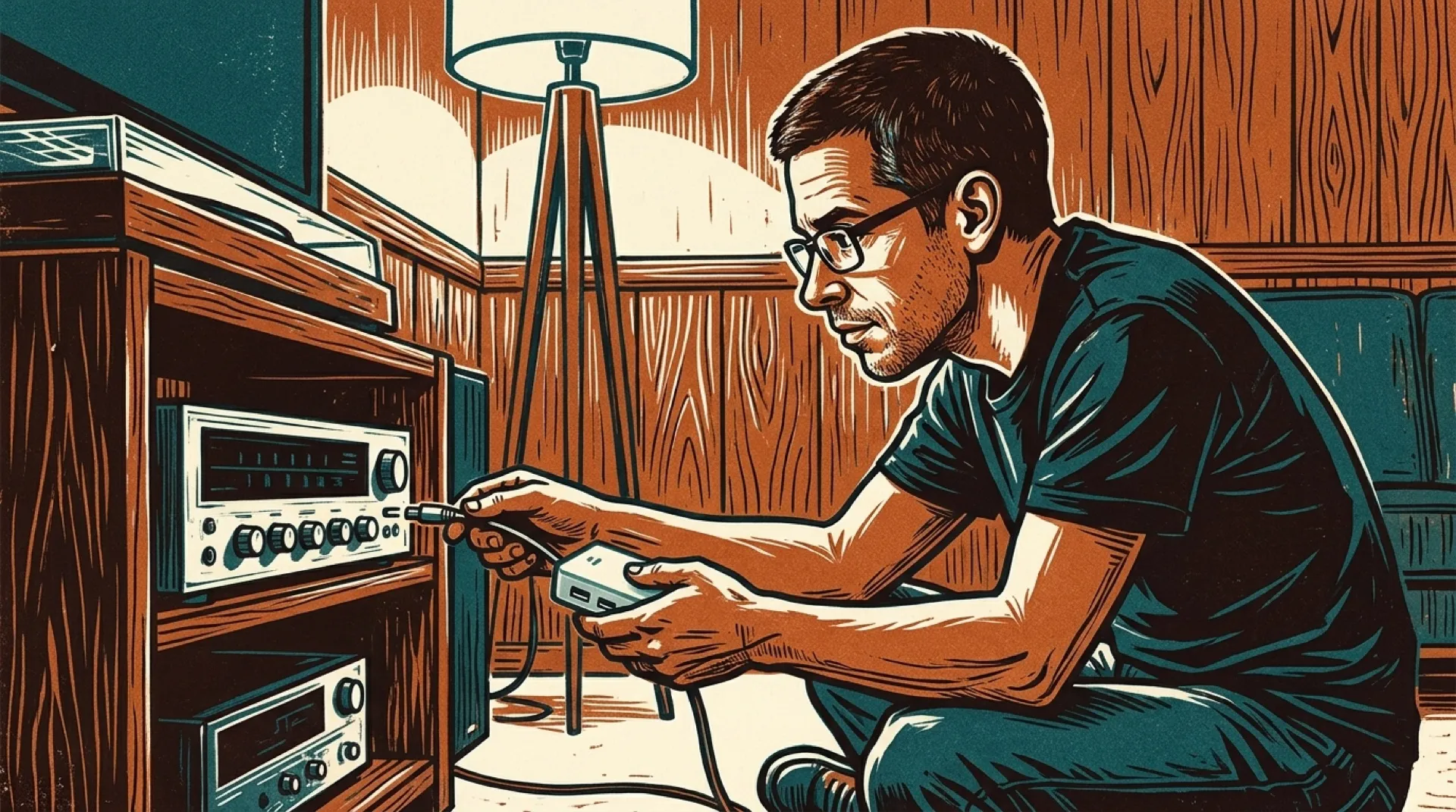
Nabu Casa has a box for everything your smart home can’t talk to: the receiver in the living room, the TV with no app, the UPS in the closet, the inverter on the garage wall. The Home Assistant Connect AUX-2 gets there with two 3.5mm RS-232 ports, each with its own TX/RX switches and ±5V signaling. RS-232 is the serial jack older gear exposes, and until now it mostly sat there collecting dust. Plug a cable in, and Home Assistant can send commands to the machine the way an installer’s control panel once did. CNX Software says the whole thing is built to work “without cloud services.” A serial port, no cereal, and no subscription either.
The box itself is small: 106 × 63 × 25 mm, 104 grams, under 1W, with an ESP32-S3 running ESPHome. It reaches Home Assistant over an encrypted connection using 2.4 GHz Wi-Fi or 10/100 Ethernet. The Ethernet port takes 802.3af Power over Ethernet, so a single cable feeds it and lets you mount it beside the receiver instead of beside the server. USB-C at 5V/2A works too.
The audio side is more serious than you’d expect from a control gadget. A Texas Instruments PCM5122 DAC (112 dB signal-to-noise) feeds one combined 3.5mm jack that does analog or mini-TOSLINK optical S/PDIF, switching automatically based on the cable you plug in, one at a time. It plays FLAC, MP3 and WAV through Music Assistant using the Sendspin protocol, at up to 24-bit/48kHz stereo with firmware 2026.11.1. Several units can be grouped with compatible smart speakers for synchronized multi-room audio. The catch: output only, with no Bluetooth audio streaming.
| Plug | What it does |
|---|---|
| 2× 3.5mm RS-232 | Sends commands to receivers, TVs, UPSs, solar inverters |
| 3.5mm analog/optical jack | Plays Music Assistant audio into an old amp |
| USB-A host | Takes a ZWA-2 Z-Wave stick or a USB-to-RS-485 adapter |
| Grove connector | GPIO and I2C for extra sensors |
| Bluetooth LE | Proxies up to three active connections plus passive sensors |
Zigbee works only experimentally through the Connect ZBT-2, and only with ZHA on Home Assistant 2026.11 or later. Zigbee2MQTT and Thread are not supported through the AUX-2.
The bootloader is unlocked and OTA updates are supported, so custom firmware is allowed, and the firmware is open source on GitHub. It costs $68.90 at Seeed Studio, with distributors across North America, Europe, Australia and Africa. Nabu Casa also plans to release the PCB design and 3D-printable enclosure files, which for now are still only a plan.
Expect more of this. Gear that predates the smart-home era is still in working order, and the cheapest way to make it useful is a small, open board that speaks its original language. A $69 price tag makes that a weekend project instead of a purchasing decision.
My money says the interesting growth is in the serial side, not the audio. Anyone with a rack of old equipment has a drawer of manuals and a pile of codes, and a community that shares command lists for each model would turn this box from a gadget into a library. The open firmware is what makes that possible, and the planned PCB and enclosure files would let tinkerers build their own variants.
The limits are worth knowing. No Bluetooth audio, no Thread, no Zigbee2MQTT, and Zigbee through the AUX-2 is experimental. That narrows the audience to people already living in Home Assistant, which is fine, because they are the ones who will write the serial command lists.
Power supply and cables not included, naturally.