
HardwareVoyager 1NASAlight-dayMorse codePale Blue Dotdeep space
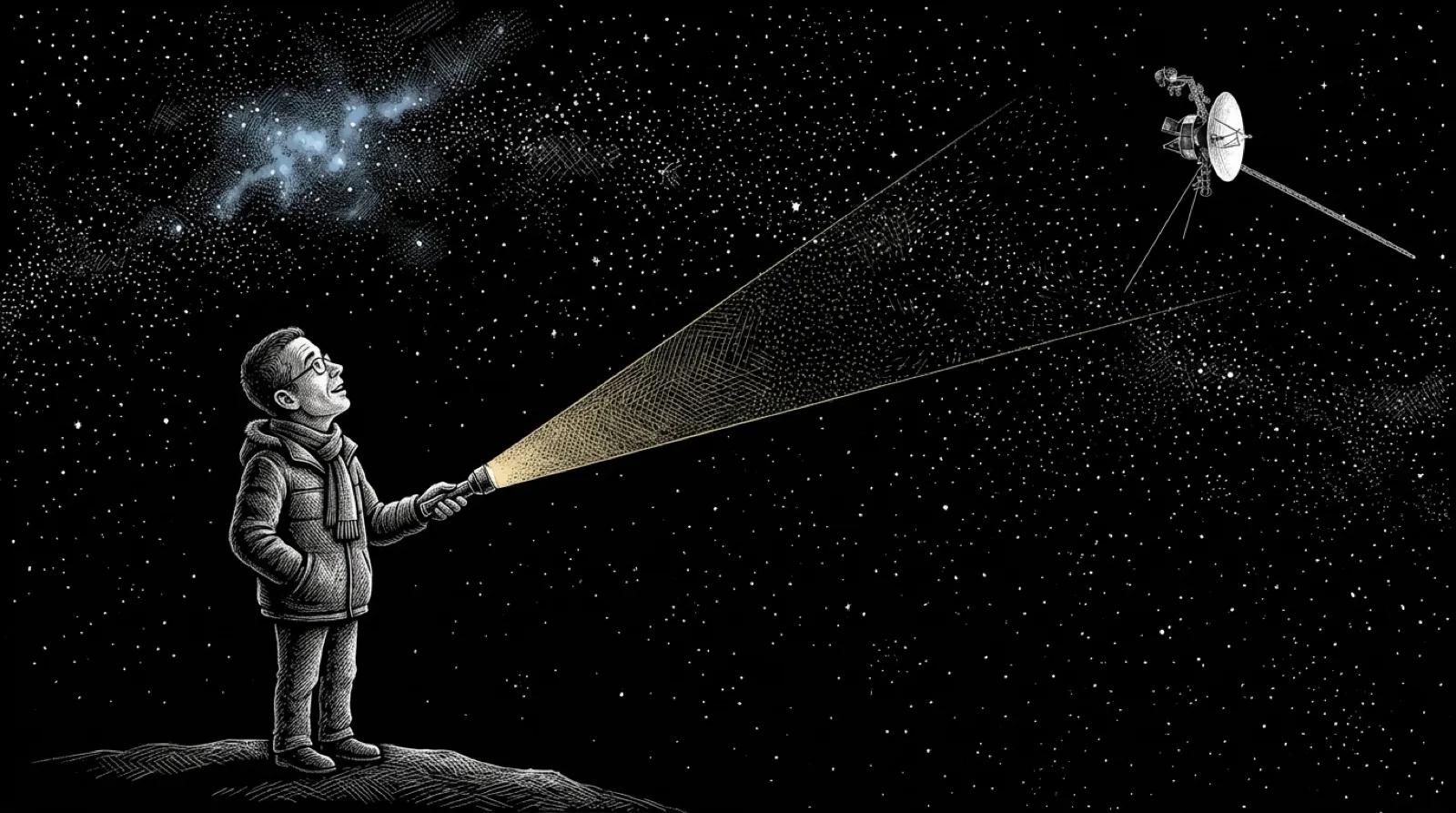
Voyager 1 passes one light-day from Earth on November 18, and NASA wants flashlights flashing VGR in Morse code at a probe with its cameras switched off
Launched September 5, 1977, the probe is still talking back, and the Morse salute is a gesture for the people on the ground, since nothing aboard can see it.
A radio message sent to Voyager 1 after November 18 will take a full 24 hours to get there, and the reply takes another 24 to come back. NASA’s own explainer defines the milestone: “A light-day is the distance that light will travel in 24 hours, or 16,094,799,096 miles (25,902,068,356 kilometers).” Voyager 1 crosses that line “on Wednesday, Nov. 18, 2026, at 5:16 a.m. EST,” while “cruising at nearly 38,000 mph (61,000 kph) through the vacuum of space.”
For scale, NASA says sunlight takes about eight minutes and 20 seconds to cross the 93 million miles from the Sun to Earth, and Neptune is four light-hours and 10 light-minutes away. The probe launched on September 5, 1977, two weeks before its twin Voyager 2, and it has been commuting outward ever since (with the worst ping in the solar system).
NASA’s invitation, on its Shine Bright for Voyager’s Light-Day page, is to “shine V-G-R in Morse code” after sunset on Tuesday, November 17. V is dot-dot-dot-dash, G is dash-dash-dot and R is dot-dash-dot. Any light will do, since the page suggests you “grab a flashlight, glow stick, solar lantern, bike light, or your phone” and point it skyward.
The Register spotted the catch, and it is a fun one. Voyager 1’s cameras were switched off decades ago, so the probe cannot see any flashlights, and the outlet notes they went dark after the Pale Blue Dot picture. The Register’s phrase for the result is “a symbolic wave of golden light encircling the planet after sunset.”
The Register also points back to the 2013 Cassini photo “The Day the Earth Smiled,” and the encouragement that came with it to “just smile at the sheer joy of being alive on a Pale Blue Dot.” So the salute is aimed at the people next to you, with the spacecraft as the excuse.
The distance doesn’t stop the hardware talking. The Register says Voyager 1 had a recent communications hiccup, and that the probe will mark 50 years since launch next year. It adds that Voyager 2 is not expected to reach the same milestone for about nine more years, and whether it can still communicate by then is uncertain.
A 24-hour one-way lag means any command sent to Voyager 1 takes two days to be answered, so every “try again” costs two days. Spacecraft that have to run out here keep getting older while their lag keeps getting longer, and the next light-day marks (Voyager 2’s, nine years off) depend on hardware that is already decades old.
For everyone else, it makes a rare bit of civic nerd theater: one Morse phrase, any flashlight and a spacecraft launched in 1977. NASA’s page gives no way to count the participants, and Voyager 1 will not be around to answer the lights.
Allow 48 hours for a reply.