
GamingEliteCommodore PETBBC Microretro computing6502
David Given ported the BBC Micro's Elite to the Commodore PET, which has no bitmap screen, as a 64x35 grid
The PET build starts from Mark Moxon's annotated 6502 source, ships as a disk image for a 2031 drive or an emulator, and its author is upfront that it plays slowly.
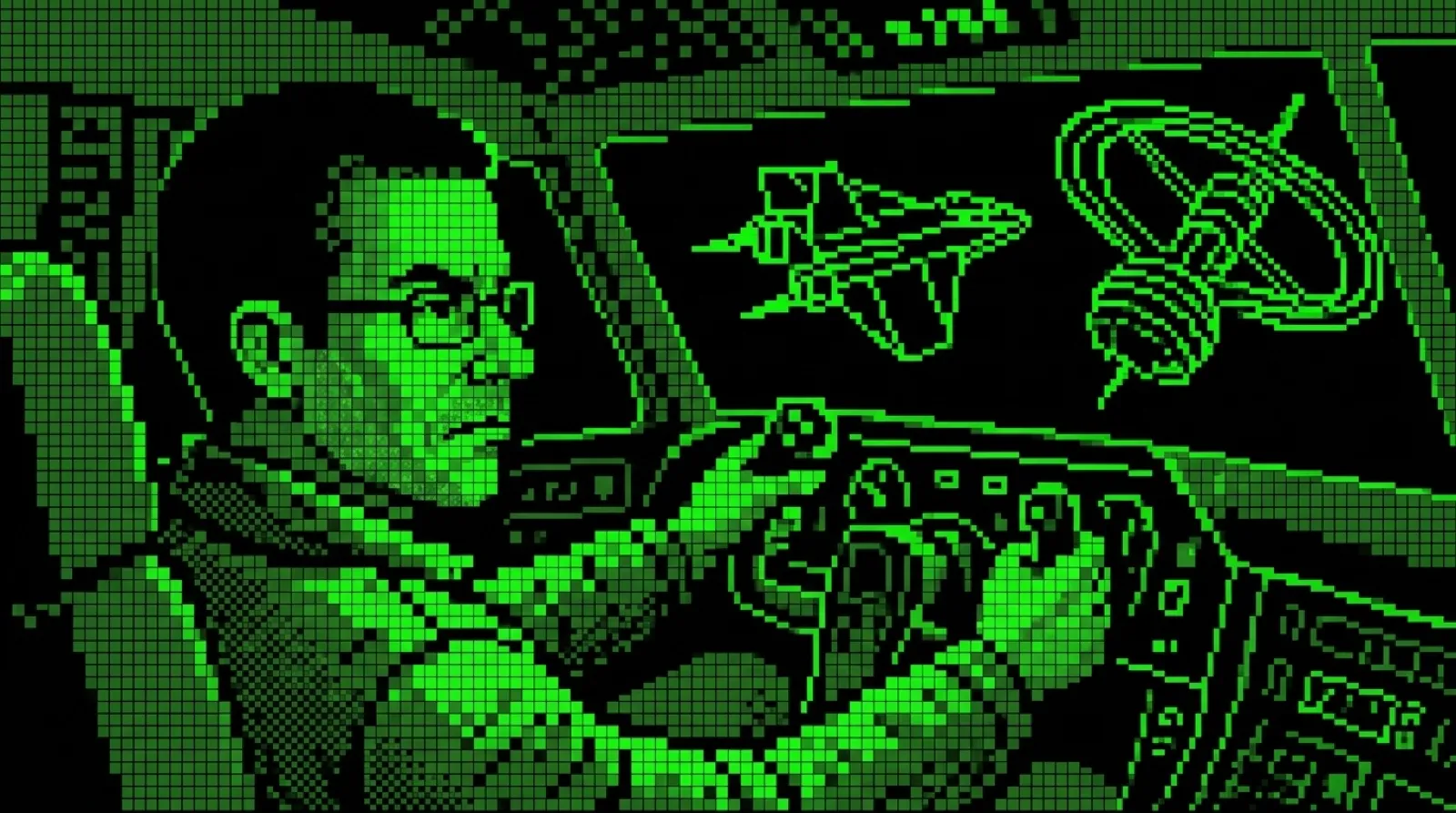
The Commodore PET has no bitmap graphics. Its screen shows characters. Elite, the space game where you fly a wireframe ship around 3D space, needs lines drawn fast. Those are not the same job.
David Given’s answer is to draw the wireframes out of the PET’s block characters on a 64x35 grid. The README puts the number next to the original’s: “the 64x35 ‘graphics’ being slightly lower than the original’s 256x192.” The scare quotes around “graphics” are his, and they are doing honest work. A 256x192 picture becomes 64x35 cells, so each cell stands in for several of the original’s pixels and every diagonal edge turns into stair steps.
The second compromise is speed. The same section of the README says the game plays badly “due to the PET’s CPU being half the speed of the BBC Micro’s.” Half a CPU is not a rounding error. You are flying a wireframe through molasses.
None of this is hidden. The README opens with the author’s own review of his own code: “The code is a mess. It needs some major cleaning up.” If every project page were that candid, the internet would be a shorter place.
The lineage is worth knowing. The port starts from Mark Moxon’s work, who describes his site as “literally the original 6502 assembly source code, just heavily commented.” His page lists versions for the BBC Micro, Acorn Electron, 6502 Second Processor, Commodore 64, Apple II, BBC Master and NES, among others, and does not mention a PET version, so this one is Given’s own addition. The README credits Ian Bell and David Braben for the original game, Moxon for the upstream port and Given for the PET version, and it asks people not to bother the upstream authors with bugs in this one.
Running it is a short procedure. The disk image is 5-compiled-game-discs/pet-elite.d64, you load it on a 2031 drive or in an emulator, and you start it with SHIFT + RUN/STOP. The README says it “ought to run on any 32kB PET with a disk system, but if you don’t have a 2031 disk you’ll need to make your own disk images.” “Ought to” is the sound of a man who has tested it on the machines he has.
Then there is the keyboard, which is where the pun lives. The README says: “The key one (pun intended) is that if you have a graphics keyboard you still have to enter numbers on the keypad.” PET keyboards came in two flavors, graphics and business, and the flight keys differ between them: S, X, comma and semicolon on a graphics keyboard, period on a business one. Fire is A, missiles are T, M and U, ECM is E, the jump drive is J, and the docking computer switches on and off with C and P. Throttle is Space and question mark.
On the license, the README is blunt: “None. Elite is abandonware, which means that distributing it is technically illegal.” That sentence is the reason this lives on GitHub with a shrug instead of a storefront.
The finished product draws a spaceship in a character grid on a 32kB machine at half the speed of the one it came from. Nobody needs it. Somebody will run it on actual hardware anyway, probably just to hear the floppy drive.
The README hands over the real-hardware instructions, so I expect somebody to try the 2031 floppy route.
Keypad numbers only, graphics keyboard or not.