
GamingAtari 2600AdventureWarren RobinettEaster egg6502game history
Atari 2600 Adventure's Easter Egg: Warren Robinett Signed a 4K Game With 128 Bytes of RAM Because Atari Kept Its Designers Anonymous
Warren Robinett hid 'Created by Warren Robinett' in a secret room of Atari's 1979 Adventure, told no one for a year, and Atari learned about it from a letter sent by a kid in Salt Lake City.
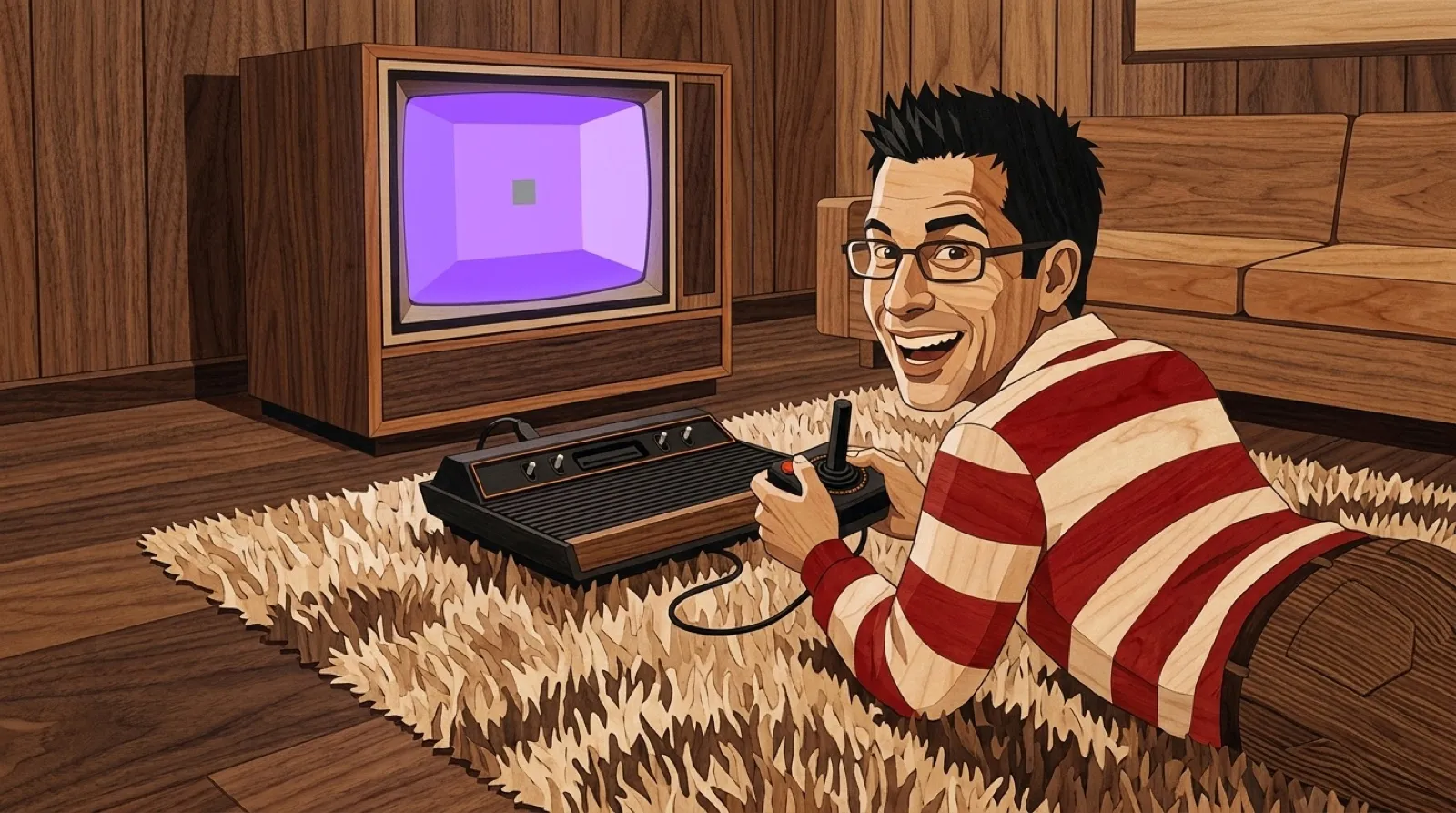
Some kid in Salt Lake City found the room first. Robinett told the story to Russ Perry Jr. of the Atari Compendium: “Some kid in Salt Lake City, Utah, discovered the room. He wrote a letter to Atari … That was the first anybody at Atari knew about it.” By then the company had “replicated it into a couple hundred thousand cartridges” and Robinett had already left.
The game was a dare from the start. His boss, George Simcock, “said that it was impossible to compress a 100K text adventure game into a game for the 2600.” Robinett says, “He told me not to do it, but I did it anyway.” On his own Adventure page he lists what it had to fit in: “4096 bytes (4K) for the game code (in ROM) and 128 bytes for program variables (in RAM),” running on “a 1.2 MegaHertz, 8-bit processor (6502).” He worked days of 12 or even 15 hours in 1978 and then rode his bike 13 miles home from Sunnyvale to Menlo Park.
Into that space he put a world made of screens you could walk between, and objects you could carry. His page calls Adventure “the first action-adventure video game” and says it “introduced the idea of movable objects (represented by visible icons) that could be picked up by the player (using a joystick).” It sold a million copies.
He also put his name in it. “We were all getting paid salaries with no royalties from our games. Atari was making hundreds of millions of dollars from the games. It was neat to get paid to make video games, but we were anonymous,” he told the Compendium. “I thought of it as putting my signature on the game, just as a painter would sign his name on the corner of a painting.” He compared it to fans playing Beatles records backward to hunt for hidden messages.
Getting in takes work. The Compendium’s walkthrough has you find a single gray dot in the catacombs of the Black castle, carry it to the room beside the Gold castle with two other objects on screen, and walk through the wall to reach the signature. The same page names the letter writer and dates it: Adam Clayton wrote to Atari in August 1980, “a year before Electronic Games confirmed its existence, and nearly 2 years before Atari published the details in Atari Age.”
Keeping quiet was the hard part. “I kept it to myself for a whole year, and believe me, it wasn’t easy. I didn’t even tell my office mates at Atari.” When the secret came out, he says, “I didn’t work at Atari anymore, so they couldn’t fire me.” He went out with some of Atari’s game designers, told them the story, and remembers “a little gleam in all their eyes.”
Where hidden credits go from here
Credit screens fixed the problem that made the egg necessary, since designers’ names now roll at the end of nearly every game. The eggs stayed anyway. Players hunt for them in every big release now, and studios plan them on purpose, sometimes as a marketing beat.
The 128 bytes will keep the game in classrooms. Robinett’s page links his lecture slides and a map, and notes that “for $20, you can get an Atari 2600 console and a dozen game carts.” A game that fits in 4K is short enough for a student to read end to end.
The letter itself survives; the Compendium says Robinett supplied a copy. Clayton found the dot, carried it to the right room and wrote to a company that didn’t know the room existed. How he found a single gray pixel in the dark of the catacombs is the one part of the story no one has explained.