
RetroRene PardoRemy LandauLANPARspreadsheetsoftware patentsLotus 1-2-3VisiCalcRefacpatent 4398249
Pardo and Landau's 1970 Patent Let Spreadsheet Formulas Sort Themselves, and Its Owners Sued Lotus 1-2-3 With It
US Patent 4,398,249, filed by Rene Pardo and Remy Landau in 1970 and granted in 1983, covered a compiler that put a businessman's formulas in the order a computer needs; its owners sued Lotus with it, and a court held it unenforceable.
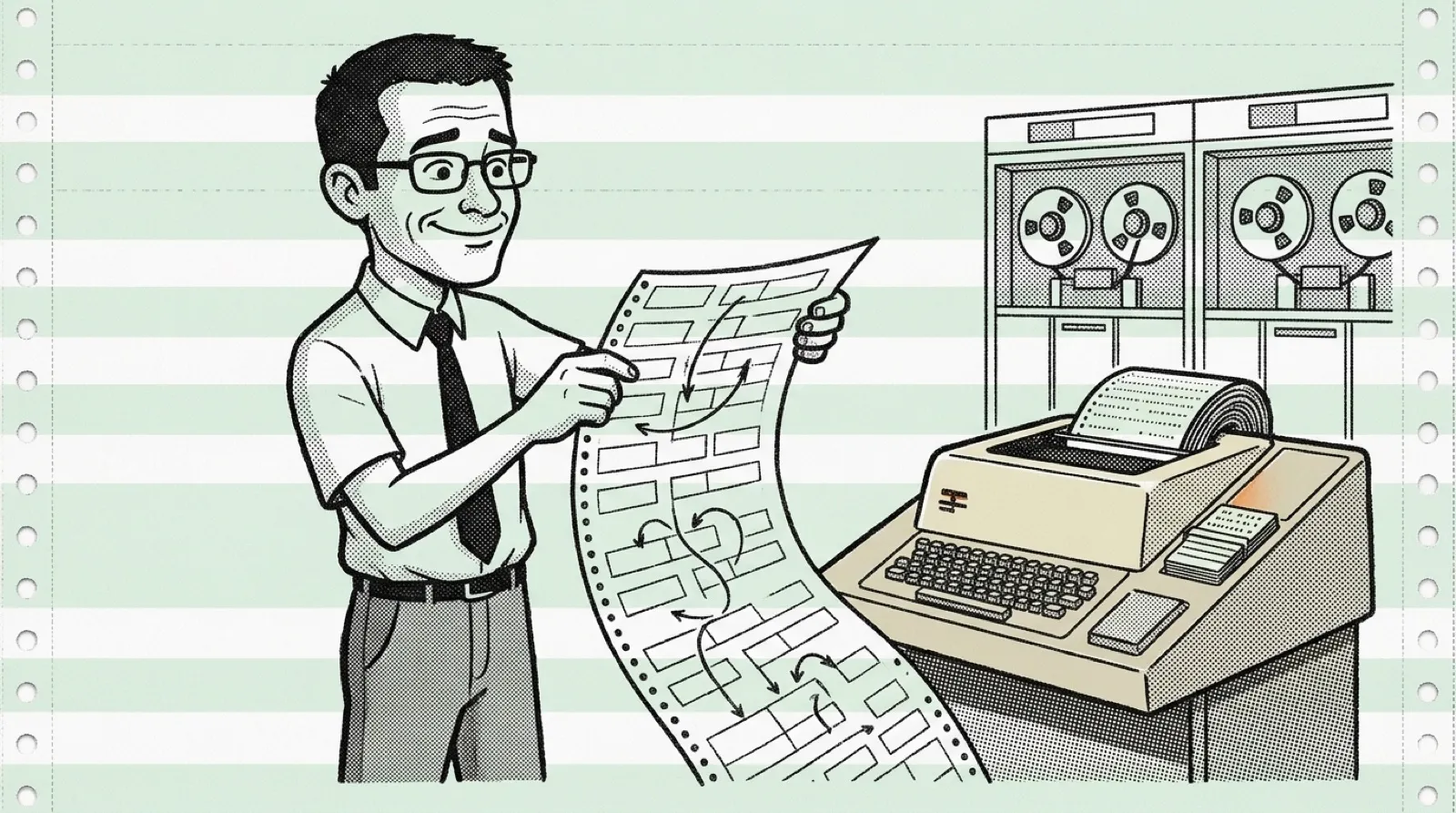
The patent describes a budget laid out as a grid of boxes, each one named by its row and column. “Thus, 302 refers to the box in line 3, column 2,” it explains. In its own example, “box 101 contains the product of the contents of box 102 and box 103.” Box 102 waits for a number read from “a deck of cards,” and box 103 holds the constant 0.5. The formula sits in the first box, and its inputs come after it.
On the machines of 1970, that order was the coder’s problem. The patent says whoever wrote the program “was forced to concern himself with the order in which the formulas of his program were executed by the computer,” and calls that “a very difficult and tedious task.” Pardo and Landau wanted to “permit a businessman, who has had no previous association with computers, to write his own source programs … after a short period of instruction,” in a sequence “logical to him,” and leave the reordering to the compiler.
The trick is a loop of passes. The compiler looks at each formula in turn. If everything it depends on is already known, the formula is “removed from the first storage area, placed in a second storage area of the computer and marked in storage as being defined.” If it isn’t, “it is retained in the first storage area” for the next pass. The loop stops “when no formulas have been transferred during a given pass,” and the patent reads that as a mistake in the program: “Such an occurrence implies a logical error in the source program.” Every spreadsheet that has ever flagged a circular reference does a version of this check. The inventors say it “has been successfully practiced on a general electric 400 Series Time Sharing Computer.”
Pardo’s own site gives the program a name the patent never uses. He describes “co-inventing and developing the world’s first electronic spreadsheet (1969),” called LANPAR, and says it was “licensed to and used by the budgeting department of AT&T and every telephone company in North America throughout the early 1970’s, including Bell Canada, as well as by General Motors in Warren, Michigan.” Those are his claims, and he tells the story himself on video.
Play the video on YouTubeThe application sat at the Patent Office for 13 years. It was granted on August 9, 1983. The Christian Science Monitor’s Simson L. Garfinkel put the timing plainly in 1989: “Lotus’s program had been on the market for just nine months when the US Patent Office awarded Patent 4,398,249 to Rene Pardo and Remy Landau.” By then 1-2-3 “accounted for more than half of Lotus’s $470 million in sales.”
Refac, the patent’s exclusive licensee, “filed suit against Lotus and several other spreadsheet vendors.” Its chairman, Eugene Lang, told the Monitor, “We are asking what is considered a reasonable royalty - 5 percent on the net selling price.” Daniel Bricklin, who co-created VisiCalc, answered from the other side: “if you just do normal, good engineering, you can ship a product, be successful, and afterward find out that somebody applied for a patent that was issued after you shipped.” He added, “The structure of this industry is such that we cannot tolerate 100 people asking for 5 percent of your revenues.”
The patent didn’t survive the case. A district court in New York held it “unenforceable on the ground of inequitable conduct,” and in April 1996 the Federal Circuit affirmed in Refac International v. Lotus Development. The patent expired in 2000. Google Patents still lists its owner as Forward Reference Systems of Downsview, Ontario. Pardo’s site still uses the phrase “Forward Referencing.”
What the record still has to settle
LANPAR will keep getting more attention than this patent does, because it has a name and a living inventor telling its story on camera. Expect “first spreadsheet” lists to add it beside VisiCalc with an asterisk. The patent is the better evidence for what the program did, since it was written in 1970, before anyone knew what a spreadsheet would be worth.
The law has since changed the math on long examinations. US patents filed after mid-1995 run 20 years from filing, so a 13-year wait now eats most of the term.
Pardo’s site says LANPAR ran at Bell Canada and General Motors in the early 1970s. Nobody has yet published the budgets themselves, and those sheets would show whether the boxes on that GE time-sharing system looked as much like a spreadsheet as the patent says.