
Hacks & BuildsGaggia Classic ProespressoCNC machiningrepair
A Gaggia Classic Pro owner milled a new boiler and group head from stainless steel after finding corroded slime inside the brass original
Hans Gaensbauer's build took five months, four 375 W cartridge heaters and a relay board, and his theory about why the thermostat died is a suspicion, not a finding.
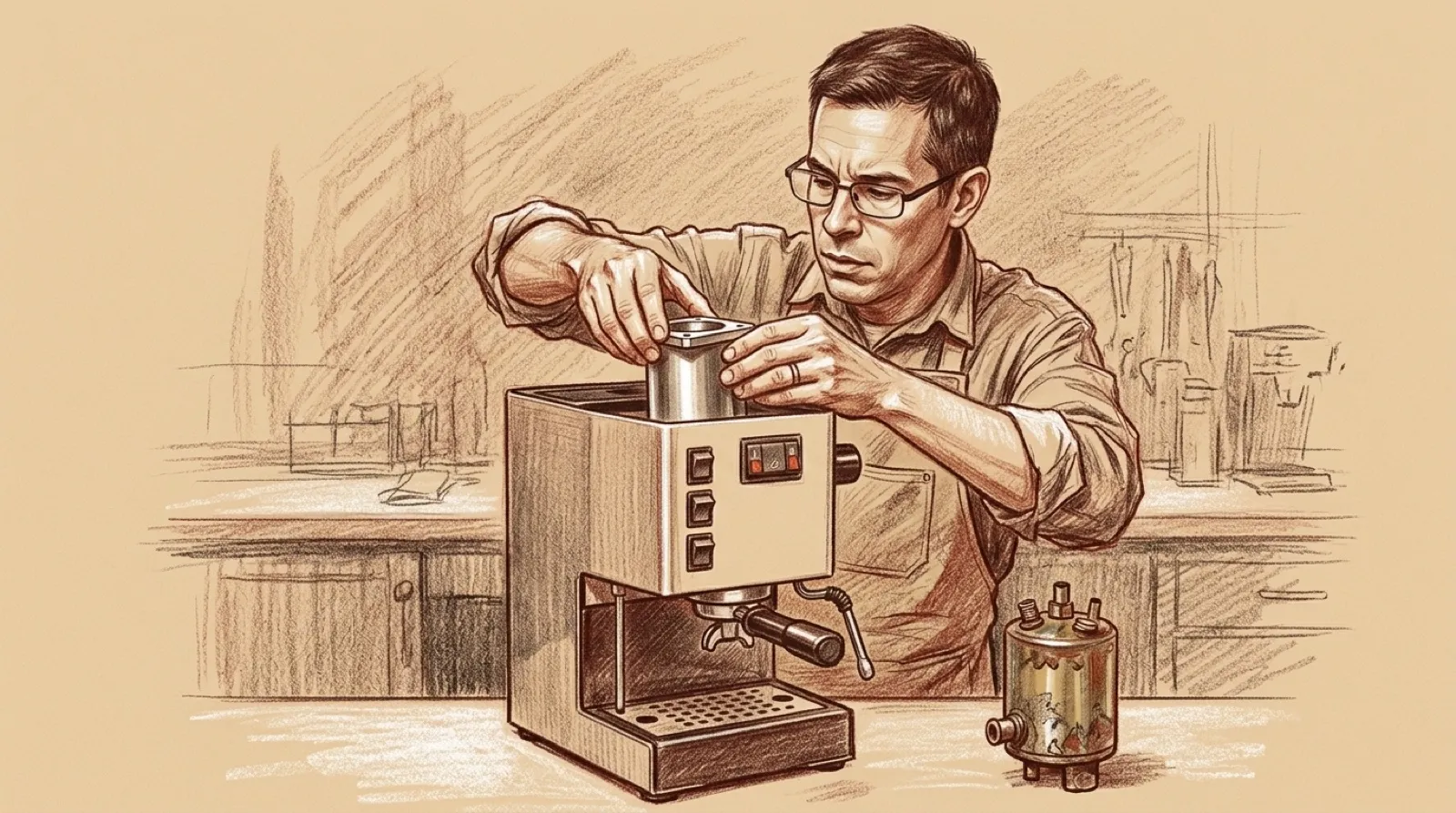
His Gaggia Classic Pro smelled bad after about six months. A few years later it stopped heating, and the steam thermostat was melted or burned. A thermostat is a replaceable part. Hans Gaensbauer opened the boiler too, and he wrote that he “was greeted by a whole lot of corroded slime.”
The slime sent him down a rabbit hole of owner reports, which he summarizes on his page. The original boilers were coated aluminum, and owners reported the nonstick coating shedding into the espresso. Newer machines, his included, use an uncoated “lead-free brass” boiler, and he notes that some Reddit users suspect it is not actually lead-free. His page neither confirms nor refutes either claim, and neither will this one. The fix he chose was to make the part himself, from stainless steel.
That meant two blocks of stainless from McMaster-Carr. The group head came from a block roughly 4 by 4 by 2.5 inches, and he set out to keep the original’s internal water-channel geometry, because he believed it mattered for performance. The first pass was facing, to remove most of the stock, including a half-inch protrusion on the cast original. Then came contouring the outside profile, a pocket for the bottom of the boiler, and a helical relief for the portafilter, cut with a T-slot mill. A four-jaw chuck on the lathe finished the facing and chamfering.
The group head took far longer than he planned, so he simplified the boiler. It came from a 3 by 3 by 4.5 inch block: drill and bore the chamber, rough the outside on its side with a 5/16-inch TiN-coated HSS endmill, then finish with a 3/4-inch endmill in 4-thousandth passes. The side reliefs went in as plunge cuts, 20 thousandths at a time. He measured the chamfered O-ring groove at the top with a height gauge on a surface plate. Most home espresso repair is descaling. This was descaling with a mill.
The boiler carries four 375 W cartridge heaters set in high-temperature thermal paste. That part is still a heater, and it still needed something to switch it. Gaensbauer’s diagnosis of the burned thermostat is a suspicion, and he words it that way: he thinks “the failures are caused by thermal runaway on the contacts in the thermostat,” and that “it is unwise to attempt to switch upwards of 10 amps through a bimetallic thermostat.” Online consensus, by his account, blames loose connections.
His answer was to take the load off the thermostat. “The solution to this is to move the switching hardware away from the boilers,” he wrote, to industrial relays that stay near room temperature. He designed a board with the relays and a thermocouple amplifier, built to replicate the original two-thermostat function.
Then came the first power-up. “I took the machine outside for testing in case anything caught fire,” he wrote, since the new heaters might smell on first use. After flushing cycles, he tested steaming with the lid off and then brewed espresso.
The build dragged, as builds do. “In the five months it took to get this far, many of the smaller screws and O-rings vanished,” he wrote. Parts took weeks to gather, and the reassembly was a bolt-up job: group head to the pump inlet and solenoid, an O-ring sealing it to the boiler, the steam valve on top, the whole assembly bolted back into the case.
This is one person’s write-up of one machine, and it is the whole story: every claim here is his, from the slime to the burned thermostat to the thermal-runaway suspicion to the five months.
What it might lead to depends on the relay idea. A mill and a lathe are out of reach for most owners, and moving the switching off a hot thermostat is not. If his suspicion about the contacts is right, that is the one piece a non-machinist could copy.
The missing screws are still missing.