
Nintendo DS had 512 times Game Boy’s main RAM and still could not play its games
Nintendo’s support record explains why a later handheld’s Advance slot stopped short of the older cartridge families and their link-cable games.
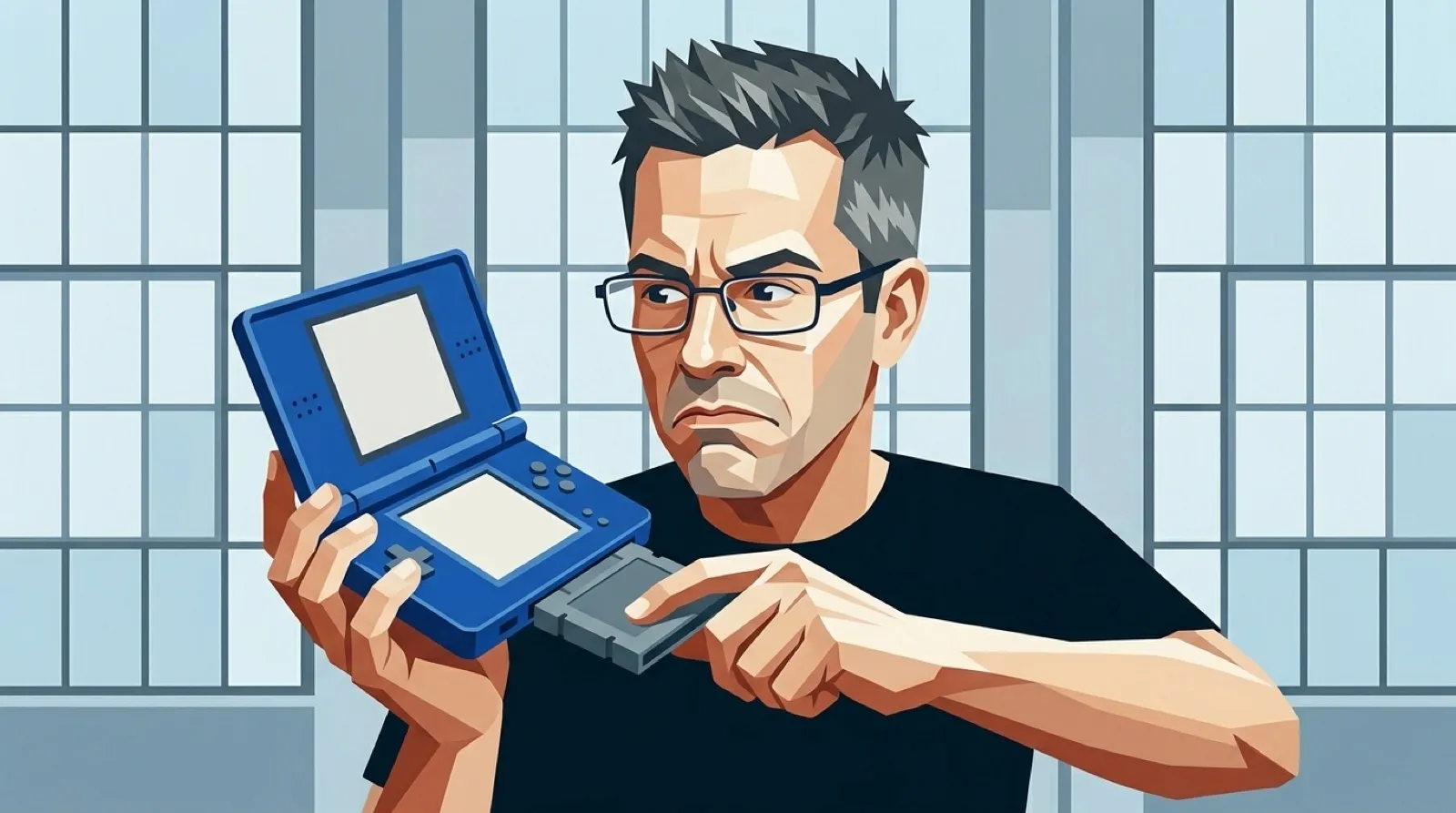
A Nintendo DS could have dramatically more memory than a Game Boy and still leave an original Game Boy cartridge useless. The newer handheld’s extra capability did not include every earlier machine hiding inside it.
Nintendo’s explanation is specific: DS and DS Lite omit the special processor required for original Game Boy and Game Boy Color games. Nintendo attributes the decision to the older processor’s age and the difficulty of incorporating it into what it calls an “already highly complicated architecture.”
There is an Advance cartridge slot, which makes the boundary easy to misunderstand. Nintendo lists Game Boy Advance games in single-player mode among the supported formats. Original Game Boy and Color games remain outside that support. Similar family names don’t settle what the slot can run.
| The deciding row | Original Game Boy | Original Nintendo DS / DS Lite |
|---|---|---|
| Working/main RAM | 8 KiB | 4 MiB |
| Original Game Boy cartridges | Supported | Unsupported |
| Game Boy Advance cartridges | Unsupported | Single-player supported |
| Older link-cable multiplayer | Native Game Boy environment | No link-cable port |
The memory arithmetic starts with units. Nintendo’s Game Boy history page gives 64-Kbit static RAM. Divide by eight bits per byte to get 8 KiB. GBATEK’s hardware reference lists 4,096 KB of DS main RAM. Using binary capacities, 4,096 KiB ÷ 8 KiB = 512.
That figure excludes the DS’s separate video memory and other RAM regions. It also compares the original DS main-memory configuration, rather than quietly borrowing a later model’s larger capacity. There is plenty of room for a ridiculous ratio without adding mismatched categories to make it more ridiculous.
The multiplayer boundary is another separate condition. Nintendo says DS systems use wireless communication and lack the older link-cable port. An Advance game that boots successfully in single-player mode therefore hasn’t demonstrated that its old multiplayer connection works. A successful title screen answers one compatibility question.
Nintendo’s original DS specifications describe the later machine’s color-screen hardware, touch input, and rechargeable-power setup. Those are reasons someone might want a DS for its own library. They cannot make the missing older execution hardware appear.
An owner happy with a working Game Boy collection doesn’t need a 512-fold memory upgrade to continue playing it. A DS buyer should choose the DS for software it actually supports. Anyone trying to combine both collections in one purchase has another investigation ahead: which specific machine supports the required cartridges and the accessories that make those games complete?