
In 1996 Bandai Sold a PS1 Fighting Game You Had to Build Out of Plastic Robot Kits, Years Before Skylanders
The Japan-only ZXE-D cost ¥19,800, came with 40 collectible cards that fueled a refund trick, and one collector is still charting its damage numbers by hand.
The box held four 7-inch mecha model kits, a PlayStation disc and a pack of 10 collector cards. It went on sale in Japan in December 1996 at ¥19,800, and the credits name at least nine separate companies. Writing for Time Extension, John Szczepaniak calls that list “a bewildering smorgasbord of names.”
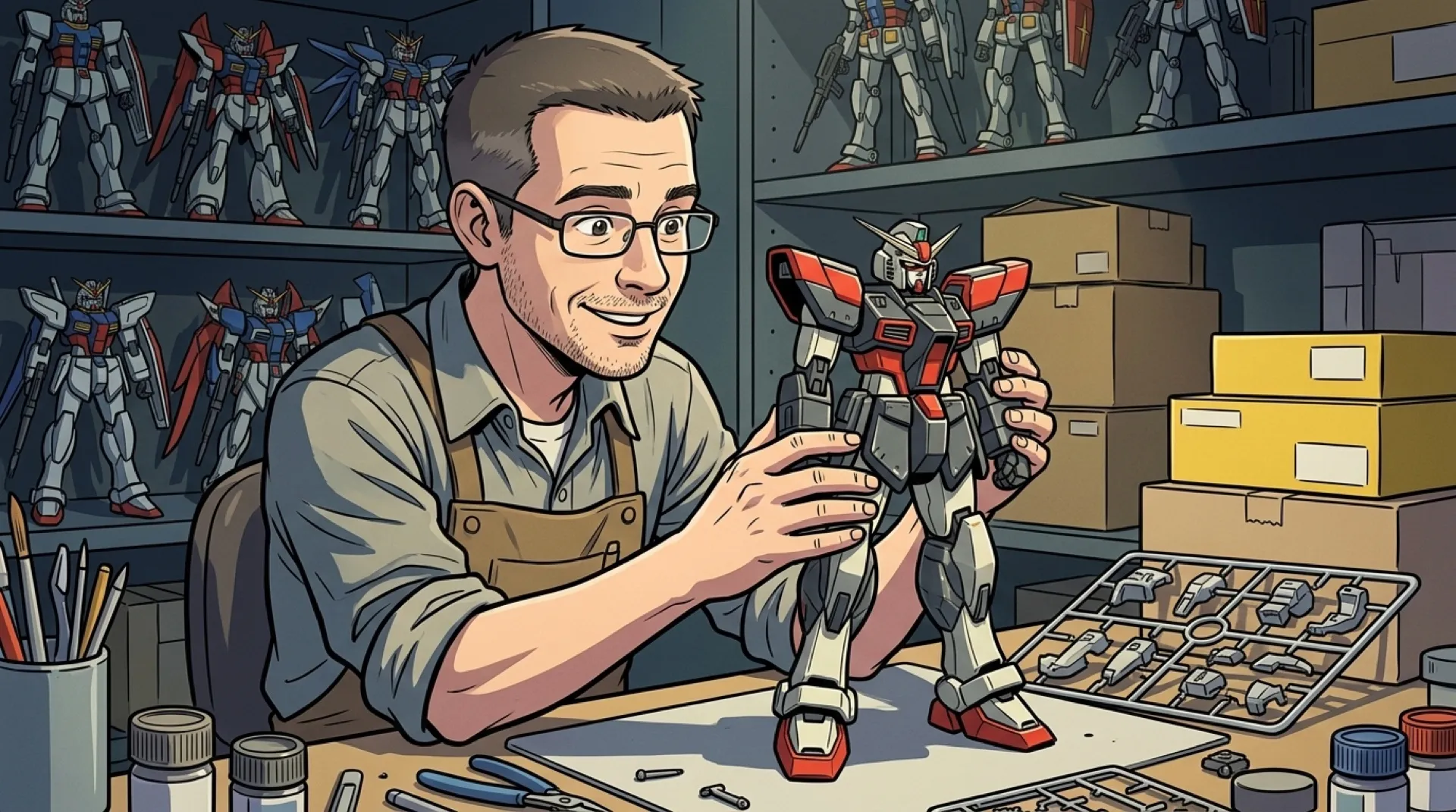
The robots did not come assembled. Szczepaniak spent a month building all four, one Saturday each, cutting hundreds of pieces off plastic frames, smoothing them and gluing them together. He first had to visit a Warhammer store for pliers, nail files and brushes. The kits were designed by mecha illustrator Kow Yokoyama and made by Bandai, so they are real model kits that happen to ship with a game disc. Put the disc in a PS1 and you can see the robots you built, play with their color schemes and make them fight.
The math is fun. Four torsos, four sets of arms (twice) and four legs make 256 unique configurations, and there are eight pilots on top. Szczepaniak says the half-page news item that introduced him to the game promised that the PS1 would recognize any configuration you built.
Nintendo’s Robotic Operating Buddy (1985) and Captain Power and the Soldiers of the Future (1987) came earlier. Szczepaniak says neither let you choose a toy that then showed up in the game, and he calls them fancy peripherals. That is why he says ZXE-D is likely the first true version of the idea Skylanders and Amiibo later popularized.
Even the name is a mess. It’s Plasmatlite, with a T, but the katakana reads Zexeed, which has been romanized as Zexede, Zexcede, Zexseed and Zeckseed.
Szczepaniak found it in the March 1997 issue of Electronic Gaming Monthly, issue 92, on half of page 21 (Independence Day was on the cover). EGM put the import price at around $180, and you needed a chipped PlayStation to run it. He stared at that half-page for nearly 30 years.
The cards explain why complete copies are rare. Collectors bought multiple sets, pulled out the card pack and returned the boxes for a refund. Sealed copies kept turning up on eBay and Yahoo! Auctions with the bags unopened and the cards gone.
Then a complete copy appeared in the USA for $175, listed by Jason Dvorak (@gamerave) of Game-Rave. Dvorak had spent more than two years buying sets to archive the game, and he had scanned all 40 cards. By his own count he bought 8 new full sets, 2 incomplete sets, 2 scrap sets and 2 loose card lots, plus a card trade with a Japanese collector. He kept three kits. One is a misprint: the sealed baggie held two sets of Einhorn jacks and was missing one of the other robots.
He is now charting the game’s damage values by hand. Each entry takes about two minutes: start a 2-player versus round, throw one attack, wait 30 seconds, open the “methenance” screen and do the math. For the full 64-variant star sheet per torso, he rigged GameShark codes for a one-hit death on 2P and set a mug on the auto-fire button of a programmable joystick. “The game played itself until I came back 15 minutes later to change out the next part as the credits are rolling,” Dvorak said. At 15 minutes a variant, across 64 variants and two robots, that is a long weekend. Two maxed-out robots unlocked nothing.
There is almost nothing else to read. Szczepaniak’s trawl of Japanese magazine archives turned up basic previews with factual errors, a few TV ads and maybe one page of manga. In English he lists only a few print mentions, including a news item in the very first issue of Official UK PlayStation Magazine.
One writer at Kimimi opened the box, saw the model kits and closed it again. “It’s not a game bundled with a fun set of accessories; it’s a crafting kit that expects me to supply a significant amount of my own time, skills, and even basic materials just to get it into a functional state,” they wrote. Metal Jesus Rocks got pre-built robots and found the game fun for a while, so he missed the main experience.
The next fights over game preservation will be about the plastic. A disc image can be copied forever, but the robots, jacks and card packs live in attics and get returned for refunds, and nobody has a file for them. Expect more projects like Dvorak’s, where the scanning, the unboxing photos and the spreadsheets matter as much as the ROM.
Expect the same pattern with newer toys-to-life games. Once the figures wander off, the discs become the easy part. And the build-it-yourself approach tells you what happens when a game demands a hobby from you: most buyers closed the box. (Bandai, to be fair, did warn them with the model kits.)
The full CIB copy Szczepaniak got is now on his shelf. Four robots stand built, but the painting is unfinished, the greeblies are unattached and the dry-rub decals sit untouched, a victim of choice paralysis.
Some toys outlast their game.