
A Flood Soaked a Radio Broadcaster's Windows 95 PCs, So the Team Ordered Emergency Vodka
A support worker nicknamed Bruce says a new facilities hire turned a random tap and sent a rusting tank into the room that kept radio stations on the air.
Bruce, a pseudonym for the reader who told the tale, helped look after about 30 PCs at a global radio station. They were “all running slightly different radio shows depending on the time zone where we broadcast,” so a sick computer could mean a silent station somewhere else.
The machines were old clunkers still on Windows 95, long past the end of Microsoft’s support. Management knew they needed replacing, but the money was probably another year away (a budget classic).
That left the support crew running a retirement home for beige boxes. “We had to coax them on till then,” Bruce said. “And by coax, I mean we were buying RAM on eBay because nobody sold the 4MB sticks we needed anymore.”
The coaxing worked until a sunny spring Tuesday, when a call interrupted the team’s tea: one station was down. A colleague went off to give the presumably cranky PC a reboot. Then the phone rang with a second outage, and the rest of the crew headed back, chatting about which switch or shared device could have taken out two machines at once.
The shared component turned out to be the room. The colleague who had gone ahead ran in to announce that the computer room had flooded.
Dirty brown water covered the floor, walls, ceiling and the racks holding the PCs. Two machines were somehow still working, in the loosest and soggiest sense. “Water was even spraying out of the front fans of the last two PCs that were still working,” Bruce said. Nobody orders a tower case with a fountain feature.
After what Bruce described as a lot of unprintable shouting, everyone started ripping out hardware, shutting down whatever still appeared to be running and lining machines up outside. Some people stripped them to component parts. Others washed those parts with isopropanol.
Then the isopropanol started running out. One team member arranged an urgent delivery of vodka, giving the phrase “liquid assets” its first useful day in IT.
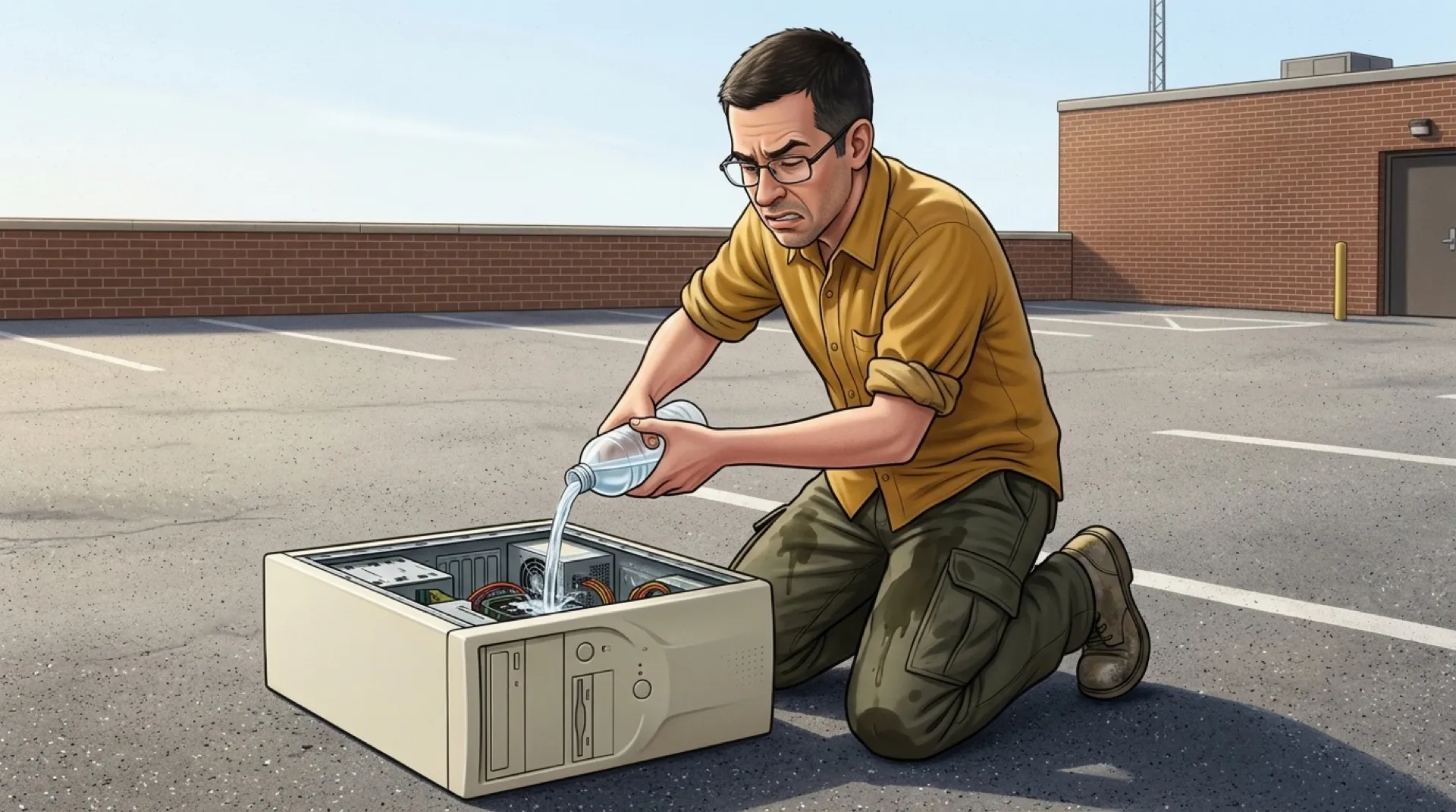
The weather did the team a huge favor. “Luckily, it was a gloriously sunny day, so we quickly rinsed the PCs and left them to dry, strewn all over the car park,” Bruce said. Picture a yard sale where every item is mission-critical and slightly damp.
Filthy and exhausted, the crew still had stations offline and computers to rebuild. The casualty list was remarkably short: “We only lost two sticks of RAM, one sound card, and a power supply.” For hardware that had just taken a rust-water shower, that’s a bargain (RAM hunters may disagree).
And the water? A new hire on the facilities team had been touring the building and turned a random tap to see what would happen. Something did. Bruce said it “released water from a stagnant iron tank that sat there rusting away for years.” For reasons nobody understood, that tank drained through a pipe into the room with the broadcast PCs.
The vodka makes this story easy to retell, but the tap deserves the space in the runbook. A disaster plan can name backup servers and phone trees while missing a rusty tank that nobody has thought about in years. Asset inventories tend to stop where the plumbing starts.
My forecast, with moderate confidence: the odd old box will keep outliving its replacement date wherever it still does its job and the new one needs funding. The hardware will change. The person searching resale listings for a discontinued part will look very familiar.
So give the building the same suspicious squint you give a mystery cable. If a valve has no label and no owner, find both before a curious visitor runs an unscheduled test. Bruce’s team could strip, wash, dry and rebuild computers. Preventing the sequel meant dealing with a pipe.
Talk about a station break.