
Tools & Gearair-qualitysleephome
Your white noise machine is a fan blowing nowhere: Jeff Kaufman's case for a $47 purifier that makes the same hum and cuts bedroom smoke to 16% of outdoors
A small HEPA purifier sounds like a classic fan-in-a-box sleep machine. Jeff Kaufman ran the numbers: a 34-CFM unit at 45 dB takes a 10x10 room from AQI 200 smoke to about 72.
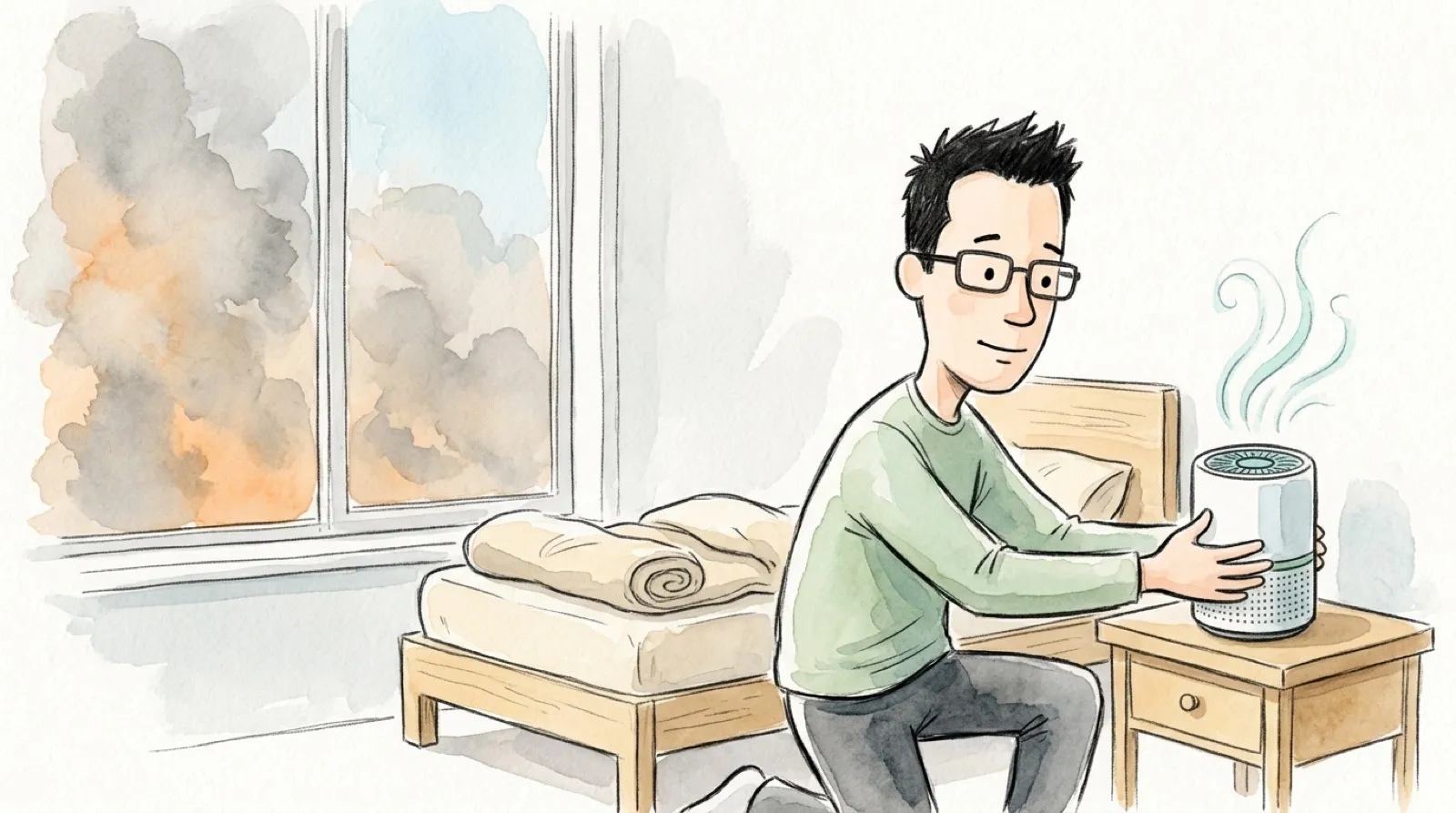
The old white noise machine was a fan in a box. Over the past decade, most people switched to electronic ones. Kaufman, who writes about indoor air at jefftk.com, points out that the original design was fine and just wasted the airflow: “you just need to put it to better use: have the fan clean the air.”
His example is the LEVOIT Core Mini, a 6.5-inch cylinder that sells for about $47 and is rated to clean 34 cubic feet of air a minute (its CADR) at 45 dB. “A small purifier sounds a lot like a classic noise machine, is only a bit larger and more expensive, and removes smoke and infectious particles from the air,” he wrote.
Then he did the math for a 10-foot-square bedroom with an 8-foot ceiling. That room holds 800 cubic feet. Leaks bring in outside air at about half a room’s worth an hour, which he calls “reasonably typical.” The Core Mini scrubs 2,040 cubic feet an hour, about two and a half rooms’ worth. Clean air outruns dirty air five to one, and the result in his words: “this small purifier will cut particulate levels to 16% of the outdoor level.” On the AQI scale, which isn’t linear, that’s AQI 200 outside and about 72 in the bedroom, or 100 outside and 31 inside.
He doesn’t run the little one himself. His own pick is an AirFanta 3Pro, a $165, 12.6-inch-square box that “cleans ~6x more air for the same amount of noise, or ~12x more air with much more noise (~56dB).” He also calls it “arguably uglier.” In an earlier noise test, he recorded it at several fan speeds and found that at the lowest one it was “essentially indistinguishable from the background while still cleaning a useful amount of air.”
That same test found the catch. The 3Pro has no sensor, so it “can’t change it’s fan speed based on the level of particles in the air,” which matters when someone burns the toast or the wildfire smoke rolls in at 3 a.m.
Expect the white noise aisle and the purifier aisle to merge. A small HEPA fan with a “sleep sound” mode and a smoke sensor is an easy product to build, and the speaker-based noise machines can’t follow it there. What nobody has measured yet is whether people sleep better next to the hum that’s cleaning the air, or only breathe better.