
Engine-X lets you pull a running gearbox apart in your browser
Parth Parmar's machine atlas pairs moving models with guides, downloads and a clear limit on using them for real designs.
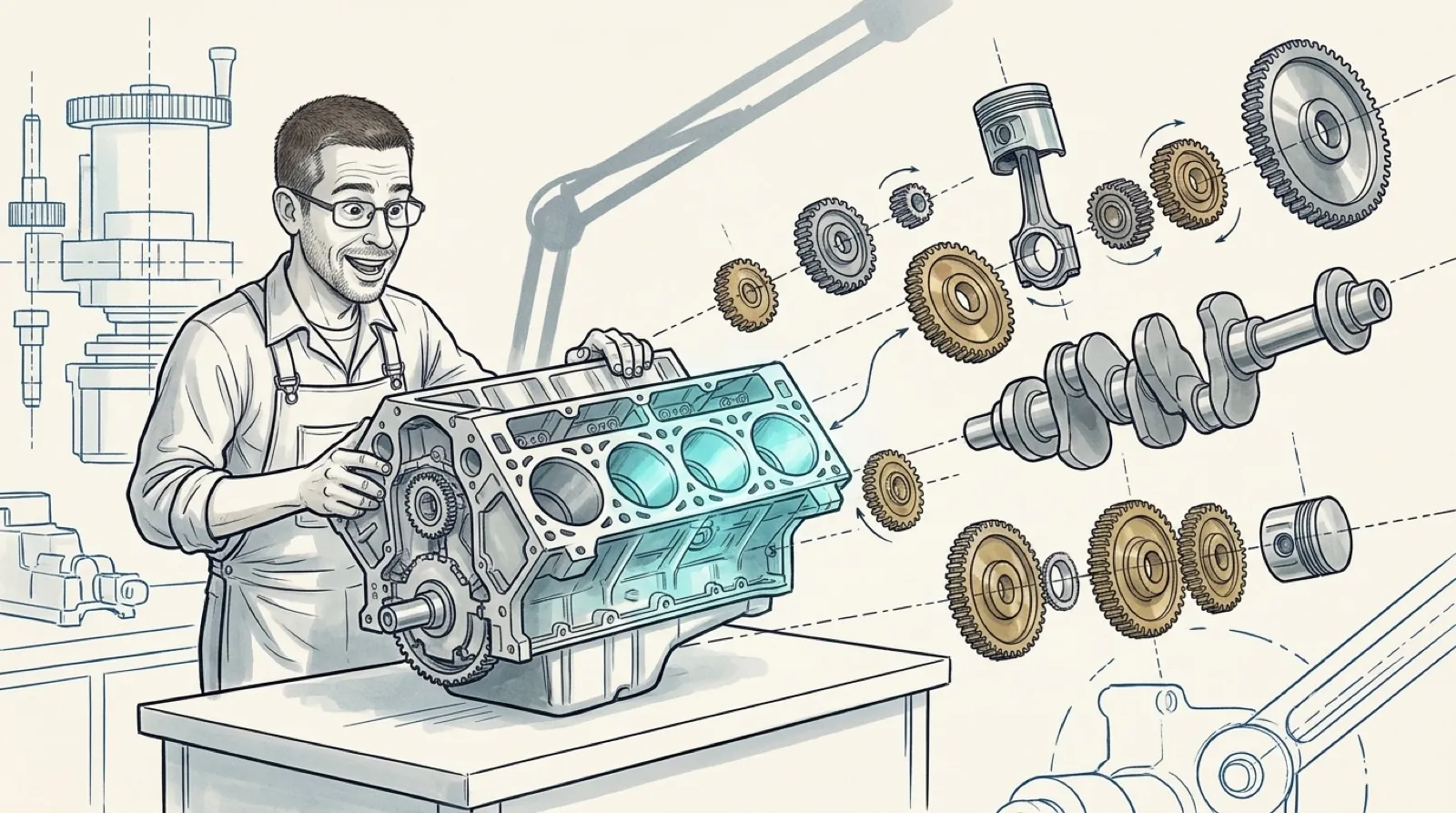
Engine-X lets you take a gearbox apart without finding a spring on the floor afterward. That’s already a considerable upgrade over the educational value of a real disassembly gone wrong.
Mechanical engineer Parth Parmar’s browser atlas includes machines such as a turbocharger, a centrifugal pump and a planetary gearbox. The attraction is being able to separate the assembly while keeping a view of its motion. A flat drawing can show you which parts exist; a moving model gives you somewhere to point when asking which part turns what.
The planetary-gearbox guide offers a good place to begin. Its model has a sun gear in the middle, three planet gears, an outer ring and the carrier holding the planets. With the ring fixed, the sun spins quickly while the carrier turns more slowly. Opening the housing visually helps separate the parts that a product photo would hide.
The guide gives this example a five-to-one ratio using an 18-tooth sun and a 72-tooth ring: 1 + 72 ÷ 18 = 5. Keeping the configuration attached to the arithmetic is the useful part. A gear ratio describes particular inputs, outputs and fixed members. Change which member stays still and you’re asking a different question.
An exploded view can help make that distinction visible. Move the parts apart and follow each connection back into the assembly. Then put the enclosure back and watch what it concealed. It’s the rare exploded thing you can reassemble without muttering at a tiny screw (progress).
The site’s disclaimer calls the models “simplified, illustrative models.” Their dimensions and behavior are representative; they are not manufacturing plans for a particular maker’s machine. That warning has a direct consequence for the person tempted by the downloadable parts: an attractive model can be an excellent teaching object without being a specification for something you should fabricate.
The atlas advertises GLB and STL downloads under CC BY-NC 4.0 with credit. Free access and permission to use something commercially are separate questions. The page is useful in a classroom or a personal exploration, but a business wanting to build the models into its own material needs to read the applicable terms rather than treating the download button as universal permission.
A useful next version of this kind of atlas would let more technical arguments begin with two people looking at the same moving assembly. That could shorten the distance between a term somebody remembers and a motion everybody can recognize. The question for each model remains whether its simplified behavior explains the relationship you actually came to understand.
Fifty-five parts, zero missing screws.