
Retroclassic macgliderclaudetypescriptemulation
D. Bohdan and Claude ported the 1991 Mac game Glider 4.0 to the browser from its Pascal source, checking every pixel against the original on an emulated Mac
The TypeScript port of John Calhoun's paper-airplane game rebuilds enough of the Macintosh Toolbox to run with no ROM, keeps the original's bugs on purpose, and has Calhoun's blessing.
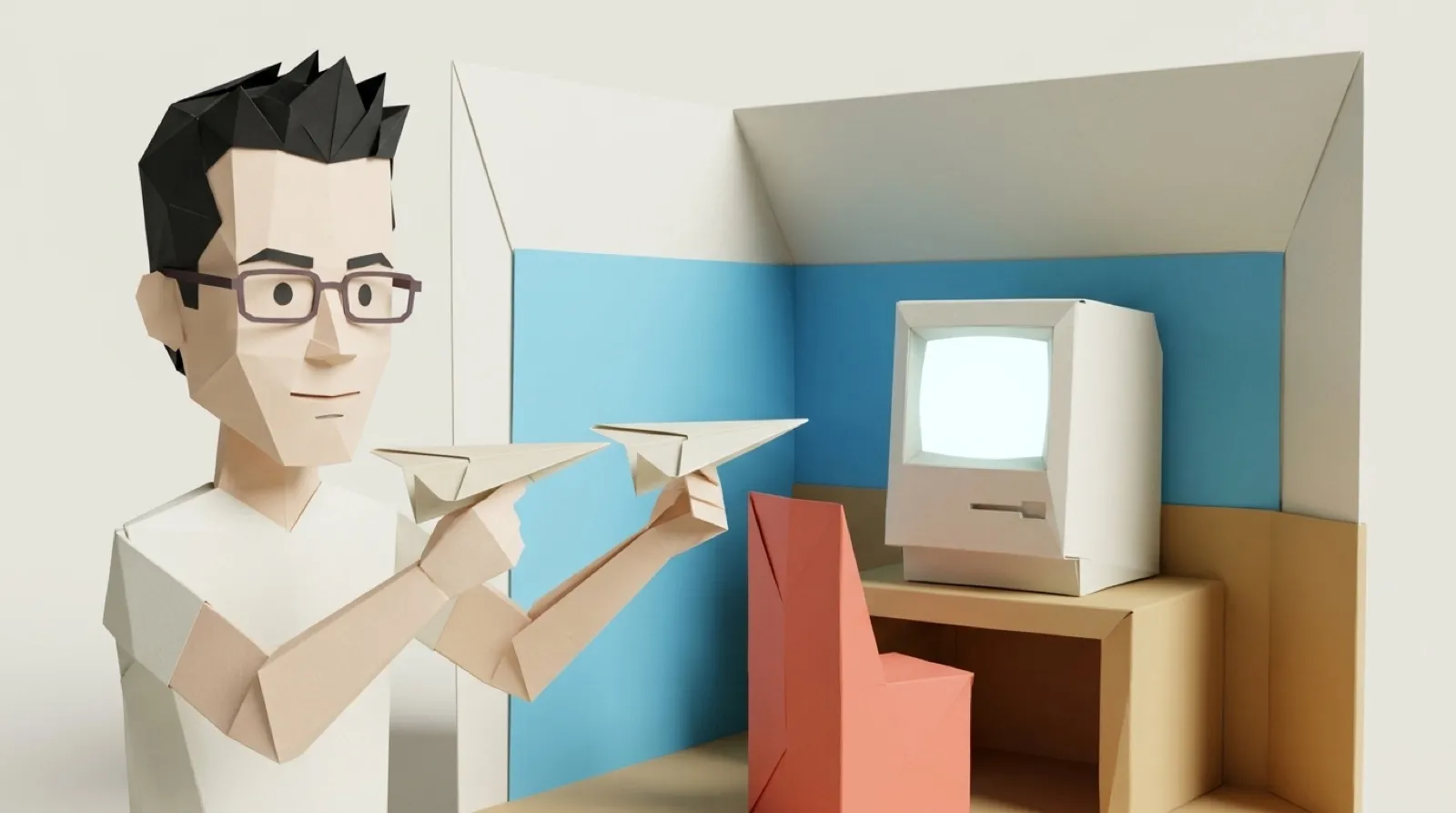
“D. Bohdan faithfully ported Glider 4.0 (a Mac game I wrote & released back in 1990) to run in your browser,” Calhoun wrote on Bluesky on October 26. “It’s the first port I am aware of that also brings along the Room Editor.”
The README credits the work in one line: the port “was directed by a human, implemented by Claude Opus 5.5, and designed by both.” It started from the original source, which went up under the MIT license in 2016: 12.2k lines of THINK Pascal for the game and 9.9k for the editor, calling about 200 Mac Toolbox routines. Each Pascal unit became a TypeScript unit, with the same procedures, variables and control flow, and enough of the Toolbox was rebuilt underneath to run them. “It is a source port rather than an emulator. No Mac ROM is required to run it.”
The referee is the part worth stealing. The original game had no tests, and the Mac’s system software had no pixel-level spec, so the original Glider became its own spec. The port runs Glider 4.06 on a headless, deterministic build of Mini vMac that boots to the first room in 0.4 seconds of real time and repeats a run “bit for bit.” A test is a script of key presses and mouse clicks at given ticks. The original plays it, the port plays it, and the port “must match the original exactly: every pixel of every screenshot and the sound tick by tick.”
The idea came from Claude. According to the README, it was “singled out by Claude Opus 5.5 at the planning stage” as the key lesson in Bohdan’s notes on porting Starlark to Python, where a conformance test suite played the same role.
The bugs make a better story than the features. In the Room Editor, Try Glider leaves a trail of glider copies across the screen, because the editor’s flight skips the erase code the game has. Locked houses stay locked forever. And Hands-off House, a bundled level that plays itself, flies twelve rooms and then gets “unceremoniously fried by the outlets of room 13.”
That one went to the oracle. The original on a fast emulated Mac dies in room 13 too, with 22,531 points, and all 180 screenshots on each machine match the port pixel for pixel. At a real Mac Plus’s own sluggish speed, though, the house flies all the way to room 40 and 115,411 points. The outlets keep time by the clock while the glider moves once per frame, and a slow Mac’s uneven frames, two to five ticks each, are what carried it through. The port models a Mac fast enough that no frame runs long, so the README lists the death as a quirk.
Play it in a browser with a keyboard, mouse, gamepad or touchscreen, as a black-and-white Mac Plus, a 16-color Mac II, or with the art from 1994’s Glider for Windows.
The year on the box is still in play. Calhoun’s Bluesky post says 1990, and the port’s journal answers with 4.05’s own “© 1991 Casady & Greene” resource and art files dated January and February 1991. Per the same journal, Calhoun plans to host a copy of the port himself, which may settle which year goes on it.