
Tools & Gearhardwareopen-sourcediy
Nick Steele Reverse-Engineered Digital Calipers Into an Open-Source $32 Linear Encoder, Gapped With Two Layers of Kapton Tape
Nick Steele's open capacitive linear encoder reads to about 40µm against a Mitutoyo indicator, costs roughly $32 to build, and sets its 0.1mm air gap with Kapton tape. KiCad files, STM32 firmware and test data are public.
“I started by reverse-engineering digital capacitive calipers,” Nick Steele writes in the project’s README. “I wanted to publish this working capacitive encoder because I had trouble finding open information about them.”
He went as far as the silicon. In the KiCad forum thread where he posted the design on October 17, he describes opening up a cheap dial indicator: “after decapsulating the die, I found it was the same flip-chip part that the capacitive digital calipers always seem to have,” he wrote.
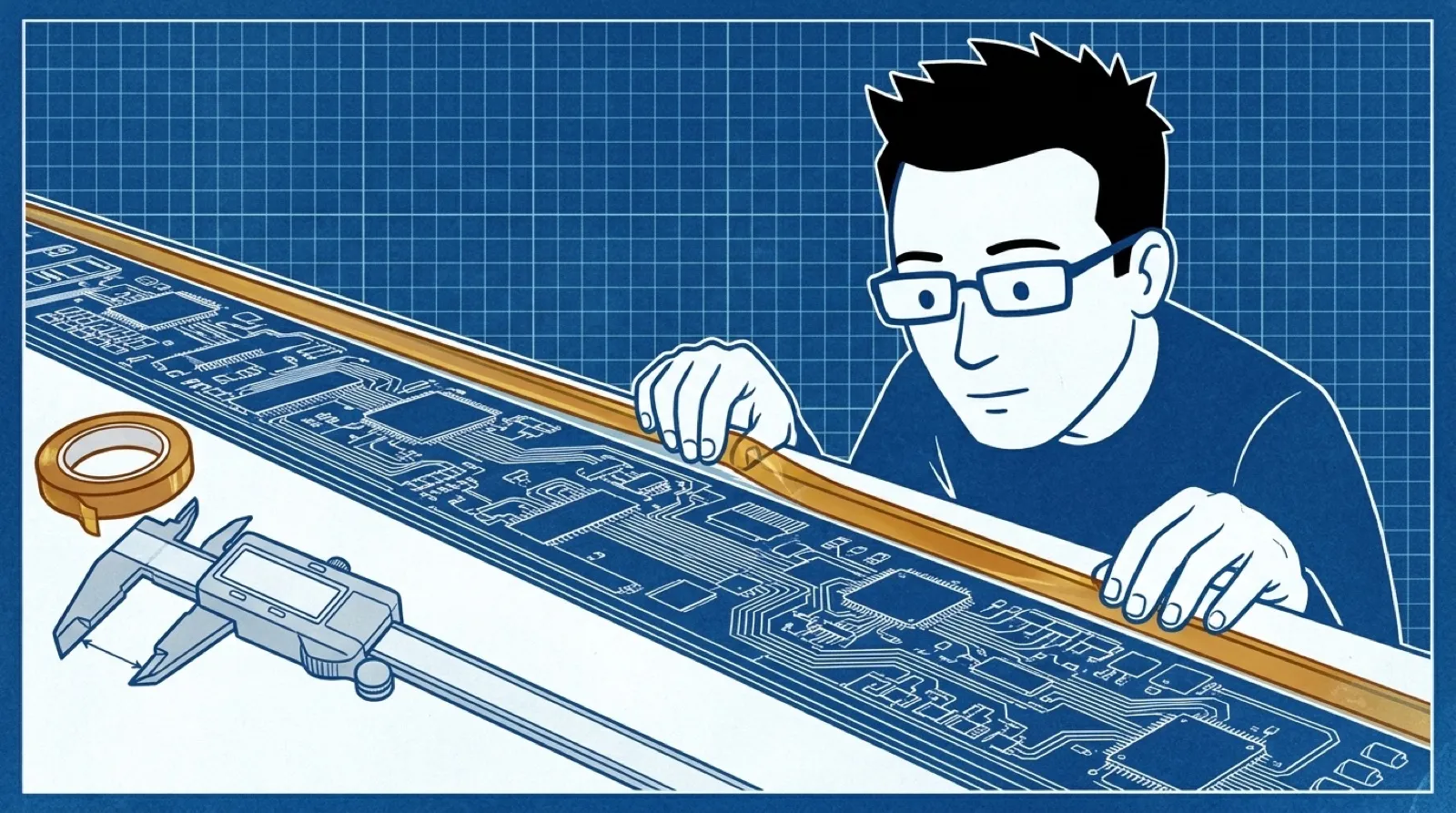
His version swaps that mystery chip for parts you can order. A sensor board carries eight repeating transmit antennas he calls emitters. A passive reflector board with a row of T-shaped copper pads runs the length of the axis. “They do not touch. The copper faces sit about 0.1mm apart.” An STM32L4 steps the emitters through a 16-step pattern at 16kHz, reads the charge that couples back through the reflector, and sends a position over UART every millisecond.
The gap took the least engineering. “I tried a 3D printed shim to set the gap, but two layers of Kapton tape turned out to be much easier and more accurate,” the README says.
The accuracy took the most. “When I started, I hoped for 10µm electrical accuracy. My first revision was about 0.5mm.” The 40µm rating came from plots against the Mitutoyo, which he “read the accuracy figure visually from the plots and rounded it up conservatively.”
What it still can’t do is remember where it is. “At power-up it assumes it is at position zero, so it needs zeroing or homing every time it starts.” Steele says he’s “pretty dead-set” that the next revision gets “two measurement scales for absolute position sensing.”
Every repeat in this design is imperial: the emitters sit every 0.635mm, a period every 5.08mm. “I do prefer metric, and the next version probably will be,” Steele said in the thread. That next version is supposed to be absolute, metric and off the hard-to-find chip at once. Another forum member has already offered to write a script that generates the reflector board; Steele told him to send a pull request. Whether a parametric reflector generator lands before the absolute scale does decides how fast anyone else can cut one to the length of their own machine.