
MattKC ran the Philips CD-i off a USB-C phone charger by building a board that asks for 9 volts and flips part of it to the minus 5 volts the console needs
The CD-i 450's power brick plugs in with an Ethernet-style connector and is sealed with one-way screws. MattKC replaced it with a board inside the console that negotiates 9V over USB-C, makes 5V and minus 5V, and still answers to the original power switch.
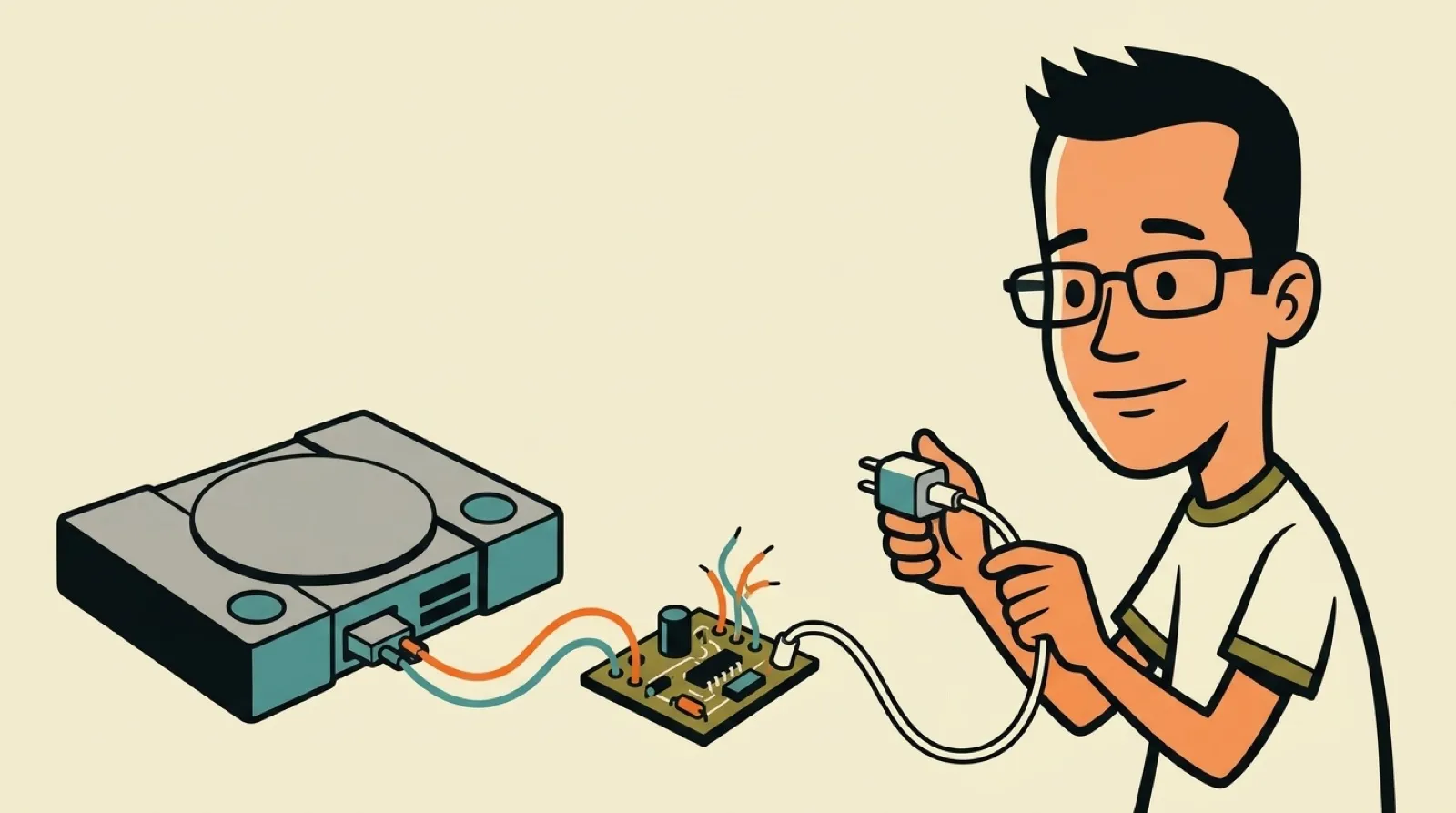
The CD-i’s power plug “is just straight up an Ethernet cable,” MattKC says in the video, then corrects himself: it’s an 8P8C connector, the same shape Ethernet uses. The little latch tab snaps off like it does on every Ethernet cable you’ve ever owned, and when it goes, “a stiff breeze can make it fall out and shut off the system.”
The brick on the other end is worse. Philips sealed it with one-way screws hidden under the rubber feet, “designed so that they can be screwed in but not out.” The AC cable is hard-wired, and his has a European plug, so it lives on an adapter. It supports universal voltages anyway. “Why go to the effort of that if you’re going to hard-wire the cable?”
He got a few of those screws out “through sheer willpower” before deciding to skip the brick altogether. The CD-i runs mostly on 5 volts, and USB has been 5 volts “for the last 2,000 years or so.”
Mostly. USB-C’s default is 5 volts at 3 amps, 15 watts, and that would almost cover a CD-i 450. Then there’s the one pin that wants minus 5 volts at 0.2 amps. That’s “a whole extra watt that puts it just over the baseline USB-C power spec.”
More amps at 5 volts is off the table, too. Chargers “almost never provide more than 3 amps on the 5 volt rail,” he says, because more current means more heat, thicker cables and bigger parts. They hand out the extra wattage at 9 volts instead. So the board asks for 9.
His plan broke the job into four chips’ worth of work. A CH221K, “a tiny 6-pin chip,” requests 9 volts, picked with nothing more than one resistor’s value. A TPSM84538 brings it down to 5 volts and can put out up to 5 amps; it’s the most expensive chip on the board, and he paid for it on purpose to keep the layout small. An LT3580 makes the minus 5 volts. It can deliver 2 amps, “10 times what the CD-i needs on this rail,” and it eats the most board space, so it’s the first thing he’d shrink in a version 2.
The fourth job was the switch, because the CD-i’s power button is wired straight to the brick. The TPSM84538 has an enable pin and a slow start built in, so it doubles as the load switch. The catch: the pin wants a high signal and the CD-i’s switch pulls low. He fed the switch and the USB-C chip’s “done negotiating” signal into a NOR gate, which only says go when both are low. Power for that little circuit comes from the 3.3 volts the USB-C chip already makes for itself.
He 3D printed the board first to check the fit, found it stuck out the back “like a tongue,” moved parts to the sides, printed it again, and sent it to PCBWay (the video’s sponsor) to be built and assembled.
Play the video on YouTubeThe smoke test passed. The power test didn’t. “This should come out to 9 volts, let’s see if it does…” Nothing. A second board, nothing.
USB-C plugs don’t decide who’s charging whom until something says so. A device that wants power pulls the CC1 and CC2 pins to ground through two 5.1K resistors, and without them “the charger doesn’t know what to do, and ends up providing no power at all.” They were right there in the chip’s reference schematic. “Guess which two resistors didn’t make it into my design?!”
He tacked on a pair of through-hole resistors “big enough for human hands to solder,” got his 9 volts, then 5, then minus 5, and booted the console off a phone charger. “This is… absolutely insane,” he says, holding the tiny charger next to the brick Philips shipped. He’s been wanting to do this “for over a year now.”
He’d still like the boards to be tested properly before anyone else plugs a vintage console into one. “I plan to get these thoroughly tested and make any revisions I need to before selling them,” he says, maybe with an external version on an 8P8C cable so nobody has to open their CD-i. There’s no store page yet.
He isn’t the first to make a replacement supply for this model, he says, just the first he knows of to get it running on USB-C. A board that asks a charger politely for what it needs works for more than a CD-i. Plenty of retro hardware out there has an odd rail or two, a dead brick, and an owner with a drawer full of USB-C chargers.