
UNIVAC Stored Computer Data as Sound Waves in Tubes of Mercury
Radar engineers built delay lines to hide anything that sat still, and early computers borrowed the trick, so every bit had to keep moving to survive.
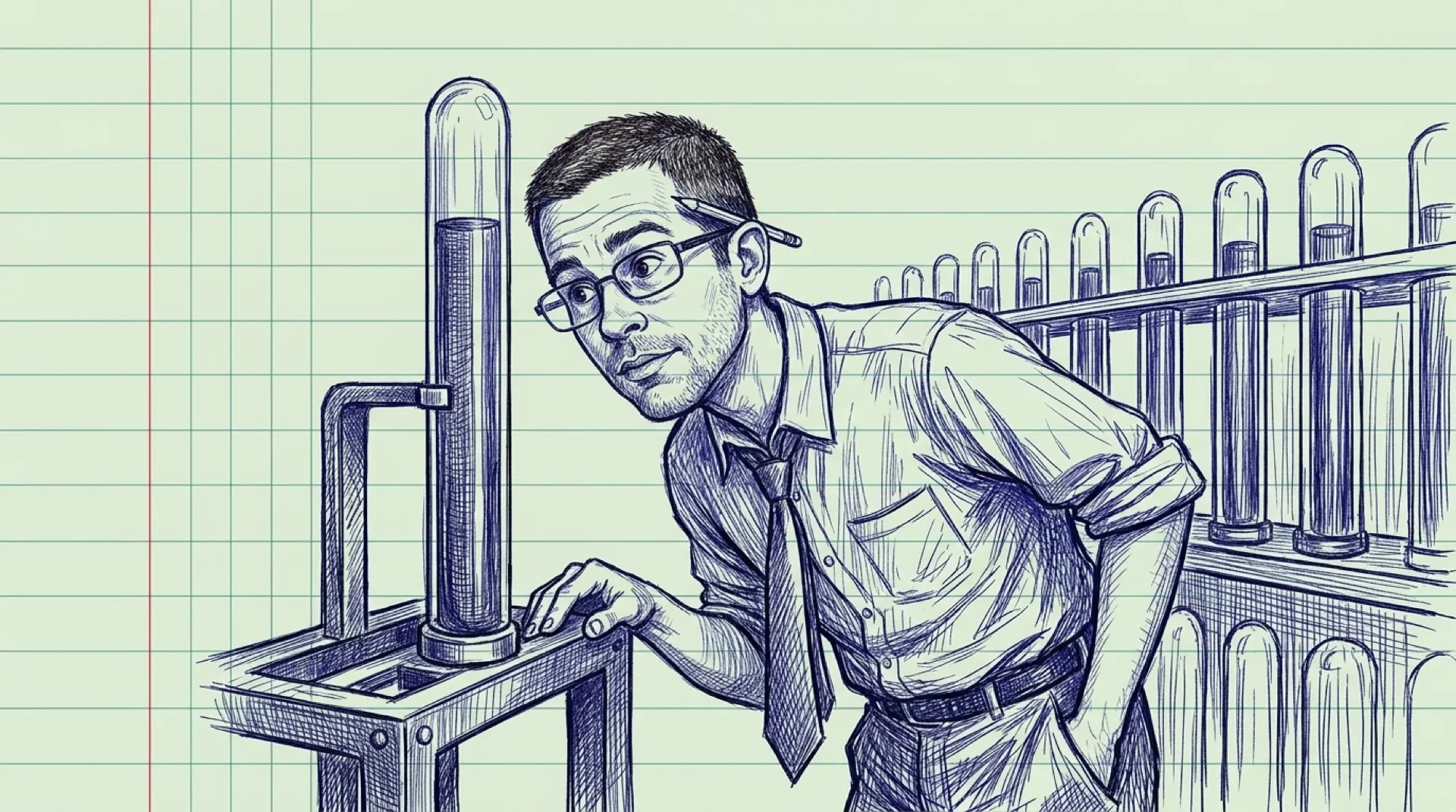
Computers in the late 1940s needed somewhere to keep ones and zeros, and one answer came from radar. The Computer History Museum calls it an “unanticipated spinoff” of World War II radar advances. Delay lines were developed to store radar blips so that screens displayed only new, moving blips. The job was to hide whatever sat still.
Computer designers took the same trick and pointed it at data. In computers, delay lines converted data bits into sound waves, transmitted them acoustically, then converted them back into bits. In the mercury version, tubes had transducers at both ends, one to generate the bits and one to receive them. (A transducer is just a part that swaps electrical signals for vibrations and back.) The page puts the result in one line: “They circulated forever until changed by the computer.”
That is a strange kind of storage. Nothing sat in a cell waiting to be read. The bits existed as a stream of pulses traveling down a tube of liquid metal, got caught at the far end, and were sent around again. Memory, in this design, was a thing in motion.
It was also a thing with mass. The museum’s entry on the UNIVAC I says a set of these structures, with their associated electronics, gave the machine a memory of about 1.5 KB. Each tube weighed nearly 800 pounds when filled with mercury. That is a lot of heavy metal for roughly the amount of text in a long email. (Nobody said the 1950s were efficient.)
The museum’s caption for the Ferranti Sirius spells out the catch. Like all delay line memories, a stream of bits continuously circulated and was accessible only at one point. If the bit you want has just passed the access point, it will be back after it makes a lap. A program that wants a particular bit has to wait for it to come around.
Other machines made the same bargain in different packaging. Maurice Wilkes designed the EDSAC, one of the earliest stored-program computers, and it used delay line memory. Turing’s design for the Deuce used a mercury delay line for its main memory of 1,600 bytes, in the same neighborhood as the UNIVAC I’s 1.5 KB. The museum’s verdict on that machine: it was fast, but difficult to program.
Not every delay line used mercury. In magnetostrictive delay lines, an electromagnet twisted a long wire one way or the other to represent ones or zeros. The Sirius, a small, low-cost business computer, used a thin strip of special metal rolled into a coil, with transducers at either end. Same idea, no liquid, and the bits still chased their own tails.
Here is a reasonable guess, and it is only that. Memory you can reach at one point forces programmers to think about when a value will arrive, not just where it lives. Turing’s Deuce, fast but difficult to program, fits that pattern, though the museum does not tie the two together. If you have ever tuned code around cache behavior, you have met a distant cousin of the problem.
Back then the cousin was literal. Nearly 800 pounds, and every bit went in circles.