
Rez's Creator Dyed His Hair Silver and Played It Wordlessly at a Sony Party. Then the Music Chairman Took the Stage.
Tetsuya Mizuguchi's own telling of how a Zurich parade, a VJ friend and a Kenyan street video shaped Sega's Dreamcast-era trance shooter, republished for its 25th anniversary.
Time Extension republished its Rez oral history for the game’s 25th anniversary, and the best material in it is not the shooting. It is what happened in rooms around the shooting.
Rez began with a parade. Tetsuya Mizuguchi, a Sega staffer since 1990 who had worked on the company’s hydraulic AS-1 motion simulator and produced the arcade hit Sega Rally Championship, was traveling for that racing game when someone took him to a street parade in Zurich, Switzerland.
“300,000 people had gathered in the city centre for a concert. It blew me away,” he says. The art student in him saw sound and light locked together, and he started chewing on a game that married music to shooting. “I wanted to make a game that could put the player into a trance-like state.”
He renamed Sega R&D #9 to United Game Artists in 2000, and that Sega subsidiary built the thing. The team ran at roughly seventy-odd people in Shibuya, and it was also making Space Channel 5 at the same time. Mizuguchi says he “slept at my desk” and “never went home.” Hopping between the two projects kept him sane: one was “pure entertainment,” the other “quite deep and elemental.”
The research was clubbing
The visual direction came from Jun Kobayashi, a VJ friend of Mizuguchi’s. They talked about Kandinsky, who painted while inspired by music, then tried “all kinds of different art styles” and visited clubs to watch how crowds reacted to the sound.
Jake Kazdal, the only non-Japanese member of the Rez team, got in through a mutual friend and a demo tape he hustled together just before E3 1998. He says Mizuguchi’s voice is the one in Sega Rally calling “LONG MEDIUM LEFT.” Kazdal modeled and animated a selection of enemies for Worlds 1 and 2, and his biggest influence was accidental. He went clubbing in Tokyo, “got entranced with the WinAmp sound visualisations a VJ was using,” videotaped a bunch and showed Mizuguchi the next week. “That really drove the future of all the style for the rest of the project.”
The team also went to Taiko drumming festivals and watched hours of street musicians. Sound director Nobuhiko “Ebizo” Tanuma brought back a video from a street in Kenya, where one guy starts a rhythm over dinner and everyone around him joins in. Mizuguchi watched it “many, many times.”
Quantization did the heavy lifting
The core trick is simple to retell. Shooting produces sounds, and those sounds are quantized so they land in step with the music. Any player stays “in time,” so play always feels good. “When we first made this work, it felt like magic.”
It still did not feel right until the team added the DJ element, where shooting the cubes changes the backing track. “It felt like we finally had the mechanics working.” (A shooter that remixes itself, so every miss is a drum fill.)
The party
The timing was awkward. Sega announced it was leaving the hardware business during development, so Rez became one of the last Dreamcast games and one of the first Sega games on the PlayStation 2.
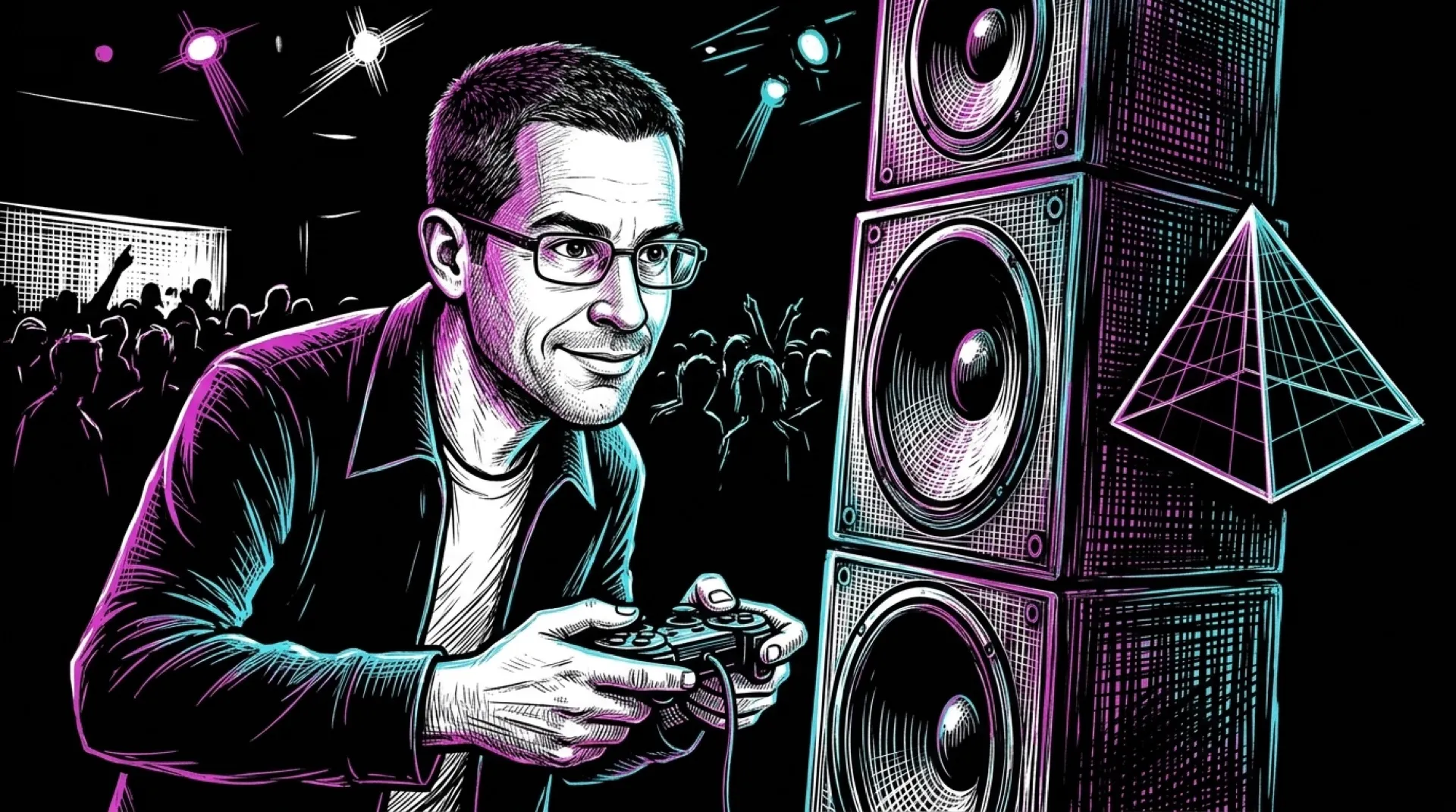
In 2001, before release, Mizuguchi showed Rez at a PlayStation Party in Shibuya. He decided to show it without words: play in front of people through a huge sound system, then leave the stage. He dyed his hair silver the day before, knew no one at Sony and compared it to “playing an away game.”
Backstage in the dark, he could not tell how it went over. Then his name came from the stage. Shigeo Maruyama, the chairman of Sony Music, called him back and said: “I think this game could change the history of music.” Afterward Maruyama told him it “wasn’t marketing talk.”
That changed things inside Sega. Up to that night, Mizuguchi says, the marketing people “didn’t seem very excited about Rez.” Some of them were in the audience. At the next visit to the Haneda office, “Sega was like: ‘We better start supporting this game.’”
Where this goes
Expect more old games to get second lives as demo software for new hardware. The mechanism is easy to see: Rez’s presentation was built from simple, abstract shapes and sound, so it still reads as unusual on any display. That is a forecast, not reporting, and the feature itself only documents that Rez was used for PSVR2.