
RetroPlayStationBlu-raySonyRetroGaming
Sony's $599 PlayStation 3 Lost $3.3 Billion and Still Won the Blu-ray Format War
Twenty years after E3's most mocked price reveal, period teardowns and studio defections show how a third-place gaming gamble quietly settled Hollywood's high-definition disc standard.
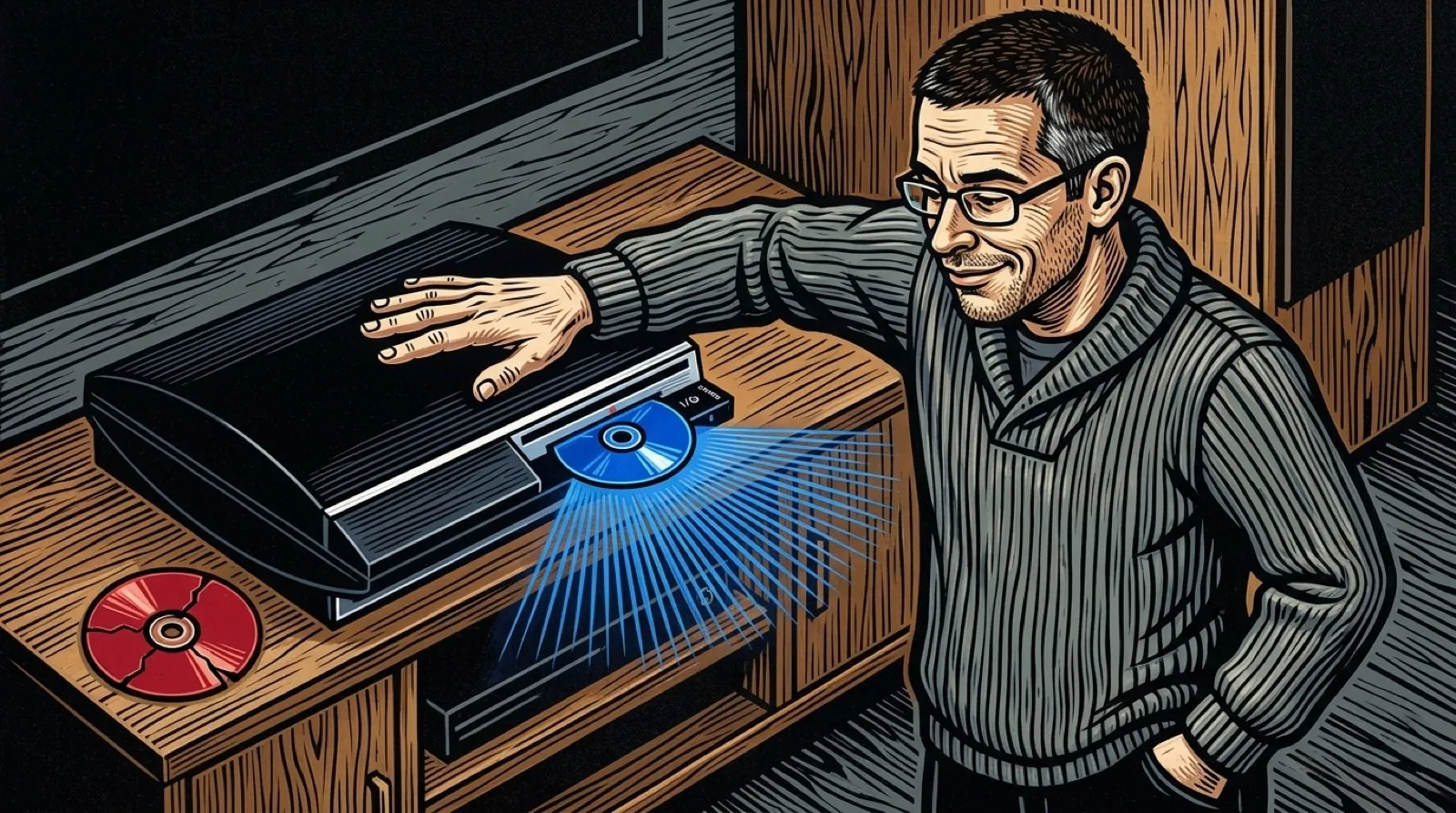
Twenty years ago today, on November 11, 2006, Sony shipped its curved, glossy black PlayStation 3 to Japanese stores with just 100,000 units on day one. Six months earlier at E3, executives had announced a two-tier $499 and $599 launch price that turned gaming’s dominant brand into an overnight internet joke. Sony Computer Entertainment executive Jack Tretton insisted at the time that “People are going to perceive enough value that they’re not going to consider the price to be a barrier to entry.” Against a $399 Xbox 360 and an incoming Nintendo Wii, plenty of shoppers saw a barrier the size of a rent check.
The joke hid the real play. Every PlayStation 3 shipped with an internal Blu-ray disc drive built straight into the console, turning game buyers into high-definition movie households overnight while Toshiba pushed its rival HD DVD standard. Sony still remembered Betamax losing to cheaper VHS decks, and this time management effectively taped twelve crisp twenty-dollar bills inside every 60GB retail box just to claim the shelf under your television.
Getting those blue-violet lasers out of the factory nearly stalled the rollout before anyone plugged in a controller. In September 2006, Sony halved its 2006 shipment forecast to two million units worldwide and pushed Europe’s debut to March 2007 because suppliers couldn’t mass-produce enough blue laser diodes (a literal case of the blues in Tokyo). PlayStation chief Ken Kutaragi apologized at Sony headquarters: “I am so sorry not to be able to answer all the expectations.”
Did buyers line up anyway? Before dawn. Over 1,000 shoppers queued in the cold outside Bic Camera’s flagship Tokyo store for launch-day lotteries while staff on microphones warned that sales would end if anyone got hurt. Forty-one-year-old gamer Tomoaki Nakamura told reporters, “I’ll play it all through the weekend. No time for meals” (priorities intact). Two days later, EDN reported from Tokyo that about 100,000 consoles shipped on day one and “immediately flew off store shelves,” with major Tokyo retailers sold out by 7 a.m. ahead of 400,000 units slated for the U.S. launch on November 17, 2006. Even then, a Sony spokeswoman admitted that a “laser diode production glitch was solved, but we are still having tough time catching up.”
When North American units arrived six days later, hardware analysts opened the case and found a parts bill that made $599 look charitable. Research firm iSuppli estimated in a teardown covered by The Guardian that materials and manufacturing alone cost $805.85 on the $499 20GB model and $840.35 on the $599 60GB version, before counting the controller, cables, or packaging. Microsoft’s hard-drive Xbox 360 cost an estimated $323.30 in materials and manufacturing against a $399 retail price. Wired reported that two components led the bill: a $129 Nvidia graphics chip and a $125 Blu-ray disc drive, so Sony lost $306.85 on every 20GB unit and $241.35 on every 60GB console.
That accounting hurt in public. By June 2008, Wired cited a Forbes report putting Sony’s PS3 losses since launch at $3.3 billion, and the console sat in third place behind Nintendo’s runaway Wii and Microsoft’s head-start Xbox 360. Even Sony’s annual report to the Securities and Exchange Commission dropped the usual bravado, warning investors that “Even if the platform is ultimately successful, it may take longer than expected to recoup the investment, resulting in a negative impact on Sony’s profitability.”
Out in living rooms, though, Sony’s bundled disc drive was quietly settling the format fight. Standalone high-definition players were tough sells while movie shoppers worried about backing another losing standard, yet every PS3 owner already had a 1080p Blu-ray deck sitting beside the couch. By February 2008, BBC News reported 10.5 million PS3 consoles sold worldwide against just one million HD DVD machines of every kind, a count that included shipments of Microsoft’s external Xbox 360 add-on drives. With Blockbuster and Target backing Blu-ray and Warner Bros. switching sides a month earlier, Daiwa Institute of Research analyst Kazuharu Miura summed up the studio math in nine words: “When Warner made its decision, it was basically over.”
On February 19, 2008, Toshiba formally pulled the plug on HD DVD players and recorders and aimed to end retail shipments and volume PC and game-drive production by late March 2008. Chief executive Atsutoshi Nishida told the press that “We carefully assessed the long-term impact of continuing the so-called ‘next-generation format war’ and concluded that a swift decision will best help the market develop.” As the Centre for Computing History notes, Microsoft later adopted Blu-ray for the Xbox One (awkward family reunion).
Once Toshiba bowed out and later hardware revisions trimmed costs, Sony’s bruised heavyweight staged one of gaming’s longest second acts. Production in Japan ran until May 29, 2017, when shipments ended on the final 500GB standard model nearly eleven years after launch. Sony Interactive Entertainment’s official ledger counts more than 87.4 million PS3 hardware units sold as of March 31, 2017, alongside more than 999.4 million software copies through March 31, 2019.
Physical discs never enjoyed DVD’s long, unbothered reign because broadband streaming showed up a few years later to shrink the movie shelf for everyone. Hardware makers will still try the same bundling play (tucking a proprietary codec, cloud tier, or headset ecosystem inside a must-have game box whenever standalone buyers refuse to pay upfront), though eating three billion dollars in red ink takes a stomach few modern corporate boards possess.
Five hundred ninety-nine bucks bought Hollywood.