
Sony’s 1998 Mavica photo printer swallowed the camera’s floppy disk directly
The FVP-1 cost ¥64,800 at its Japanese launch and also accepted video inputs, making the family snapshot workflow a surprisingly physical affair.
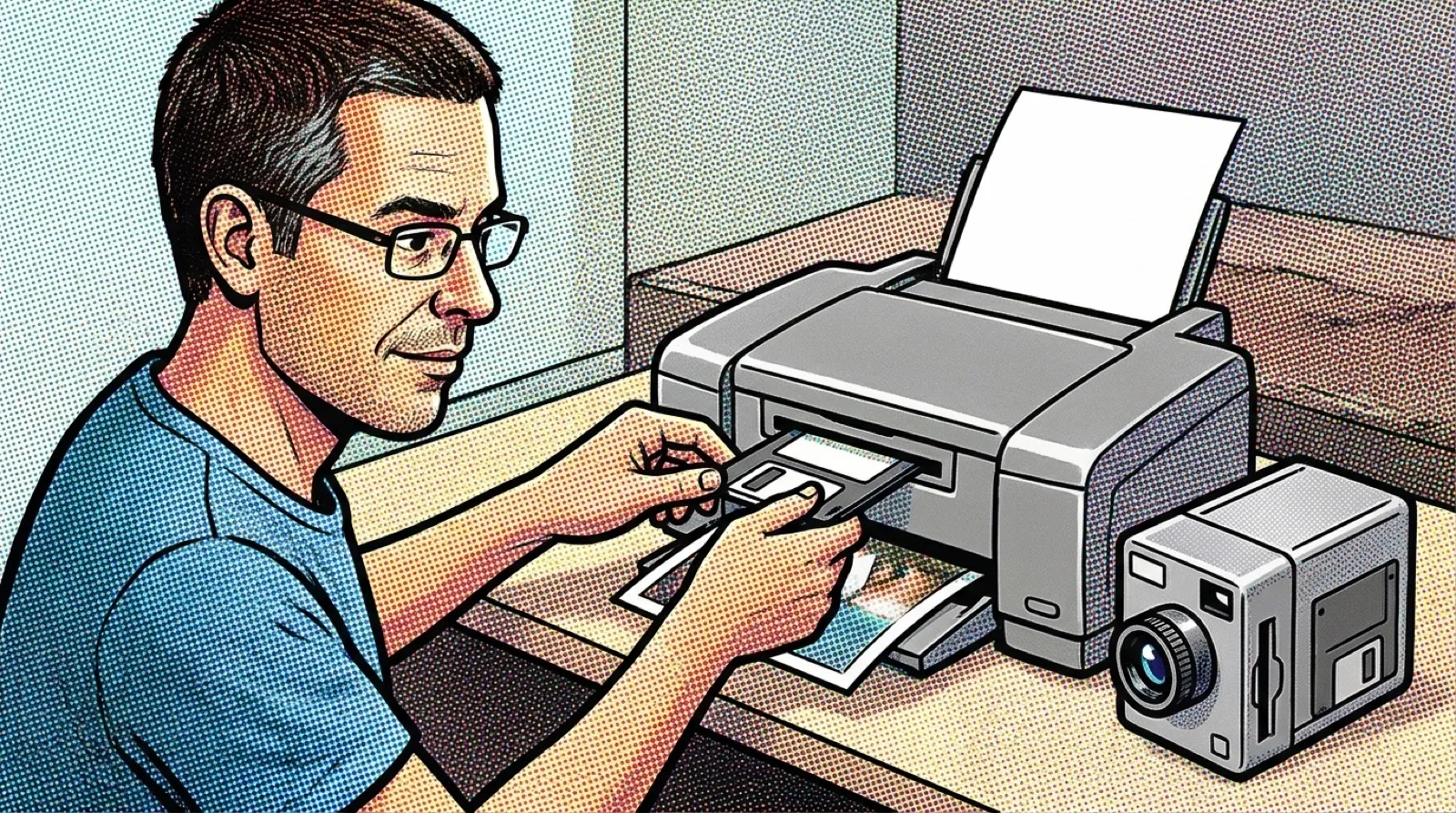
Sony solved photo transfer in 1998 by giving the printer a floppy drive. Take a picture with a Digital Mavica, remove the disk and put it in the FVP-1. The image moved across the room in a plastic square, which at least made the progress bar easy to locate.
Sony’s September 29 announcement describes the Mavica Printer as a home-use color printer. Its first listed feature is that it “Prints directly from a floppy disk.” The camera and printer shared a removable storage format, so the handoff itself carried the compatibility decision.
The Japanese introduction date was November 20, 1998, at ¥64,800. Sony listed initial monthly production of 2,000 units. Those are historical launch figures, not today’s secondhand prices or evidence that a surviving machine will still print. A printer old enough to have a floppy drive also has consumables old enough to demand a separate conversation.
Sony rated the output at 306 by 306 dpi and 1.41 million pixels. Those are printer specifications; they don’t turn a low-resolution camera file into a better original. The distinction remains useful today whenever a box combines the resolution of the output device with the impression that every picture gains that much detail on the way through.
The FVP-1 also had composite video and S-video inputs for pictures from video cameras and VCRs. A single machine could therefore make a still print from two different kinds of source: a digital file carried on a disk, or an image arriving as video. The living-room wiring diagram had joined the family photo album.
The company advertised support for postcards, greeting cards, stickers and floppy-disk labels, along with image-processing software. Sony described its compatible polished paper as improving color reproduction and print life. That’s a manufacturer claim from the launch release, rather than a longevity test of prints that have now had decades to sit in a drawer.
The appealing part of this setup is how visible the handoff was. The disk was a distinct object with a place to go next. Somebody who understood that sequence could produce a print without understanding folders, image import or the computer’s printer driver. The PC could take the afternoon off (please contain your excitement).
That convenience came with a boundary. The printer’s useful direct route depended on the expected disk and image format; a familiar-sized slot alone wouldn’t make arbitrary files printable. Anyone reviving one now would need the manual and compatible media, plus a reason to trust the mechanism and supplies. The launch announcement describes what Sony intended to sell, while a restoration still depends on the individual machine and supplies.
Physical media can make a workflow easier to understand while making its long-term survival harder to arrange. If today’s connected cameras and printers outlive their apps, the future restoration problem may be less visible than locating a floppy disk. The FVP-1 at least leaves the missing piece with a shape you can hold.
Please insert your family vacation.