
Hardwaresony3d displayelf-mn1spatial reality displayusb-c
Sony's ELF-MN1 is a six-inch desk display that shows anime avatars in 3D without glasses, if your phone and cable cooperate
It costs about ¥54,000, ships in Japan only so far, and needs a USB-C cable with DisplayPort support plus a power adapter you buy separately. The 3D works for one viewer at a time, and Sony warns your phone's battery may keep draining while it is plugged in.
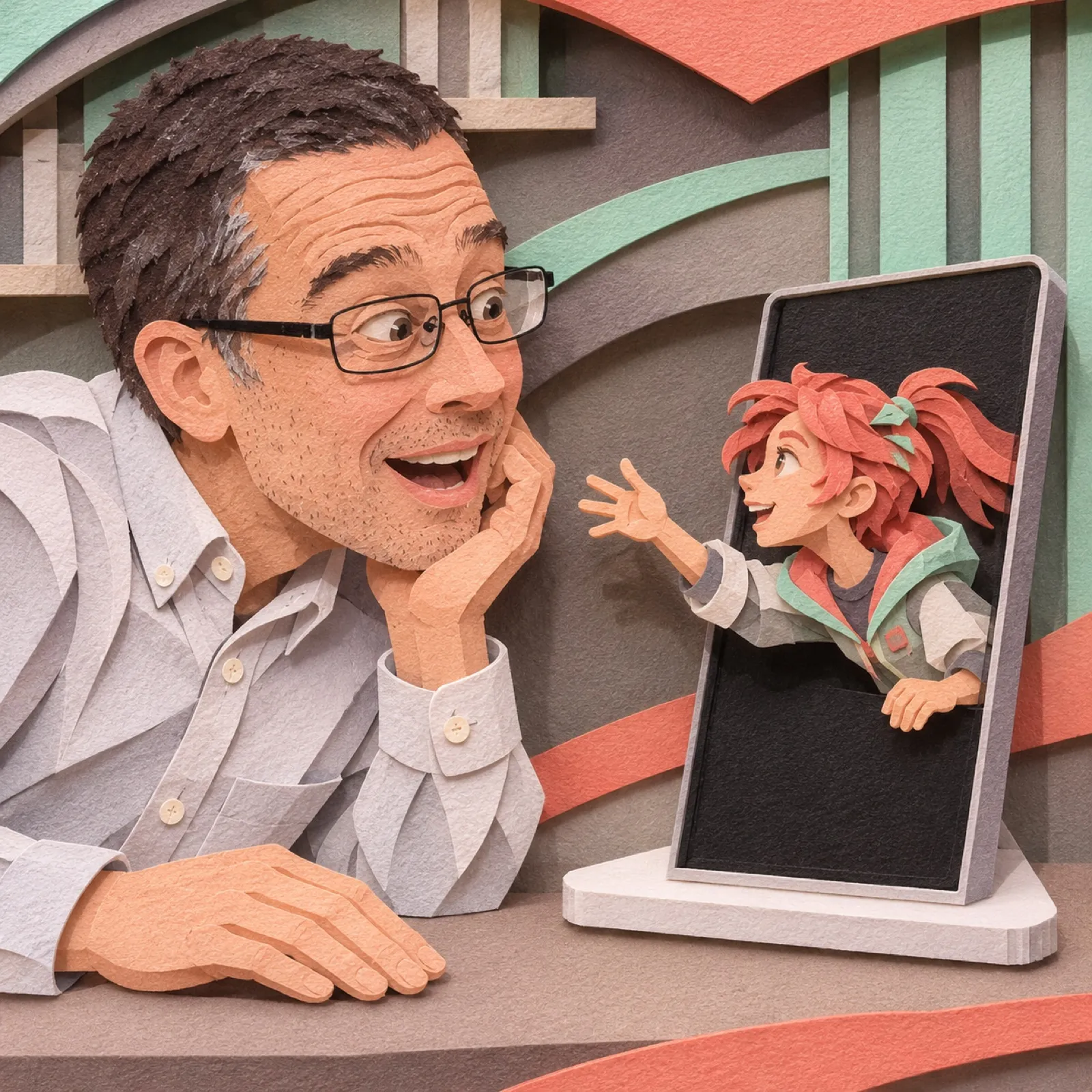
Sony’s press notice dated October 28, 2026 describes the ELF-MN1 as a compact display for viewing 3D content, such as characters and avatars, without a headset. It lists a December 11 release in Japan and an estimated market price of ¥54,000, a figure Sony footnotes as its own estimate for a product that is not on sale yet. The official price is “open,” so each retailer sets its own. New Atlas puts that at roughly $340.
The trick is a tracker. New Atlas says the 6-inch LCD sits under a micro-optical lens layer, and a high-speed sensor follows your pupils so the display can render a separate image for each eye as you move. A new infrared sensor in this third-generation eye tracker is meant to keep it working in a dim room. Sony’s own notice says the display’s 403 ppi is the highest among its spatial reality displays. Notebookcheck lists a 3,840 x 2,160 panel that delivers a 1,080 x 2,160 3D image, with a 60 Hz refresh, 470 nits of brightness, and a best viewing range of 30 to 80 cm.
That range matters, because the screen is small and the 3D is the point. Sony’s notice says it sits on a desk or side table on a stand. Both outlets put the weight near 300 to 350 grams. Two 1-watt stereo speakers ride along, Notebookcheck says.
The hookup is one USB-C cable to a recent phone or a Windows PC. Notebookcheck lists an iPhone 15 or newer, a Galaxy S23 or newer, a Pixel 10 or 11, or a recent Xperia on the phone side. For a PC it names a 6-core Intel Core i5 class chip, an RTX 2070 or 2070 Super, and 16 GB of RAM. Sony’s notice adds that the display needs a USB-C cable with DisplayPort Alternate Mode, and sells the AC adapter separately. It also warns that the phone’s battery may drain depending on the app, even though the display can charge a connected phone.
What goes on the screen is mostly anime-style figures. Sony is partnering with Gugenka on a 3D digital figure service, and the notice names XR creators VoxelKei and YORIMIYA among others. It ties the product to XYN, which Sony describes as its support program for spatial content, with software, hardware and partner collaborations. New Atlas says Sony offers a Unity SDK with OpenXR support for building apps on Windows, Android and iOS, and plans to work with creators on new material.
Sony has made this kind of display before for professionals. New Atlas says the 27-inch ELF-SR2 costs about ¥550,000 in Japan, about ten times the ELF-MN1’s estimated price, and compares the little display with the $299 Looking Glass Go. That puts the ELF-MN1 in desk-toy territory for the people who already own the phone, the cable and the characters.
Whether the figure library grows past its launch lineup is the thing to watch. Spatial displays have always had the hardware part figured out and the stuff-to-look-at part missing, and a six-inch screen that only one viewer at a time sees correctly is a niche that content makers can fill or ignore. If enough studios build for it, a desk display becomes a place where a favorite character lives, the way a bobblehead did, minus the dust. If not, it is a very precise paperweight.
The power adapter, naturally, is extra.