
Bambu’s $2,499 printer keeps nine tools loaded so a material swap takes about six seconds
Swaptek moves the filament-change bill into a rack of ready tools, with a software boundary still separating printing from flat craft work.
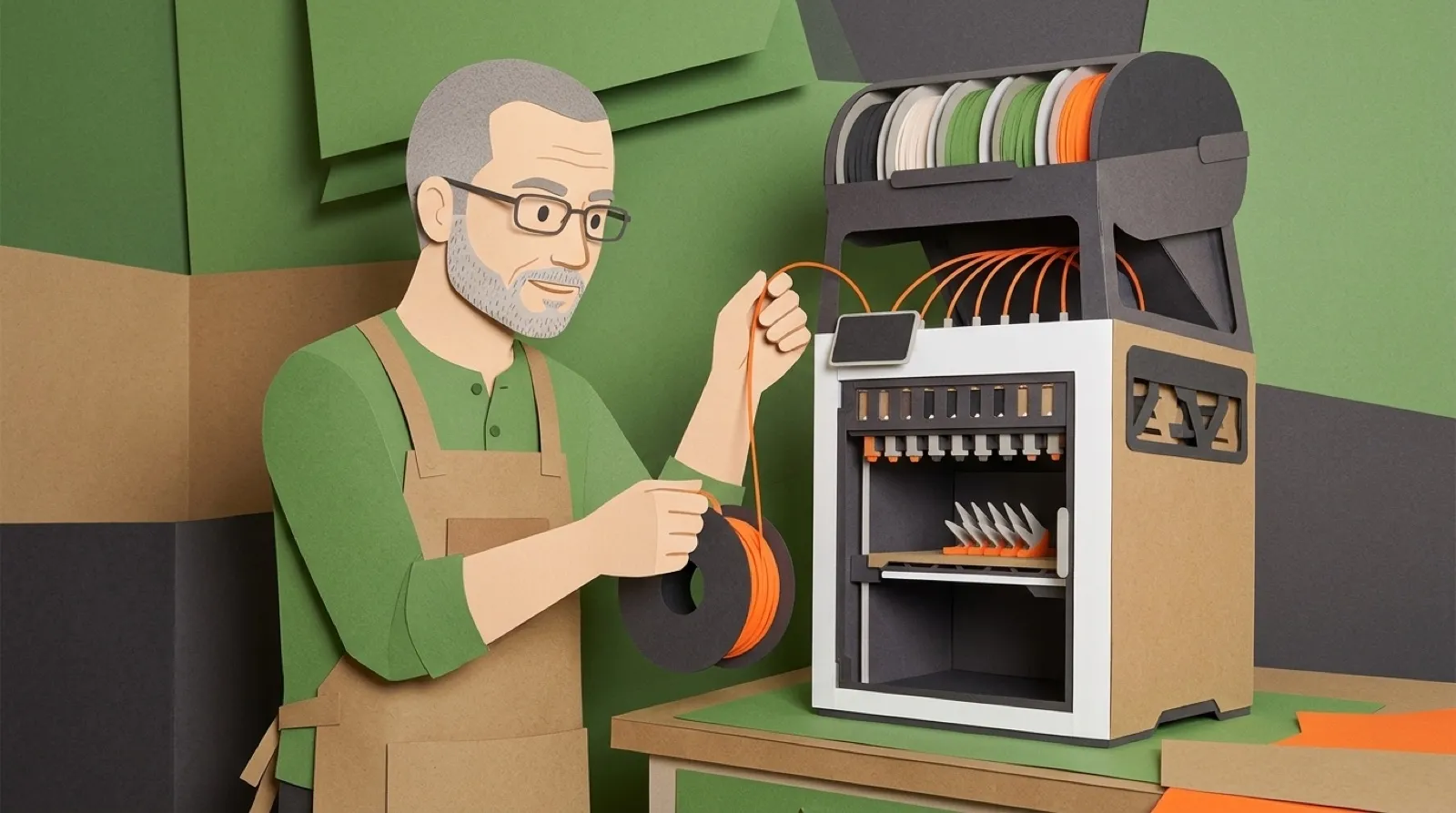
The next nozzle starts warming up before the current nozzle finishes. Bambu Lab’s H3C reads ahead in the print instructions, gets the incoming tool ready, and tries to turn a material change into a brief interruption rather than a fresh round of heating and feeding.
Bambu’s Swaptek explanation describes independent filament paths and heaters for nine tools. Keeping material loaded avoids sending each replacement filament through the same repeated unload-and-reload routine. The printer has prepared its next outfit before leaving the house (a novel concept).
The maker describes a change in approximately six seconds, including a brief prime. That is a vendor claim about changeover, not a claim that an entire print takes six seconds or that every model finishes at the same speed. The number of switches inside a job determines how often the benefit gets a chance to matter.
The launch page lists the US H3C bundle at $2,499 before tax. A machine bought for occasional single-material parts has a different case to justify than one constantly interrupting itself for color or material changes. Nine waiting tools can be impressive and still spend most of their working day waiting.
| Decision row | H3C | Bambu H2C | Original Prusa XL |
|---|---|---|---|
| Dedicated material positions described by maker | Nine independent print tools | Up to seven colors/materials with Vortek | Up to five toolheads |
| Swap approach | Independent loaded tools, preheated ahead | Vortek hotend system | Toolchanger |
The H2C announcement and Prusa’s XL description establish that ready-to-swap material systems already have alternatives. The chart compares their stated architecture, without pretending these pages are a controlled speed contest.
For a workshop, the relevant calculation would start with a representative print and its change count. A small per-change saving can compound over a complicated model; a larger sticker price does not compound into savings by itself. The slicer’s total duration and material estimate belong beside the purchase price.
The H3C, H2C and Prusa XL also require a buyer to look past the number of colors. Their workflows, supported materials and actual supplied configuration matter. An unused slot cannot improve a finished part just by looking busy.
Swaptek’s nonprinting tools introduce a useful fine-print check. Bambu says cutting, drawing and debossing tools can use the same docking system, but its explanation also says 3D and 2D work currently use separate software environments. They cannot yet become one combined job. The hardware can be ready while the software still asks everyone to change rooms.
If ready-tool systems keep reducing the cost of each switch, mixed-material designs could become easier to justify beyond decorative color. The test remains the resulting part and the resources it consumes. Bambu’s own account leaves a software join unfinished even as the next nozzle heats.
Hot swap. Warm wallet.