
A dad built a seven-foot driveway UFO with 1,406 LEDs and his three-year-old flight engineer
A backyard attraction gives a child an engineering job and its neighbors an unusual departure gate.
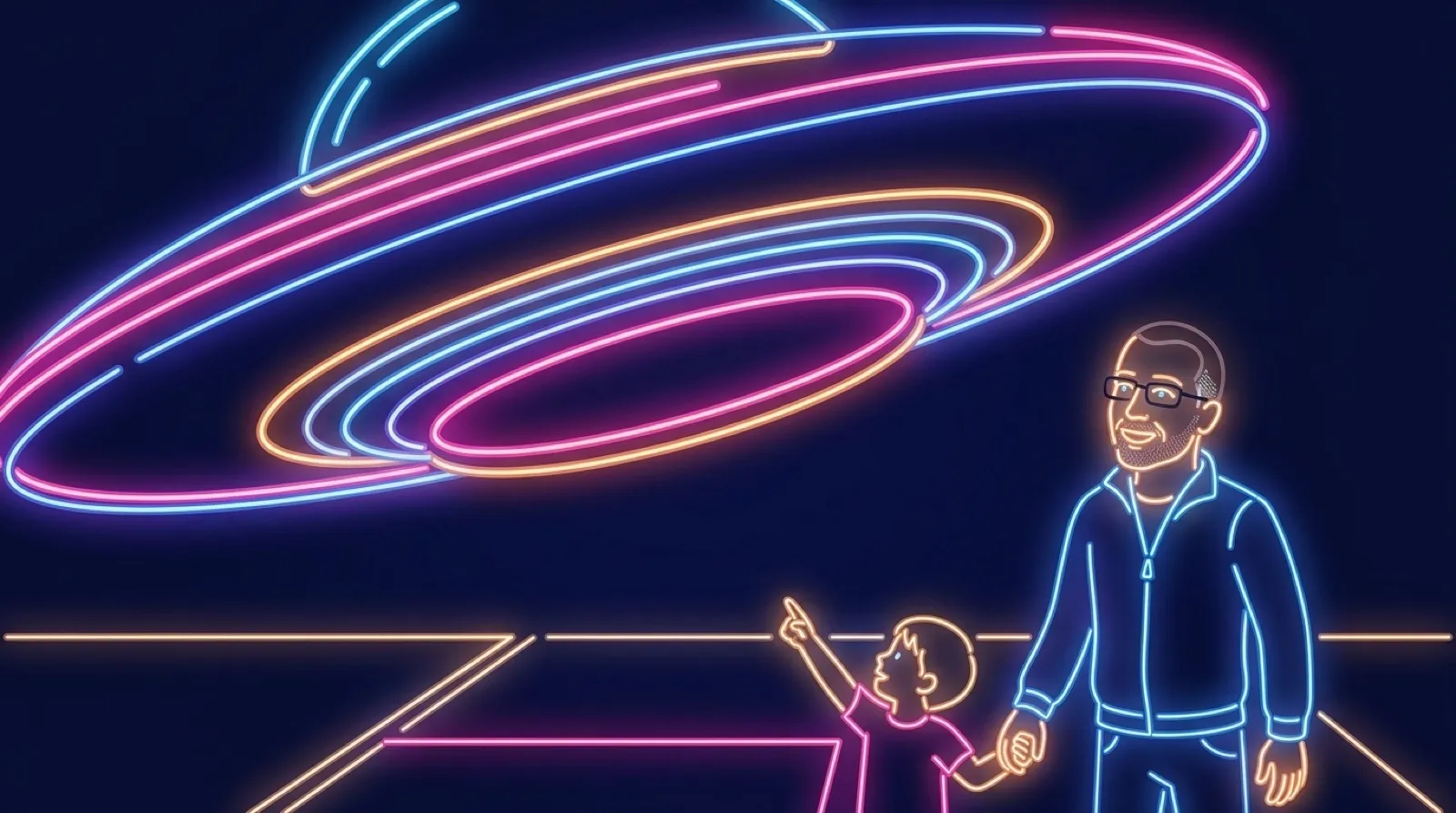
A seven-foot flying saucer in the driveway apparently wasn’t quite enough. HULL/20 also has an airline, a departures board and a passport office for neighborhood kids. The airline’s baggage allowance is one towel, which already sounds less hostile than several perfectly real carriers.
The maker, posting as 0xdxn, built the saucer with his three-year-old son, Linux. Its frame is an aluminum octagon, its pilot is inflatable, and an Arduino Nano ESP32 controls the lights. The project page describes an 11-second abduction sequence that plays as part of the yard’s show.
The supporting installation brings the total to 3,418 LEDs across the saucer, banner and garage eyes. Each controller runs its own sequence; the house sends cues rather than constantly supplying every animation frame. A Wi-Fi interruption therefore doesn’t have to strand the spaceship halfway through its big moment. Ground control can lose contact without losing the plot.
That design choice makes sense far beyond a Halloween display. A prop that finishes a known local sequence can survive a wireless interruption without improvising every flicker. The audience sees the lights, not the network diagram, and a neighborhood doesn’t issue extra applause for a beautifully centralized failure.
The flash-rate problem deserves attention before anybody borrows the saucer. Lights that seem slow separately can combine into a much faster visual sequence as they fire around a ring. Judging the whole arrangement is a different task from looking at one output and declaring it fine. The resulting show needs to be considered from the street, where the neighbors actually encounter it.
The passport office gives the hardware another purpose. Hourly codes encourage children to visit the gate, and the pretend airline turns waiting for the animation into part of the game. That is a lovely solution to a familiar interactive-project problem: after the first person presses the button, what makes the next visit different?
The build notes describe one installation, with its own location and audience to account for. A driveway prop has weather, cables and passing people to deal with, none of whom care how charming its fictional timetable is.
The pretend airline will be what the neighbors remember after the LED count gets forgotten. The controls make the display work, but the child’s role gives the machine a reason to be there. The next refit is already part of the maker’s plans, so this particular driveway hasn’t reached its final destination.
Linux cleared it for departure.