
IBM launched its 1401 computer with an empty box and engineers spinning the tape reels
The company’s own account separates the television prop from the working machine it kept safely in a lab.
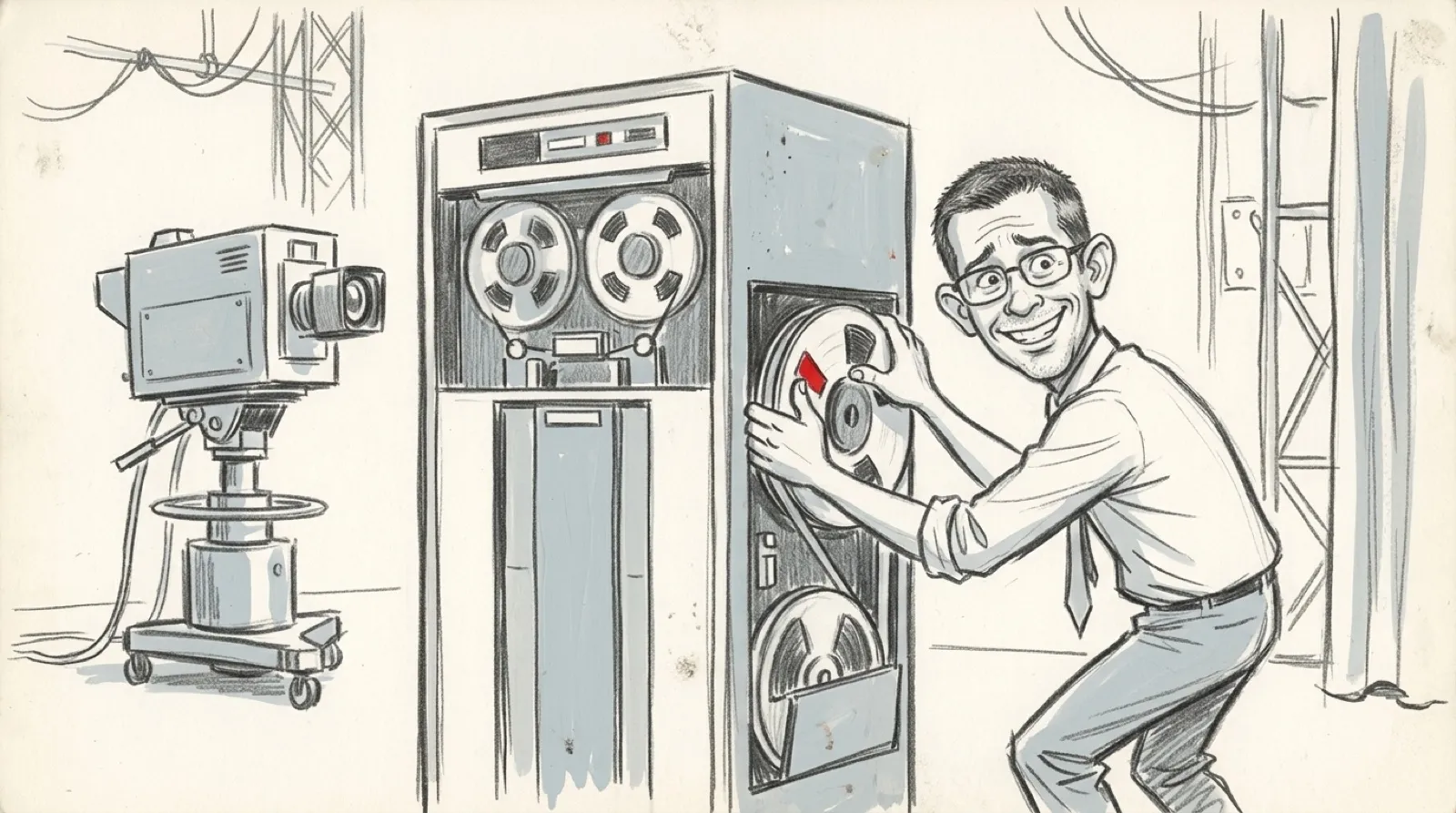
IBM had one working 1401 and a television presentation to deliver. The executives did not want to risk moving the computer, so the studio got a box with battery-powered lights. Engineers stood behind it and turned the tape reels. Even the demo had manual labor in its processing pipeline.
IBM’s history dates the presentation to October 5, 1959. Its account says more than 50,000 prospective customers watched through closed-circuit television in 102 American cities. Calling this a product demonstration requires a little generosity toward the product’s understudies (hands-on support, literally).
The real machine matters here. IBM says a working model existed in the lab; this was not an empty-box company selling a nonexistent invention. The substitution protected scarce hardware while the presentation showed buyers what they were supposed to imagine. That does not make the stage machinery computational, however vigorously somebody spun it.
Behind the spectacle was a practical change in who could use a computer. The 1401 was aimed at smaller businesses doing accounting, payroll and inventory work. IBM’s account describes transistor-based equipment and stored programs that reduced dependence on physically rewired plugboards. A business application could be loaded rather than reconstructed as a nest of cords every time the task changed.
That is a more useful lens than treating the empty box as proof that all demonstrations are fraudulent. There are separate questions: whether the product exists, whether the thing on stage is doing the work, and whether the promised workflow survives ordinary use. A presentation can answer the first while being remarkably unhelpful about the other two.
For anyone judging a technology purchase, the old footage would therefore be a starting point. A real job, its input, and its resulting output tell you more than moving parts in a cabinet. The people behind this particular cabinet supplied unusually convincing motion, but the tape reels did not establish anything about how an accounting run would finish.
The story also makes the eventual machines more interesting. They had to replace the stagecraft with routine work, in offices where a dramatic pause was something that delayed payroll. The 1401 still had to handle repeated office tasks without a presentation crew quietly helping it along.
IBM preserved the embarrassing detail in its own corporate history. Its own history credits the crew’s stagecraft alongside the engineering. The picture to keep is specific: a working computer protected in one room, a carefully animated imitation in another, and an audience watching the imitation through a very impressive communications network.
The reels had a support team.