
Konrad Zuse programmed a living-room computer with holes punched in used movie film
An early computer project turned discarded cinema material into a way to store instructions.
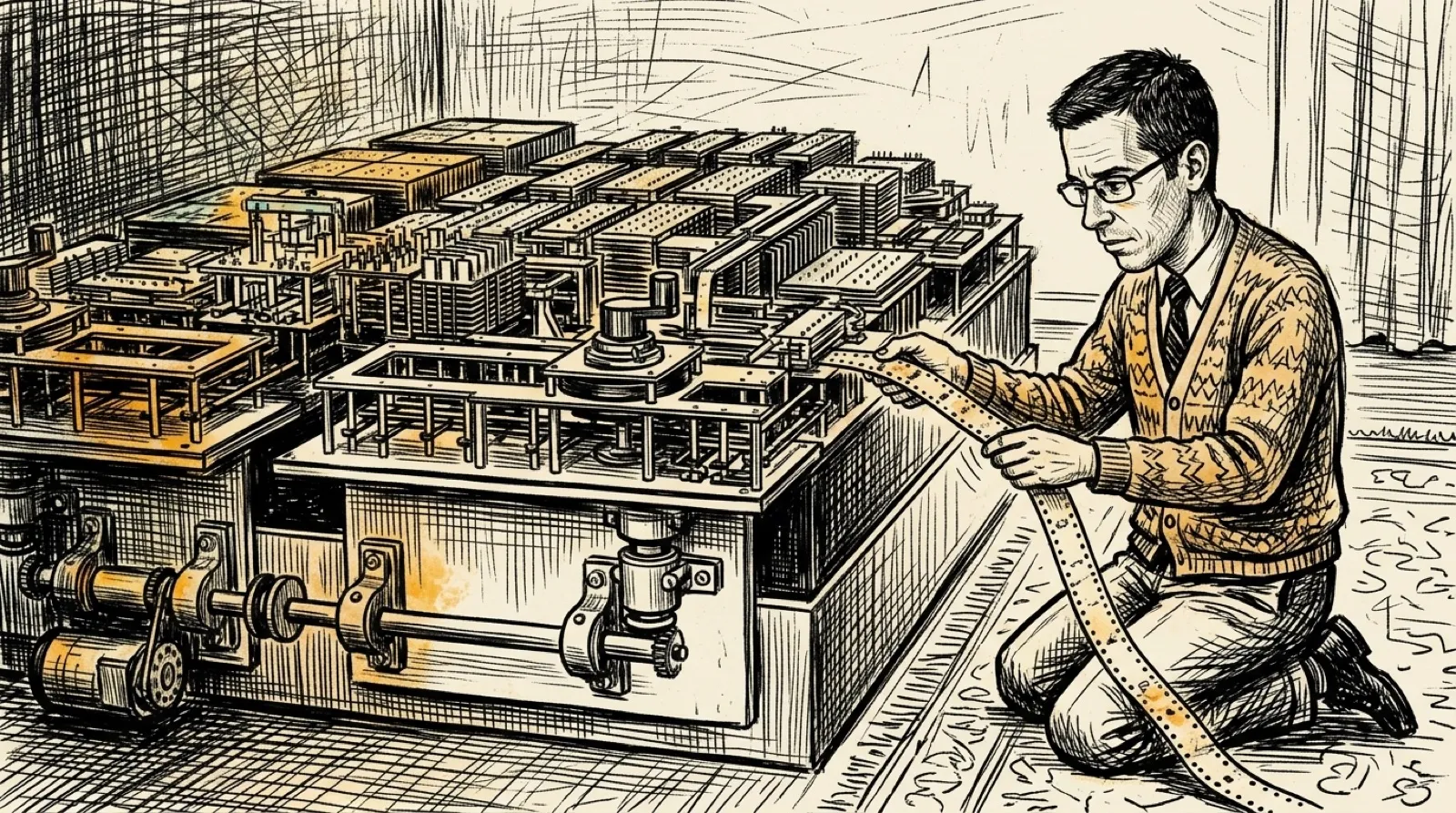
Used movie film can carry a very different kind of sequence when the next scene is an instruction. Konrad Zuse’s Z1 used holes punched into that material to hold its program. The film kept moving through a sequence, but the audience was a machine in a living room.
The Computer History Museum’s profile places the project after Zuse’s engineering studies and his work at Henschel Aircraft. He wanted relief from repetitive calculations. The response was a machine built during his spare time at his parents’ home, completed in 1938. The first requirement was practical enough: stop doing the same arithmetic by hand.
Punched film provides a concrete way to think about an instruction stream. The marks are physical, arranged in an order, and presented to a reading mechanism. Changing the sequence changes what the machine is asked to do. You can see the separation between a calculating mechanism and the stored directions that guide it without starting with an abstract block diagram.
Using existing film stock also makes the material choice memorable. A computer program did not need to begin life on a medium invented specifically for computing. The requirement was a carrier that could hold a pattern and move through the reader. Something previously used for images could become a supply of precisely placed holes.
The Z1 should stay distinct from Zuse’s later machines. The museum describes his subsequent Z3 as an electromechanical computer. Treating the whole series as one device loses the progression between designs and makes a neat historical anecdote less useful. Names that differ by one digit can conceal substantial changes in the machine underneath.
The profile follows that work through wartime losses and the later Z4. It also discusses Plankalkül, Zuse’s work on a programming language. Those are related achievements, but the film detail belongs to the Z1’s particular attempt to supply instructions. It does not establish that every later machine used the same materials or method.
For a modern reader, the familiar part is the effort to automate work that has become repetitive. The unfamiliar part is how many supporting pieces had to be made physical. Storing an instruction, advancing to another one, and keeping the reader aligned were machinery problems before they became things a programmer could take for granted.
There is a temptation to make every early computer the single first example of everything that followed. The museum account is more interesting when read as a series of engineering decisions under particular constraints. A living room, a calculation problem and a strip of reused film are specific enough to make this machine worth remembering on its own.
This reel had a calculating plot.