
Doug McIlroy Wanted Programs Chained Like Garden Hose in 1964. Unix Got the Pipe in 1973
Ritchie's own history leaves one detail open: whether McIlroy merely suggested the feature or pushed until it happened.
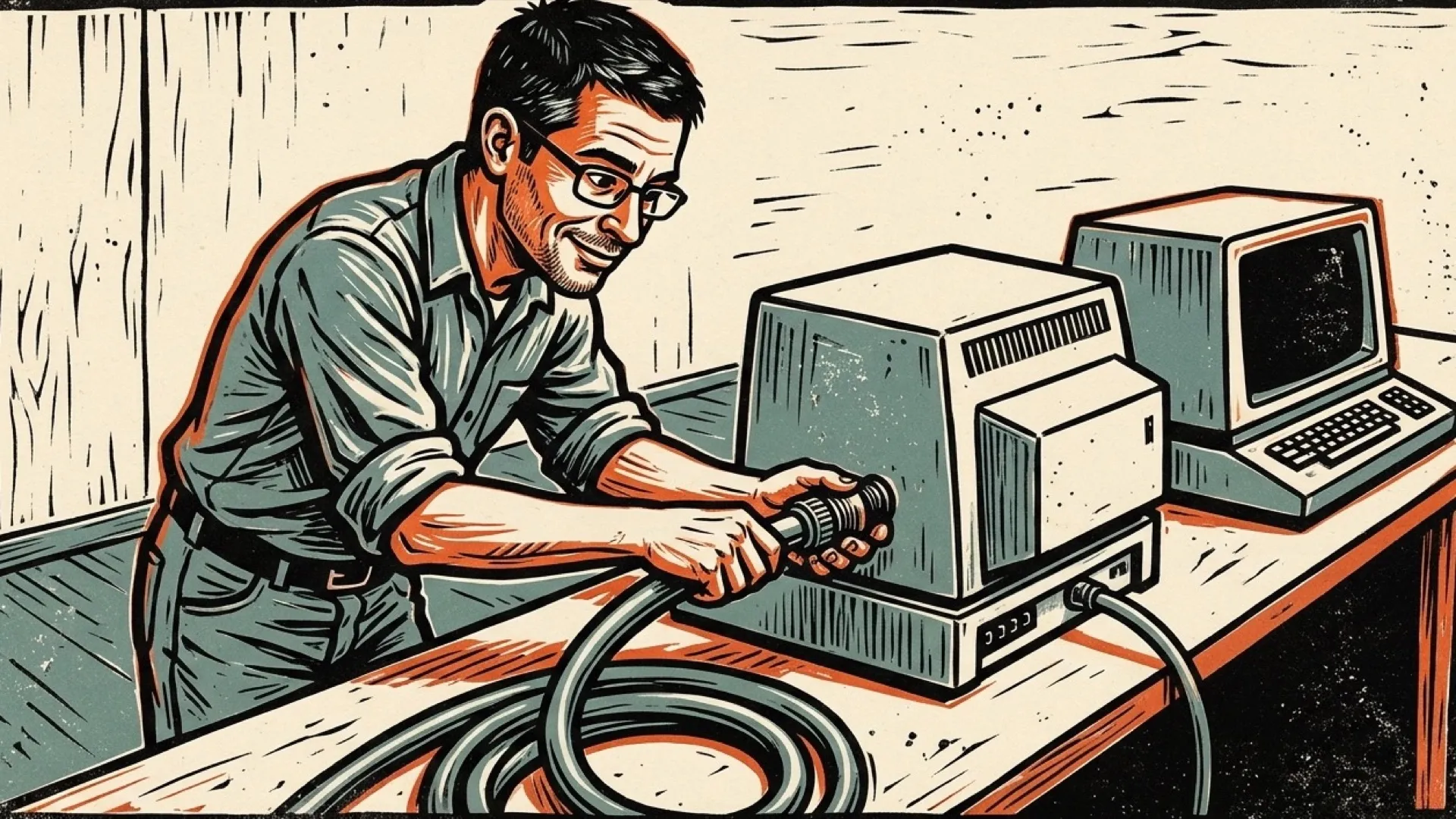
The | you type without thinking has a human behind it, and by Ritchie’s account that human was persistent. In his history of Unix, Ritchie dates the arrival of pipes to 1972-73 and credits Doug McIlroy’s suggestion, adding the hedge “or perhaps insistence.” Ritchie doesn’t say which it was. That one parenthetical is the closest the record gets to a fight over the feature.
McIlroy’s idea was older than Unix itself. A 1964 memo of his described connecting programs the way you connect lengths of garden hose, adding another segment whenever the data needs massaging a different way. From that memo to a working pipe is roughly nine years. Nine years is a long time to be a pipe dream.
To see what changed, look at what you did before pipes existed. To count logged-in users you ran who into a scratch file, ran wc -l on that file, then deleted it. Three commands, one temporary file, and a chance to forget the cleanup. With a pipe it is who | wc -l. The kernel hands the first process’s output straight to the second process’s input, and no file ever touches the disk.
That small change reshaped how people wrote software for the system. If chaining is nearly free, a program does not need to do everything. It can do one job and trust the next program in line. ps aux | grep nginx | wc -l is three tiny programs, none of which knows the others exist, answering a question none of them was written for. Every sysadmin has typed something like it this week.
The mechanism is also kinder than it looks. A pipe is a bounded buffer. On Linux the default capacity is 64 KiB. When a fast producer fills it, the writer simply blocks until the reader catches up. Nobody has to write flow-control code, and a gigabyte of log data can stream through a handful of programs without anyone holding it all in memory. The garden-hose picture holds up: pressure builds, and the water waits.
The idea outlived the system that introduced it. Today it works in every Unix-style shell, and Windows cmd.exe accepts the same character. The notation spread because it is easy to read left to right, the same direction the data flows.
A forecast, labeled as one: tools that chain small steps, whether build systems, log processors or automation runners, will keep converging on pipe-like designs. The reason is mechanical. Streaming with a bounded buffer gives backpressure and low memory use for free, and any design that skips it tends to reinvent it later. That is a prediction about engineering pressure, not a report of what any vendor plans.
Nine years, one memo, and one hedge in parentheses.