
Spacewar! used a real starfield and a surplus fighter joystick on the PDP-1
The Computer History Museum’s restoration account shows how an early two-player game doubled as an unusually persuasive computer demonstration.
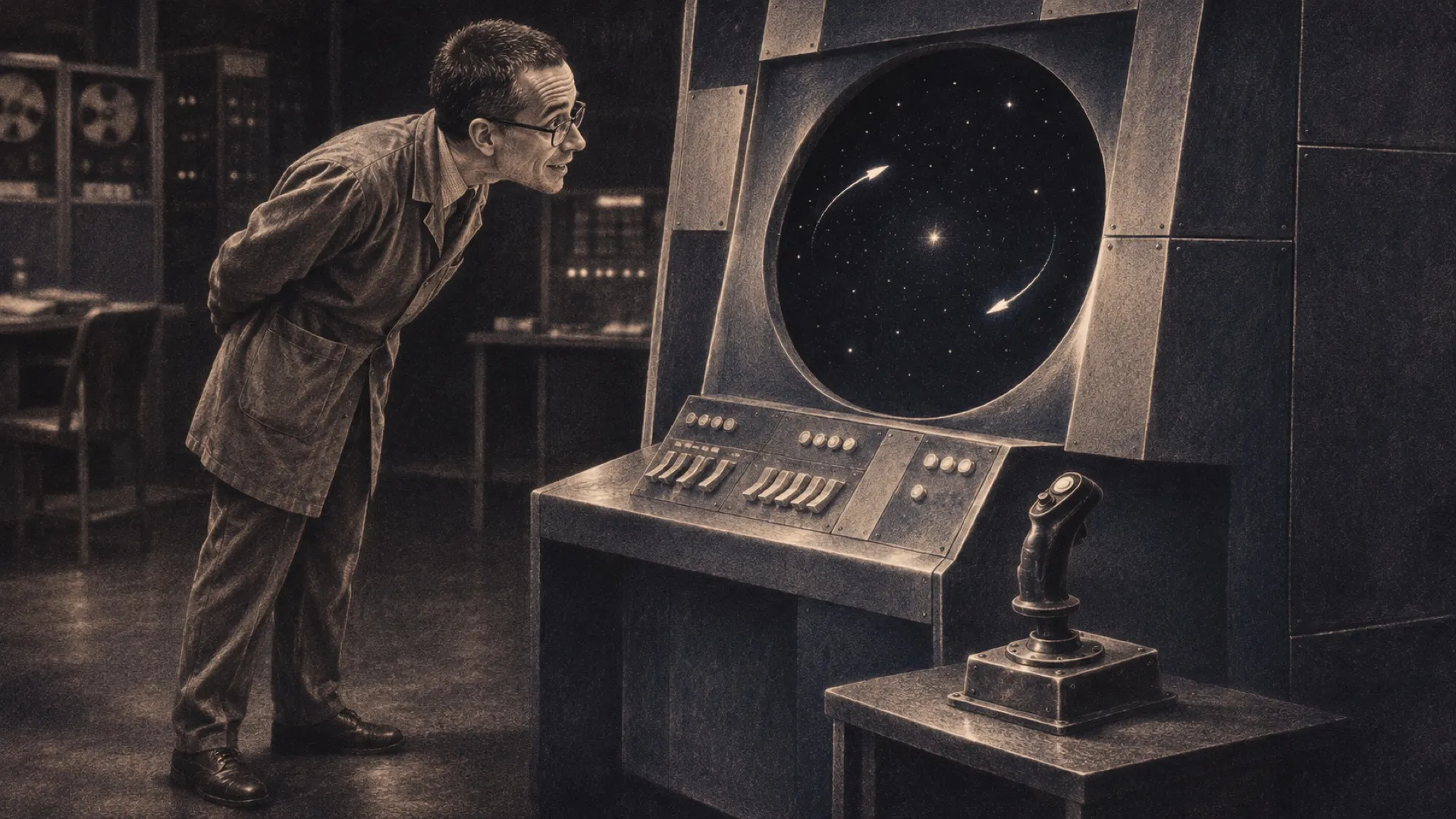
Spacewar! players fought over an astronomically correct starfield, and a surplus jet-fighter joystick eventually joined the controls. The scenery had done its homework. The controller had changed careers.
The Computer History Museum’s PDP-1 restoration account credits Steve Russell, Martin Graetz and Wayne Wiitanen with conceiving the game in 1961. Russell wrote the first version; Peter Samson, Dan Edwards and Graetz contributed improvements in spring 1962. The imposing Hingham Institute Space Warfare Study Group was actually Russell’s residence. The impressive institute name belonged to a home where the group could work on the project.
The two players each piloted a ship, trying to destroy the other while motion and gravity affected play. The museum describes the PDP-1’s easy input/output as enabling game controllers and, soon after the initial creation, that surplus joystick. The way a person touched the computer could change along with the software.
The game also served as a demonstration to prospective computer customers. The museum describes more than 100,000 calculations per second and more than 20,000 displayed points per second while it ran. Those are its historical workload figures, rather than results from a fresh benchmark or a claim about every possible version of the game.
A moving ship makes several capabilities visible together. The player gives an input, the computer updates the motion, and the display reveals the consequence quickly enough to invite another input. A sales chart can list those abilities in separate rows. A game makes a person discover how they fit together, occasionally by getting blown up.
That makes the joystick more than a decorative piece of aviation nostalgia. It sits at the point where a physical movement becomes a change in the simulation. A controller can be authentic and still be awkward for a particular game; the interesting question is what actions it allows players to perform comfortably.
There is also a useful distinction between recreating the appearance of an old program and preserving its interaction. A screenshot can keep the starfield while losing timing, feel and the relationship between a hand and the moving ship. A restoration has to decide which parts of that encounter it can actually recover.
A future exhibit could show the original controls beside a modern recreation and let people compare the experience. That would answer a more interesting question than which device owns the larger number on a spec sheet: what changed in the act of playing?
The museum account establishes the participants, the hardware connection and the calculation load. It does not settle every question about how any particular restored setup feels today. That part still needs the player, the controller and a running machine in the same place.
The joystick got a desk job.