
Floppy disk vs. microSD card: 2TB equals about 1.36 million standard HD floppy capacities
The capacity joke survives honest unit handling, but the modern card’s available space and host compatibility still need their fine print.
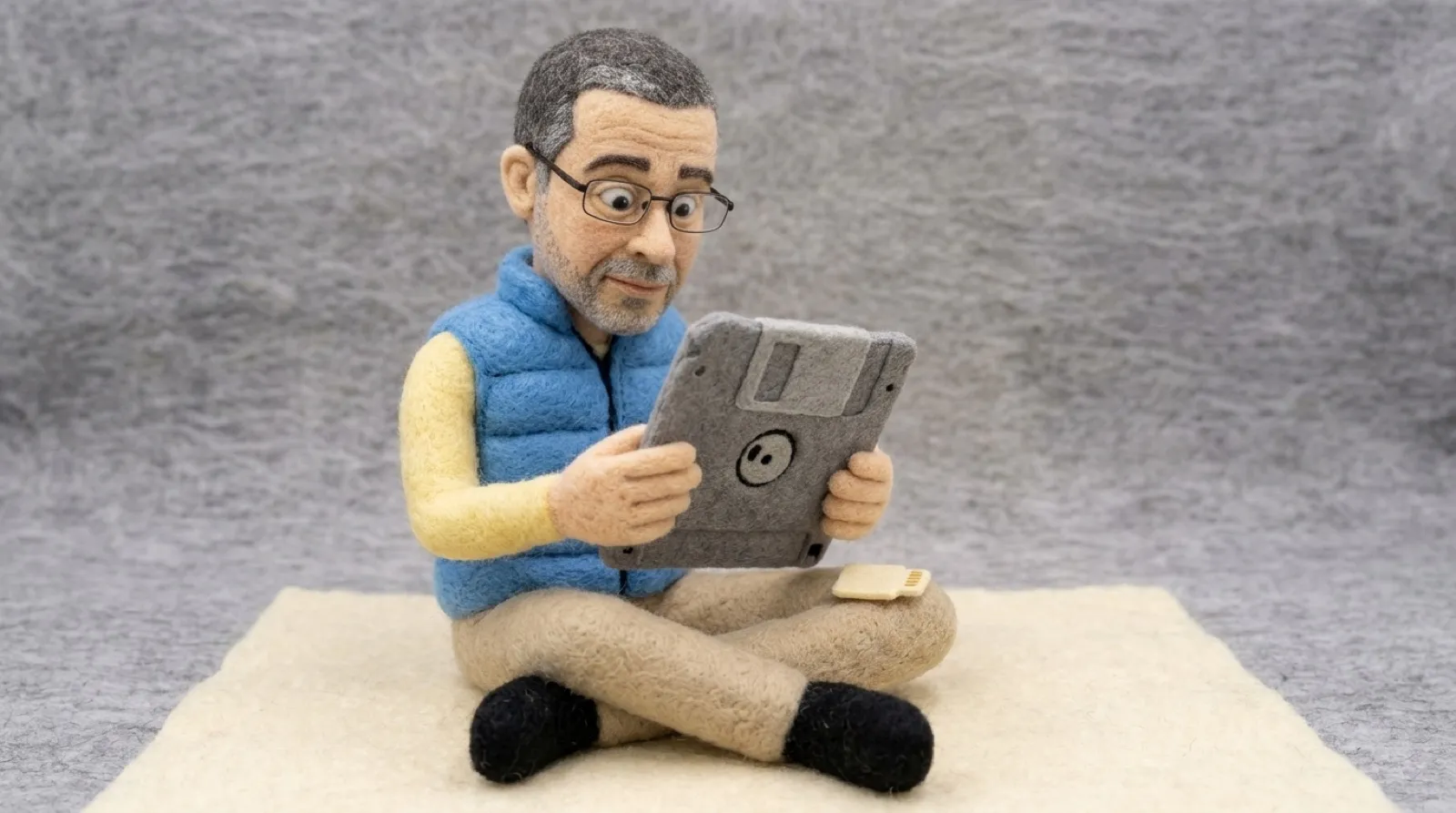
A tiny card can stand in for roughly 1.36 million standard high-density floppy capacities. The number sounds suspicious enough to deserve the long division, and the long division survives. The desk drawer is going to need a bigger desk.
SanDisk’s 2TB Extreme microSDXC sheet defines a terabyte as one trillion bytes and says actual user storage is lower. The floppy-disk record gives 1,474,560 formatted bytes for the familiar PC high-density format marketed as 1.44 MB.
| Decision row | Standard PC HD floppy | SanDisk Extreme microSDXC |
|---|---|---|
| Capacity used in the arithmetic | 1,474,560 formatted bytes (Wikipedia) | 2,000,000,000,000 nominal bytes (maker) |
| Capacity basis | Formatted disk | Advertised card capacity before user-storage overhead |
| Compatibility question | Matching floppy drive and format | Host support for microSDXC |
The calculation is 2,000,000,000,000 ÷ 1,474,560 ≈ 1,356,337. Rounding that to 1.36 million makes the joke repeatable without pretending the last digit is a useful promise. The denominator is a formatted floppy; the numerator is a nominal card. That mismatch stays visible rather than vanishing behind a neat headline.
Someone copying complete disk-image files would also need space for the files’ own format and the card filesystem. A count of capacity equivalents cannot promise that exactly this many real disk-image files will fit. The analogy fills the drawer on paper before the filesystem gets its own say.
The SanDisk Extreme 2TB microSDXC also has a much more immediate purchase question: does the intended host support microSDXC? SanDisk explicitly warns that not all devices do. Physical insertion and functional compatibility have been disappointing each other for decades.
The sheet’s performance numbers carry another boundary. Its advertised maximum rates depend on compatible hardware and conditions. They cannot be borrowed to promise a speed multiplier against every floppy drive, and this capacity comparison does not attempt one. Storage and transfer rate belong on different measuring tapes.
For someone recovering old disks, the modern card can be a destination after reading the originals, rather than a substitute for the equipment that reads them. A huge empty container does nothing for media that has not yet been successfully extracted. The drawer may shrink; the recovery work still needs its own tools.
The bigger shift is how little physical space a vast collection needs once its contents are readable files. That changes the convenience of carrying an archive without establishing that one card is a durable archive by itself. A duplicate stored elsewhere remains a separate decision from buying more capacity.
Future cards can make this ratio even more ridiculous, but the next useful improvement for an old collection may be a verified copy rather than another terabyte. The capacity is available; the unread floppy at the back of the drawer still has to give up its bytes.
Please insert disk 1,356,337.