
Retroibmibm-650computer-history
IBM's 650 kept its memory on a drum spinning 12,500 times a minute
IBM forecast 50 sales, rented the machine for under $4,000 a month and ended up installing nearly 2,000, a generation of students' first computer.
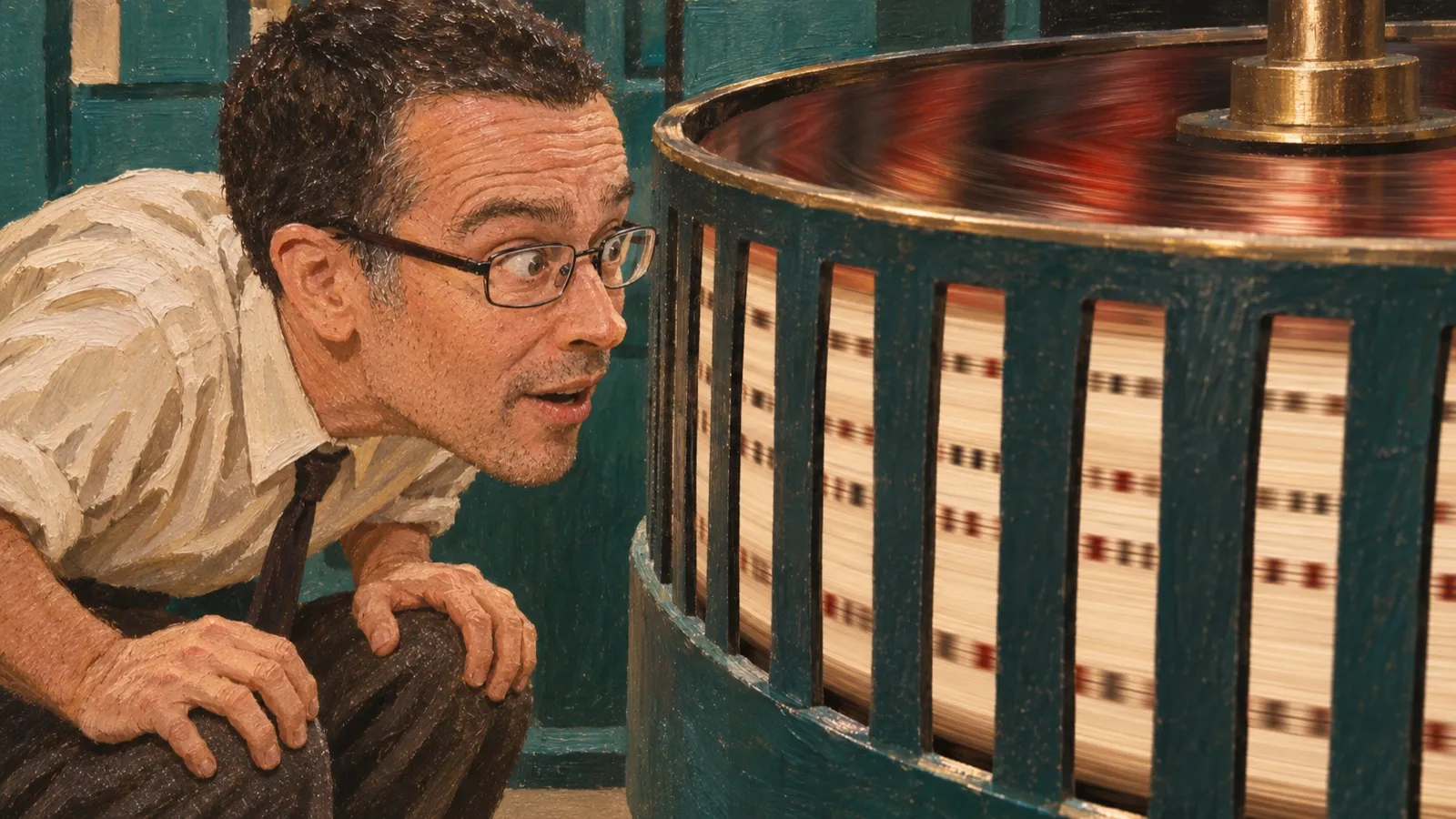
Picture your computer’s RAM as a drum going around 12,500 times a minute. That was the IBM 650. The Computer History Museum’s 1954 timeline says it plainly: “Spinning at 12,500 rpm, the 650’s magnetic data-storage drum allowed much faster access to stored information than other drum-based machines.” The Revolution exhibit says the machine’s “logic used vacuum tubes, its main memory a magnetic drum.”
That wording matters because the drum sat at the center of the machine, holding its main memory, with no disk drive hanging off the side. Do the math on 12,500 revolutions a minute and one turn takes 4.8 milliseconds. A mechanical rotation was part of every trip to memory, and the drum’s rate set the pace the machine lived by.
The calendar needs a careful read too. The museum files the 650 under 1954 as “IBM 650 magnetic drum calculator introduced.” IBM’s own archive page says the company “announced development of the IBM 650” on July 14, 1953, in Endicott, New York, and that John Hancock Mutual Life Insurance Company “took delivery of the first IBM 650 in December 1954.” Announcement in one year, first delivery in the next. Both are true, and they are different events.
What happened after delivery is the real surprise. The Revolution exhibit says “IBM’s original forecast for the 650 predicted selling 50 machines. But at less than $4,000 per month to rent, it became a winner. Nearly 2,000 were produced.” IBM’s page says it “eventually installed nearly 2,000 of the devices around the world,” with production stopping in 1962, and the museum’s timeline says IBM established the 650 as “its first mass-produced computer, with the company selling 450 in just one year.”
The storage was small by anything modern. IBM’s page says the drum was “capable of storing up to 20,000 digits in the first iteration, eventually increasing to as many as 40,000 digits.” That’s digits, not bytes, and nowhere near a photo from your phone. It’s still where a lot of people met a computer for the first time. The museum says the 650 “was also highly popular in universities, where a generation of students first learned programming.”
Donald Knuth, quoted on IBM’s page, put it this way: “Computing courses got started in universities largely because IBM donated about 100 ‘free’ computers.” The page excerpts the quote, so the rest of his sentence isn’t reproduced here.
What does the drum say about the future? Every era of computing has had its bottleneck, and the fix is almost always the same: move the data closer to the processor. The drum was the first version of that idea, and each later memory type made the wait shorter until a rotation stopped being part of the story at all. Today’s equivalent, a slow connection or a full cache, will look as quaint in fifty years as waiting on a spinning cylinder does now.
Nearly 2,000 of them, from a forecast of fifty.