
A moving van sent internet packets through Europe to prove three networks could talk
A rolling radio link made a fragile demonstration possible. Today’s roaming connections inherited the problem it confronted.
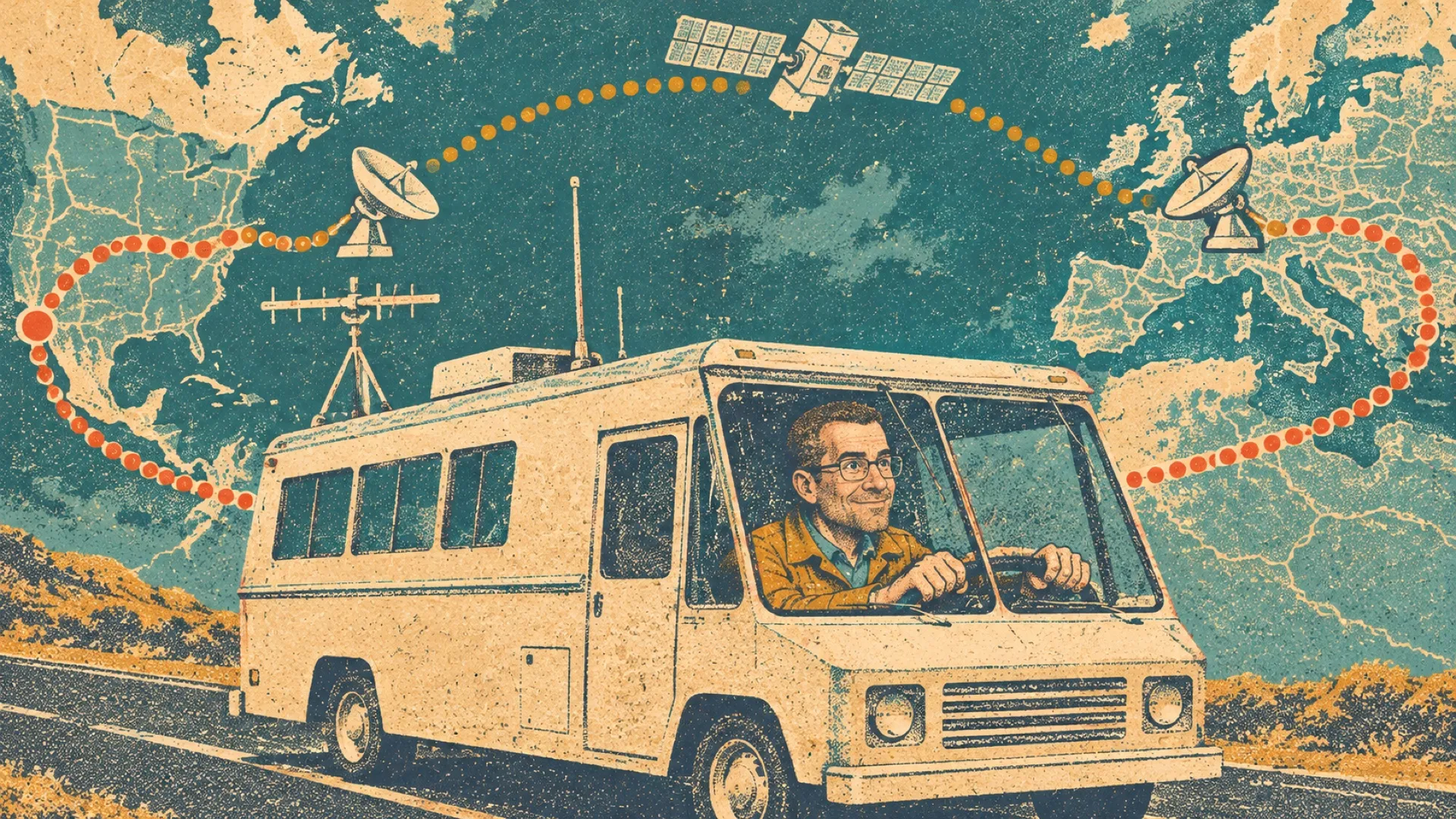
A van driving around the San Francisco Bay Area sent data to California by way of Europe. The scenic route was the point. On November 22, 1977, the demonstration joined packet radio, a satellite network and ARPANET to show that a common protocol could cross different kinds of networks. The internet had acquired a road test, complete with actual road.
The Computer History Museum’s history describes an unmarked silver step van with special radio equipment and an unusual antenna. SRI’s packet-radio team used it as a mobile network node. The larger problem was an agency running three incompatible networks that needed to communicate.
The article distinguishes that goal from connecting computers within one network. Internetworking meant bridging unlike networks without a new one-off arrangement for every pair. Two connected networks could still be a special case. Getting three to work together made a stronger case for a general method.
An earlier experiment had sent the packet-radio team’s weekly progress report through the van and ARPANET from a beer garden at Rossotti’s in 1976. Progress reporting apparently improved when it involved beer-garden seating. The later three-network demonstration required another year of preparation and participants across multiple countries.
Virginia Travers, then Strazisar, wrote early TCP gateway software at BBN and traveled to install it at the needed sites. Those gateways were the connection points between networks. The history makes that work visible, rather than reducing the entire event to a single miraculous packet and a famous name.
On the demonstration day, the museum says data flowed from the van to SRI and the University of Southern California via England, Boston and Sweden. The route crossed packet radio, satellite links and ARPANET while the van moved. Changing physical networks didn’t require the user to start a different kind of conversation at every boundary.
The museum calls it the “first major TCP internetwork demonstration.” The word demonstration matters as much as first. This was a milestone in a longer development, with earlier experiments behind it and years of deployment and competition still ahead. Giving the internet one birthday is convenient; the engineering refuses to fit tidily inside the cake.
The account says agency-wide installation came six years later, with the protocol then known as TCP/IP. It also describes the longer contest with competing networking standards. A successful test had established possibility, while adoption still required equipment, software, institutions and people willing to change what they ran.
For today’s operator, the story makes a familiar distinction tangible. A connection that works between two carefully prepared systems doesn’t yet establish that a design generalizes. The van’s oddly indirect route was a deliberate attempt to cross enough boundaries to make the result mean more.
The packet took the long way home.