
Alice hid its Mac game settings inside a Cheshire Cat
Steve Capps made preferences another discovery in an early Macintosh game, according to teammate Andy Hertzfeld.
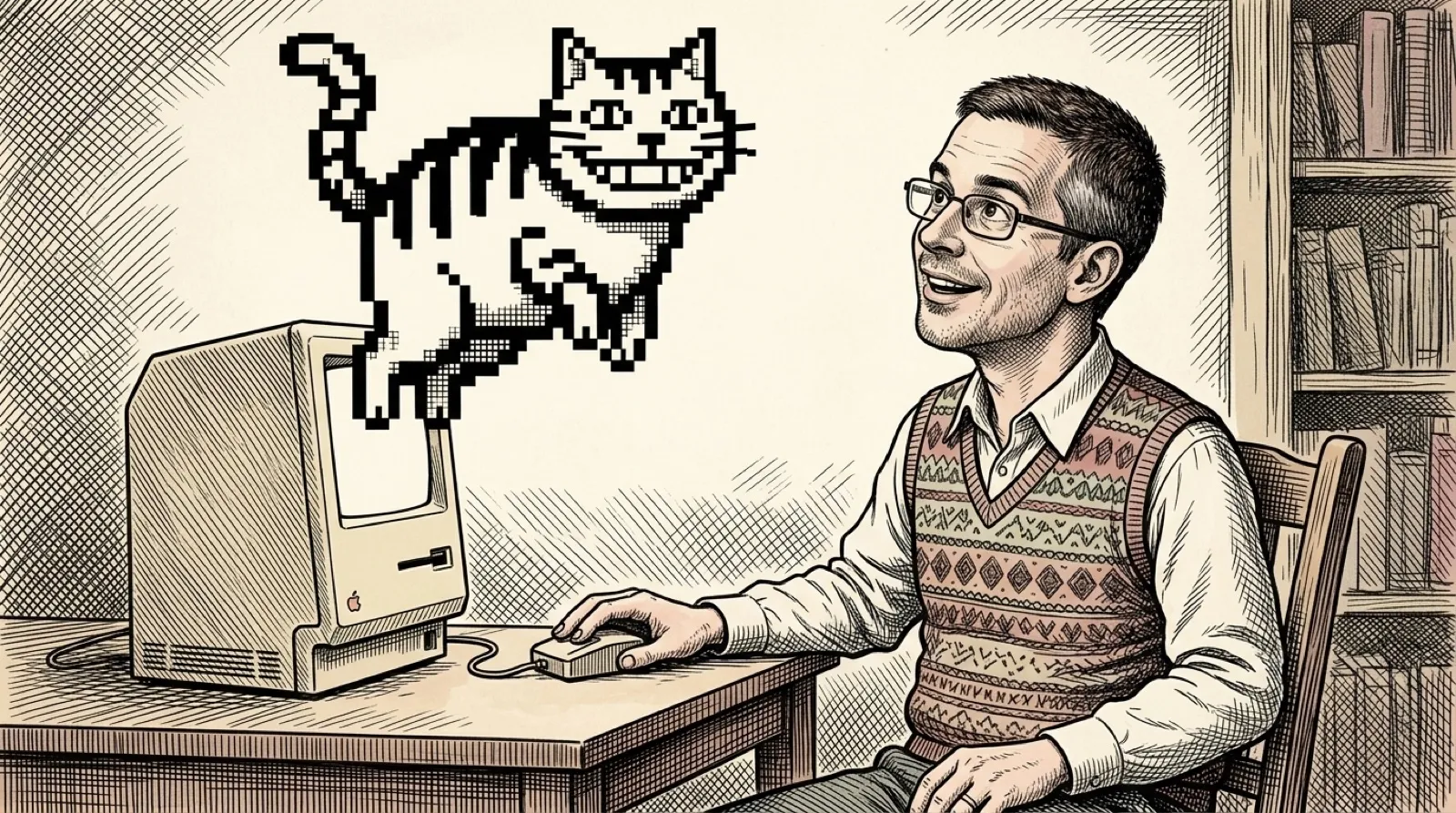
Alice made you find the cat before you could fiddle with the settings. The old joke about software hiding preferences was, in this case, an interface specification.
Andy Hertzfeld’s recollection credits Steve Capps with the early Mac game and its concealed controls. A click on the score summoned a detailed Cheshire Cat bitmap. Different parts of the cat changed different preferences. The surprise sat right inside the game, where a menu bar would otherwise have interrupted it.
The same account describes an optional variation that removed squares from the chessboard. Pieces unlucky enough to occupy those squares fell through. That’s a rather persuasive demonstration that a setting can change the rules underneath you. Usually software companies reserve that trick for the subscription page.
These details come from Hertzfeld’s firsthand memoir of the team and the game. They establish what he remembers Capps showing him, rather than a claim about every surviving disk or later edition carrying identical behavior. Anyone trying to reproduce the trick would need to identify the version being played.
The interaction works particularly well as a story because the hidden object belongs to Alice’s world. A cat appearing and disappearing needs little explanation in a game drawn from Lewis Carroll. A gear icon would have been obvious, sure, but it would also have been a gear icon.
The risk becomes clearer when you imagine using the same idea in a work application. A playful hidden visual effect is an invitation to explore. A hidden keyboard-accessibility switch would be something else entirely. The important design choice is which control you put behind the curiosity test, and who needs to reach it before they can use the application at all.
There is also a useful separation between changing a game’s difficulty and discovering that the difficulty can be changed. Someone who knows the cat is there gets to experiment. Someone who doesn’t may assume the current behavior is simply how Alice works. That difference deserves attention whenever an interface conceals a choice with real consequences.
Hertzfeld describes the preference hunt as “part of the game.” That is the detail worth carrying into a design discussion. Software can reward curiosity without making the entire product a scavenger hunt. The dividing line depends on whether the discovery adds delight or holds something necessary hostage.
A future game could make every optional control feel like a toy in its world, provided the player can still find a plain route to the things they need. Alice’s disappearing squares offer a useful warning about taking the metaphor too literally. Some settings really do remove the floor.
Mind the missing squares.