
Tools & Gearrobotsopen-sourceai
Hugging Face's $399 Microduck learned to walk, skate and stand itself back up in a simulator, and its code is on GitHub
Pollen Robotics, which Hugging Face owns, sells a 25 cm robot duck whose every move comes from reinforcement-learning policies trained in MuJoCo, and the Rust software that runs it is open under Apache 2.0.
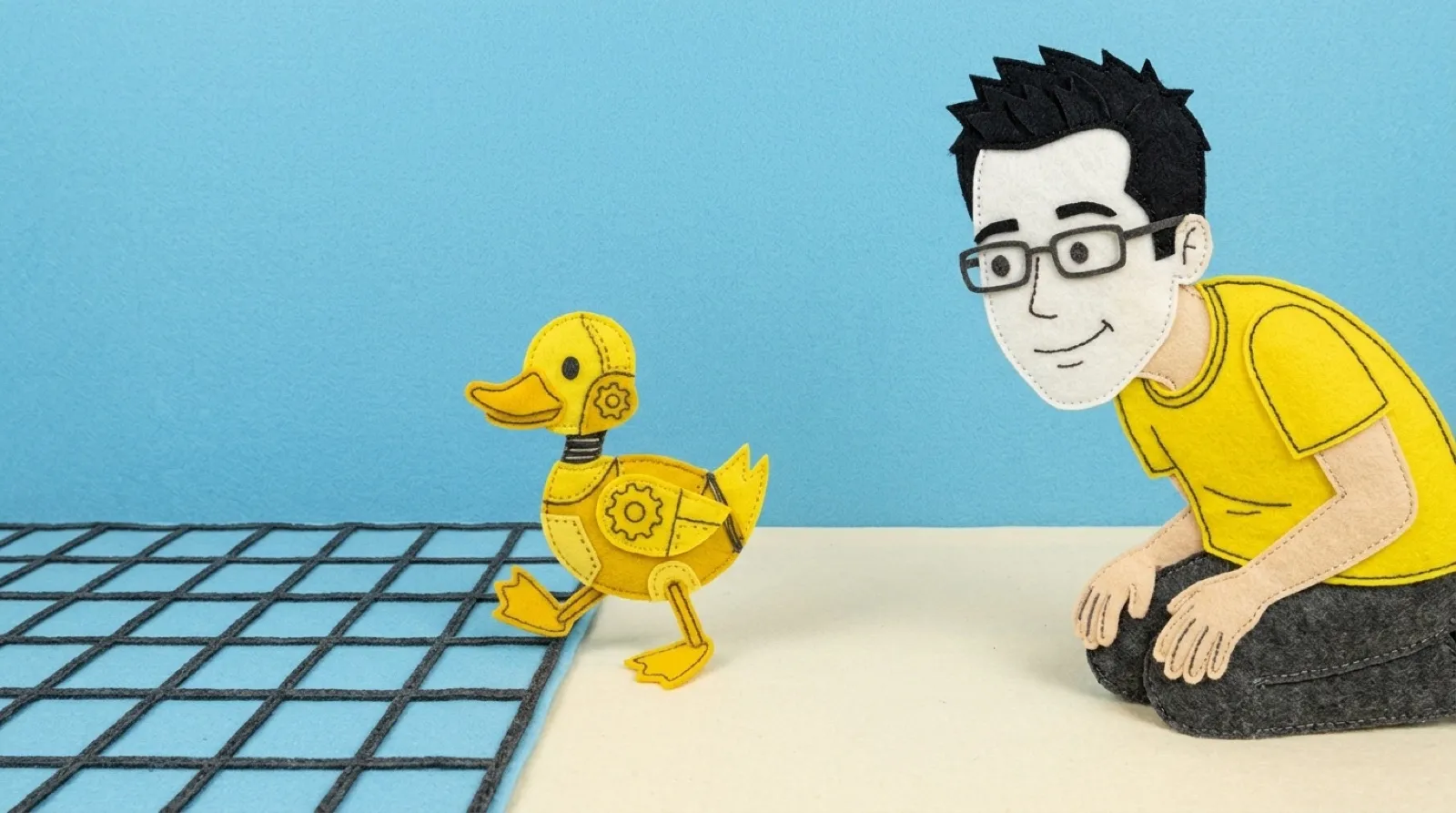
The duck’s own repo opens with “This repo is the duck’s brain.” That brain runs on a Rockchip RK3566 inside “about 25 cm and 800 g of robot,” with “a 50 Hz control loop driving fifteen servos from neural policies,” according to the Microduck README.
The feature list reads like a toddler’s report card. “It walks. Pick up a gamepad and drive.” Snap wheels on and “it loads the other brain,” a separate roller-skating policy. “Beak to the floor, one button” picks something up. And the one that sells it: “Knock it over and it stands itself up.”
None of those moves were animated by hand. The policies come from a second repo, microduck_rl, built on MuJoCo with PPO. Its README says training the walk takes “~1-2 h for a usable gait at 4096 envs” on your own GPU, and if you don’t have one, “Add --hf-jobs to any train command to run it on Hugging Face Jobs.” There’s a separate stand-up task for getting off the floor from “face-down/face-up/sitting.”
The simulator even fakes the duck’s flaws. Every main task has a backlash twin that trains on “±1° of gear play (2° total)” in each servo joint, so the policy learns on a slightly sloppy duck before it meets the real, slightly sloppy duck.
Pollen put it up for preorder on August 27, and The Standard reported it “recorded more than 10,000 sales since its launch last week,” with the company saying it “aims to reach 20,000 sales.” The open part has limits. The Next Web reported that Pollen “asks reporters not to describe the robot as open-source hardware,” and that its beak lifts roughly 100 grams, about a bar of soap.
What it does on its own is still an open question. “Adding purpose and autonomy to the robot is something we are still working on, and we expect the community to pick up and contribute,” Pollen’s Santiago Pavon said in The Next Web’s report. First deliveries are targeted before Christmas 2026, and the repo is already past 11,000 stars, weeks before most owners have a duck on the desk.
Play the video on YouTubeThousands of identical cheap bodies plus one shared training repo make a trick factory: every trick someone teaches one duck can run on all of them the same day. Expect a community library of policies (dances, fetch, football tactics) long before Pollen ships “autonomy” itself, and expect the best ones to show up first in the simulator, since that’s where the duck lives until December.
The bigger bet is that the sim-to-real recipe in microduck_rl, backlash modeling and all, becomes the template people copy for their own robots. That code is Apache 2.0 and sitting in public right now.
Whether the community turns 10,000 gamepad-driven ducks into 10,000 ducks that decide where to waddle is the part Pollen just handed over.