
A 1965 MIT editor collision put the password file in the login greeting
Tom Van Vleck’s security recollection connects a Friday afternoon disclosure to a later authentication scheme that accidentally depended on a compiler bug.
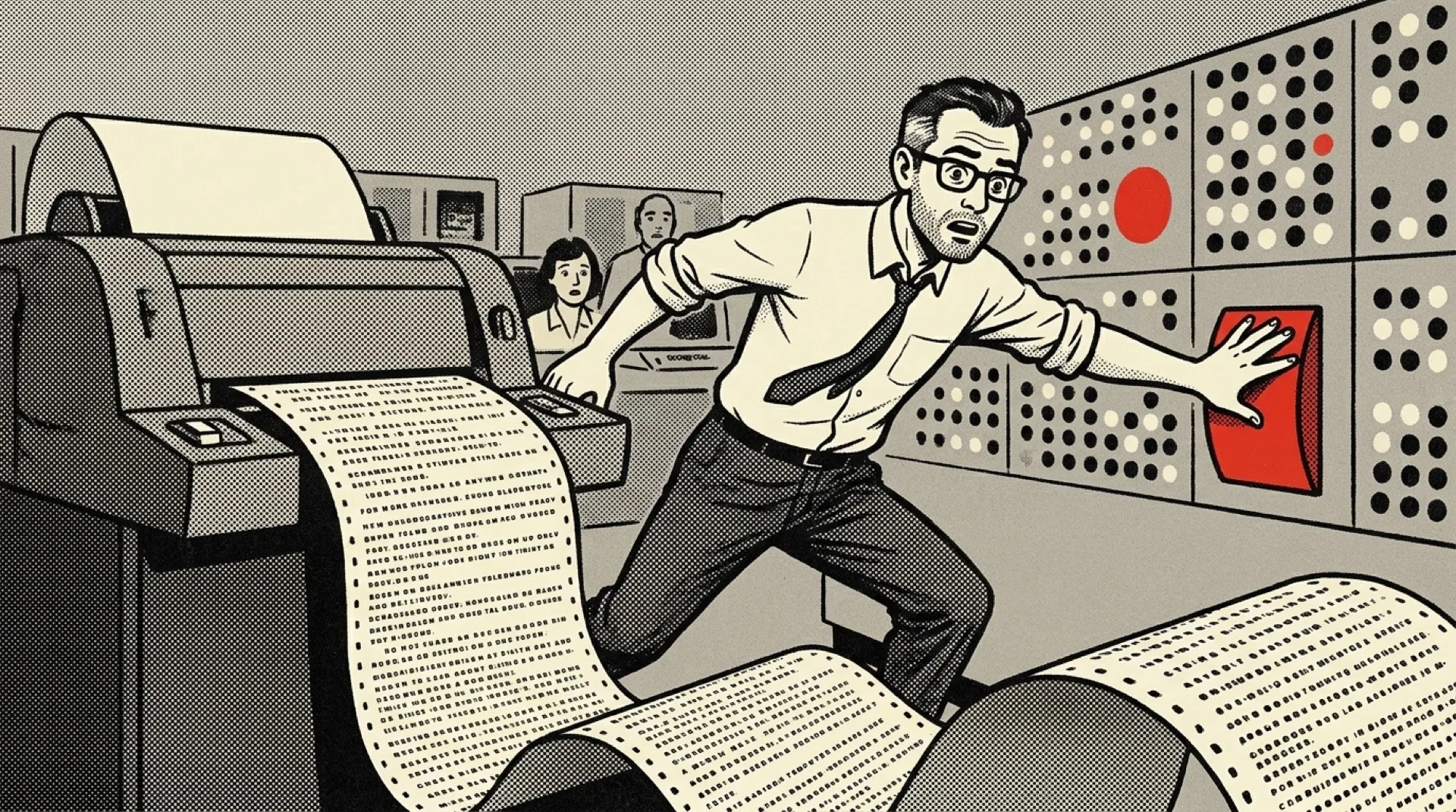
At 4 p.m. on a Friday in 1965, the CTSS login greeting began printing the system password file. A message of the day had become a password of the day, with rather more audience participation than anyone intended.
Tom Van Vleck’s Multics security account explains the mechanism: two users edited files in the same directory without realizing their editor used a constant name for intermediate files. Their work collided. Bill Mathews noticed the disclosure and used an XEC* instruction in the debugger to freeze the system.
A fixed filename sounds harmless until two people need it at once. It’s the temporary-file equivalent of leaving two people’s paperwork in the same unmarked tray. Each action may make sense alone; the combination puts the wrong contents in somebody else’s workflow. Here the wrong destination happened to greet every login.
Van Vleck tells the incident while explaining why he stored Multics passwords using a one-way transformation, on Joe Weizenbaum’s suggestion. That follow-up had its own unpleasant surprise. His scheme squared passwords and masked off some bits, while a PL/I compiler bug made long-integer squaring return incorrect results.
The account says investigators still reversed the transform, compensating for the bad arithmetic. Van Vleck calls it “Martian” arithmetic. The team changed to a stronger method before the compiler bug was repaired, because fixing it first would have prevented successful logins. Correct arithmetic would have broken authentication. There’s a support ticket nobody wants to explain twice.
The incident and the follow-up expose different ways ordinary tooling becomes part of a security guarantee. An editor’s scratch-file naming decides which file a person saves. A compiler’s arithmetic decides which stored value a password produces. Neither detail gets smaller merely because it lives below the screen the user normally sees.
A useful review would therefore follow the complete path from input to stored result. For a temporary file, that includes who else can use its name and what happens if work overlaps. For authentication, it includes whether an implementation change transforms an existing password differently from the version that stored it.
These are prospective checks drawn from the account, rather than a recommendation to reproduce either historical password scheme. The story is especially good at making a comfortable assumption uncomfortable: repairing a component can still change data that other components already rely on.
A future maintainer facing that problem would need to preserve a way for legitimate users to get back in while retiring the bad behavior. The order matters as much as the corrected formula. Van Vleck’s team had to change the password method before the compiler caught up, leaving a brief period when a bug fix was the thing to postpone.
Friday had disclosed enough.