
The original Mac shipped a hook for a little man who never fit
Andy Hertzfeld kept an escape route for Steve Jobs’s proposed menu visitor after the bitmap budget ran out.
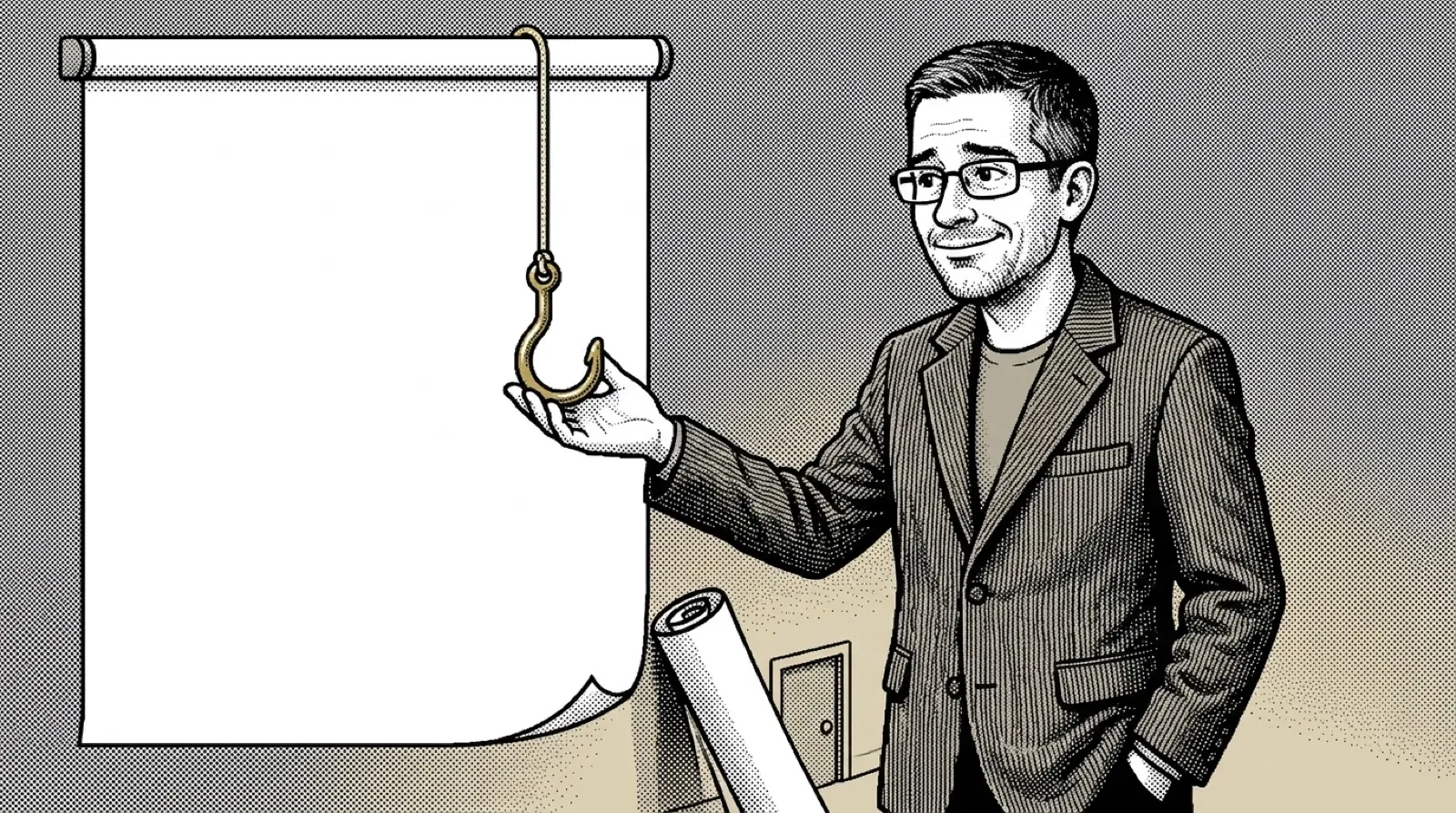
Steve Jobs wanted a mysterious little man to live inside the Macintosh. He would appear in a menu so rarely, and vanish so quickly, that an owner might wonder whether the sighting had happened at all. The computer already needed to fit an operating system into ROM; apparently it also needed to fit a tenant.
Andy Hertzfeld tells the story in “Mister Macintosh”, a first-person account dated February 1982. Jobs arrived excited about the idea, and Hertzfeld pressed him for details. The proposed visit would happen once in roughly a thousand or two menu pulls, with the character leaning against the menu’s wall before disappearing.
The joke depended on scarcity. A character appearing every time would become a normal interface feature. One appearing once, then refusing to return on demand, could feel like a tiny secret. That also explains why the planned experience needed more than a static icon placed beside the menu commands.
Jobs recruited the artist Folon to make renderings, and Hertzfeld asked Susan Kare to try animations before she had joined Apple. The drawings therefore had people and effort behind them. But most of the system software had to fit into a 64 KB ROM, and the space available for those bitmaps kept shrinking as the rest of the system grew.
Hertzfeld could not include the images. He kept a different piece: the menu-display code would inspect a low-memory location called MrMacHook for the address of a routine. If one was present, it could receive the information needed to draw in the menu box and report whether it had done anything. The vacancy had acquired a doorbell.
That callback left an application or system module a route to supply the missing character later. Hertzfeld even mentions the possibility of an “evil twin.” It is a small, wonderfully unnecessary invitation inside software being squeezed for space. The full cartoon lost its room, while the possibility of hosting it still made the cut.
The account gives a specific case for separating an optional flourish from the core mechanism that could support it. That should not become permission to install a hook everywhere just in case. Here the intended use existed, the menu path was known and the graphics were the part that could not fit. A real requirement had hit a real physical limit.
For someone preserving the original experience, the distinction prevents an easy historical mix-up. An implementation of Mr. Macintosh supplied later would demonstrate what the hook allows; it would not establish that every original machine secretly carried the complete artwork. The shipping callback and the abandoned bitmaps belong on different lines of the inventory.
The amusing unfinished part is exactly what Hertzfeld preserved. The engineer left a place for software to finish the joke, with no promise in this account that the expected visitor actually arrived. The menu can contain the invitation even while the room remains empty.
MrMacHook remained in the menu code.