
Palm Pilot vs. Apple Newton: $299 and Graffiti against $699 and handwriting
Jeff Hawkins had already sold Graffiti for Apple’s handheld. His oral history explains why predictable pen strokes mattered more than copying paper.
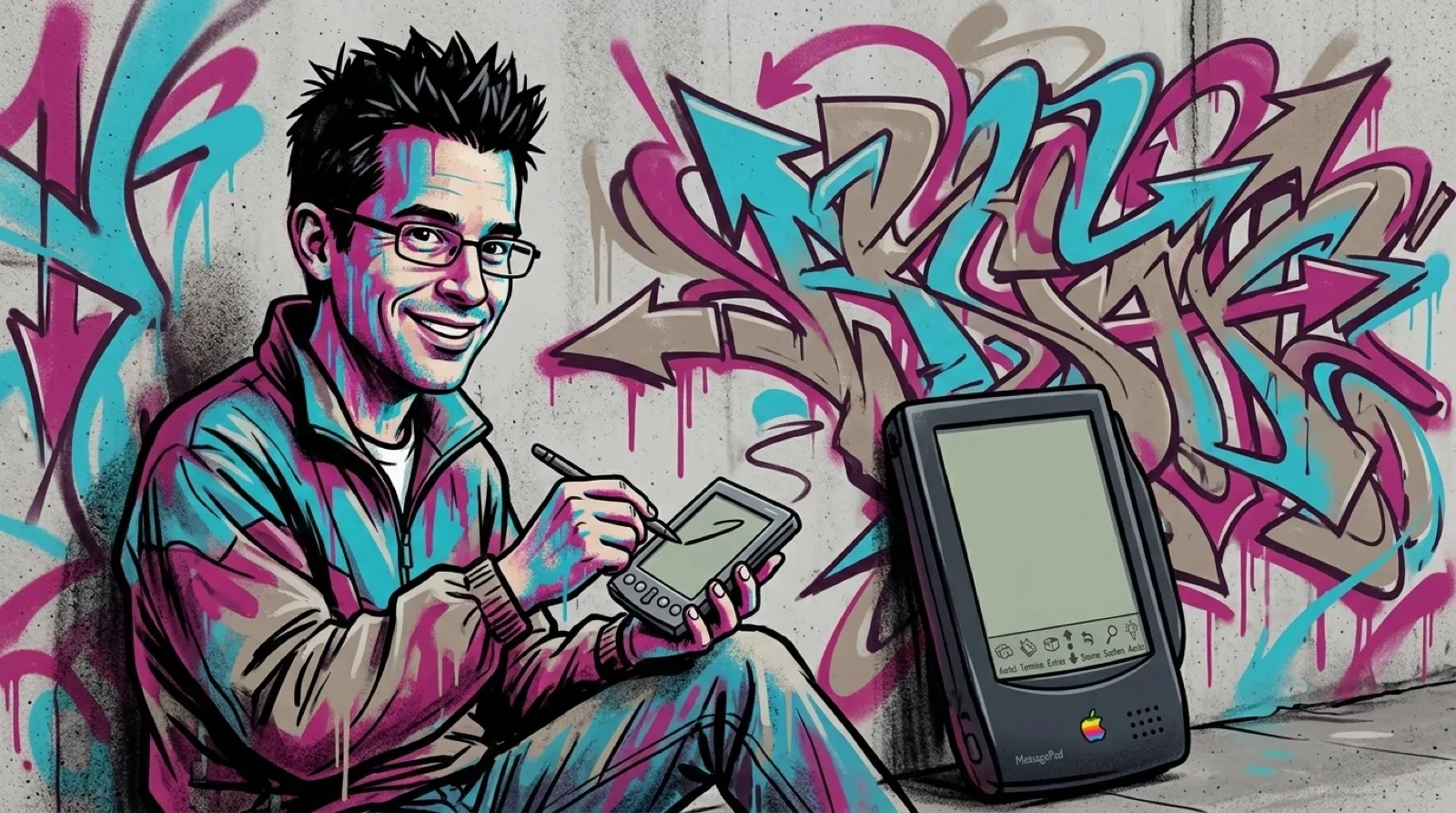
Jeff Hawkins sold a different way to write on a Newton before the PalmPilot offered it in a smaller package. In his 2007 Computer History Museum oral history, he explains that Palm first implemented Graffiti on the Zoomer, then on the Newton and General Magic devices. The two camps in this comparison already shared some software ancestry.
A pen computer can put the learning on either side of the stylus. The PalmPilot has a dedicated Graffiti input zone; The Centre for Computing History describes the original MessagePad’s “pen-based user interface with handwriting recognition” on a larger-resolution display.
| Launch models | PalmPilot Personal | Original MessagePad |
|---|---|---|
| Year | 1997 (Windows Magazine) | 1993 (Centre for Computing History) |
| Launch price | $299 (Windows Magazine) | $699 (Centre for Computing History) |
| Display | 160×160 (Windows Magazine) | 336×240 (Centre for Computing History) |
| Input | Graffiti zone (Windows Magazine) | Pen and handwriting recognition (Centre for Computing History) |
The 1997 Windows Magazine hands-on review supplies the Palm price directly: the Personal had 512KB of memory and cost $299. The Professional that reviewer Jim Forbes tested doubled that memory and cost $399. Keeping the model names attached avoids giving a buyer the cheaper unit’s price with the more expensive unit’s specifications.
The price gap is $400 in nominal launch dollars, across different years. Two $299 PalmPilot Personals total $598, leaving $101 against the earlier MessagePad’s $699. That is an amusing budget comparison, not an inflation-adjusted claim about value.
The Palm’s input area makes the compromise visible. The user has to meet the machine’s writing convention. The Newton’s promise puts more of the interpretation inside the computer. Those are different demands on the person trying to jot something down before forgetting it.
Hawkins describes the industry’s handwriting goal as “walk-up accuracy”: hand a stranger a pen and have the machine recognize their ordinary writing. Graffiti instead asked the owner to practice a defined alphabet. A keyboard also requires learned motions; its familiarity makes that bargain easier to forget when judging a stylus.
Palm simplified more than letter shapes. In Hawkins’s account, a left-to-right stroke meant a space, and an upstroke before a letter capitalized it. The system did not have to infer every word boundary or capitalization choice from a person’s freehand note. It gave those decisions their own gestures, rather like putting punctuation keys on a keyboard instead of asking the keyboard to guess your sentence.
That bargain came with an immediate cost. Forbes wrote that learning Graffiti was “easier said than done.” His review also described alternatives: saving unrecognized handwriting as Ink, or tapping an onscreen keyboard. A reliable recognition scheme still has to earn the minutes someone spends learning it.
The Newton’s original specification also exposes the ambition behind the price. The Centre for Computing History lists a 20MHz ARM 610, 4MB of ROM and 640K of SRAM, with calendar, address book, notes, fax and email features. A larger display gave that paperlike interface more room, but screen area alone could not settle how pleasantly it handled someone’s handwriting.
Future interfaces will keep making versions of this bargain. A system can accept a wider range of natural behavior, or ask people for a more constrained input that it can interpret reliably. The useful comparison is the time a person spends completing and correcting the task after the demo ends. A practiced user and a first-time visitor may reasonably reach different conclusions.
The question that survives both machines is how much a person will adapt when the device is useful enough to carry every day.