
Free Tool nospeaker Makes a MacBook Trackpad Talk Using Only Its Haptic Motor
Cody Collier's single-file Swift program needs a Force Touch trackpad, and it relies on undocumented macOS functions that an update could break.
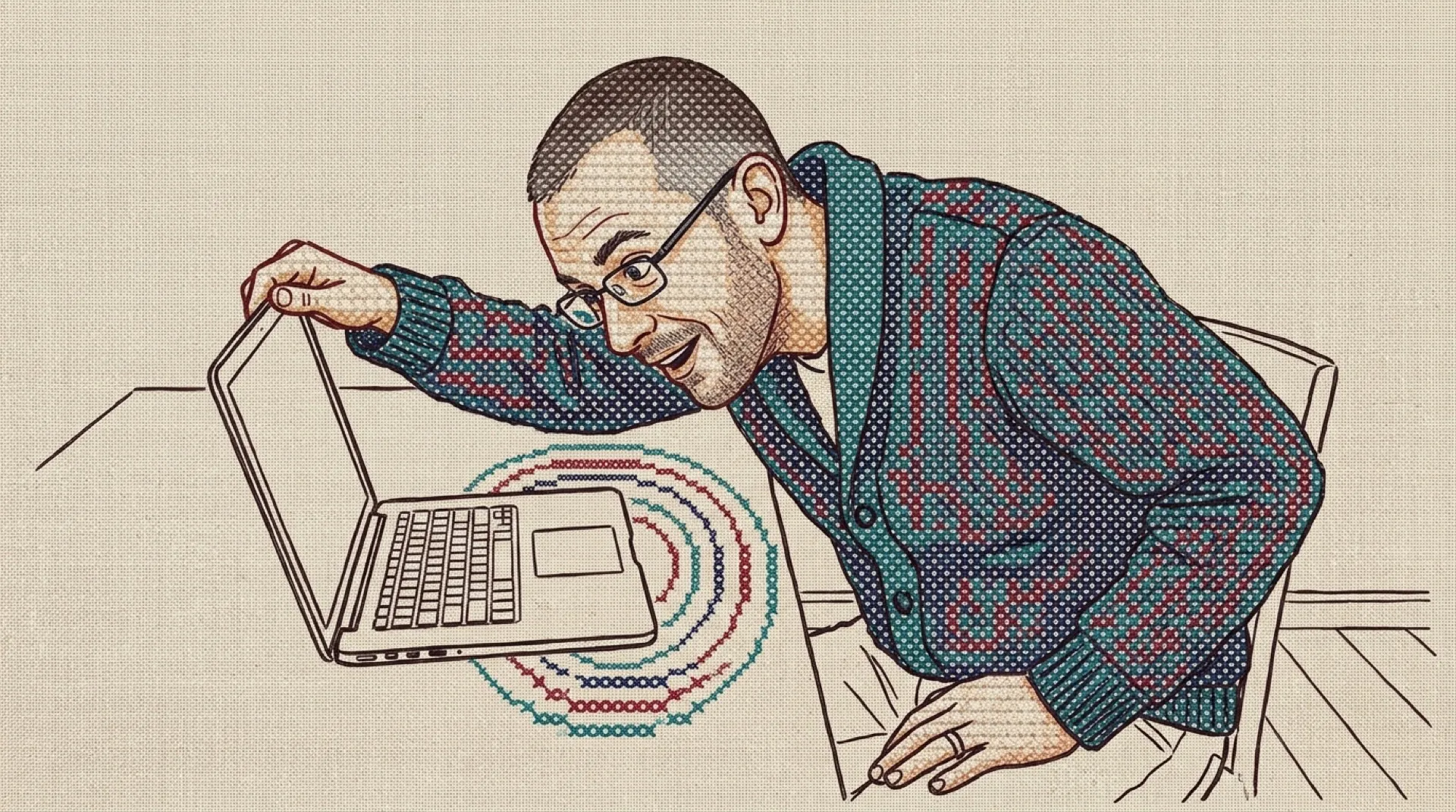
Mute the MacBook, set it on a table (on your lap it gets much quieter), and paste one line into Terminal. Then keep your hands off the glass until the trackpad asks you to touch it. Somewhere in there, the trackpad starts talking.
Cody Collier built it, and the README opens with the whole pitch: “Mute your Mac. Your trackpad will still talk.” The tool is free under the MIT license, it is one Swift file with no dependencies, and the show runs about a minute and a half. “No speakers used,” the README says, which is quite a flex for a laptop that has a perfectly good set of them.
The mechanism fits in a sentence. “There’s no speaker in a MacBook trackpad, just a small haptic motor that taps the glass so you feel a click,” Collier writes. nospeaker drives that motor up to 4,000 times a second, fast enough that the glass vibrates into sound you can hear. The result talks, sings, raps, and becomes an instrument under your finger.
Turning a click motor into a voice box takes some work. A macOS voice speaks the line into memory first. Every 10 milliseconds, linear prediction pulls out the voice’s two strongest resonances (called formants) along with its loudness and pitch. The motor then plays those two resonances as tones, restarted on every beat of the pitch, so they buzz like a voice instead of whistling like a kettle. Hiss sounds such as s, f and t become quick bursts of high tones.
Two tones, not three, was a deliberate call. In a blind test the pair came out clearer and louder, because the motor’s strength gets split fewer ways. (Fewer cooks, louder broth.)
Collier measured the range with the MacBook’s own microphone, every semitone from 98 Hz to 3,951 Hz. The trackpad is loud from about 100 Hz to 4 kHz, with a few dead spots where the glass resonates, and its loudest, cleanest notes sit around 1 kHz, which covers the most important part of a voice.
Volume is the catch. “It’s quiet because the motor is built for short taps, not for sound,” the README says. It also sounds robotic, and the README admits it’s “much easier to follow when you can read along,” which is why the show types every line on screen as it speaks. Space skips a part; q or Ctrl-C jumps to the end.
There are three ways in. The one-liner is curl -fsSL a90.com/nospeaker | sh, which downloads the latest release to ~/.local/bin/nospeaker and starts the show. That address points to play.sh in the repo, so you can read what it runs first. You can also grab nospeaker.zip from the latest release (signed with a Developer ID and notarized by Apple), or build from source with Xcode or the Command Line Tools using ./build.sh, which makes one program for Apple Silicon and Intel Macs.
After that it takes arguments. ./nospeaker "hello there" says anything you type, --voice Daniel switches to another macOS voice, --sweep plays a rising tone from 100 Hz to 4 kHz, and --dark or --plain change the visuals.
You need a Force Touch trackpad, which means a MacBook from 2015 on or a Magic Trackpad 2 or newer, plus macOS 12 or later on Apple Silicon or macOS 13 or later on Intel. Without one, the tool says so and exits. Collier built and tuned it on a MacBook Pro (Mac17,10) with an M5 Max running macOS 27.2.1, and asks anyone who tries another Mac to open an issue with the model, the macOS version and how it sounded. Loudness differs between trackpads, so those reports matter.
The dry part is the catch. Apple’s public haptics API only offers three fixed taps, so nospeaker goes around it to MultitouchSupport, the private framework macOS uses for the trackpad. Its function MTActuationCreateFromDictionary takes a list of sine tones, each with a frequency, a strength and a length, and MTActuationActuate plays them on the motor. Collier learned the function names from the open-source Tactile project. He also keeps the motor at its normal maximum strength: going past it is louder, but the driver starts to stall. And because MultitouchSupport is private and undocumented, the README warns that a macOS update could break all of this.
Apple’s public haptics API stops at three taps, and that gap is where a project like this lives. Anyone who wants the trackpad to do more has to reach into the private functions, so expect more tinkerers to poke at the same motor now that a working example sits in one Swift file with a permissive license.
The flip side is the release calendar. A tool built on private functions is tied to every macOS update, and if the calls move, the trackpad goes quiet with no warning. The README says as much up front. The likely outcomes are a patch that tracks each macOS release or a museum piece that only works on the version it was built on.
The issue tracker may end up as the real spec sheet. Collier tuned the sound on one MacBook Pro and notes that loudness differs between trackpads, so Intel Macs, Magic Trackpads and older macOS versions are waiting on their first reports from strangers with different hardware.
A part hired to fake a click now moonlights as a voice box, and it works. Talk about a touchy subject.