
Retrotech-historywebcamcambridgeweb-history
The Trojan Room Coffee Pot: The First Famous Webcam Existed So Cambridge Scientists Wouldn't Climb Stairs for an Empty Pot
In 1991 researchers at Cambridge's Computer Lab aimed a camera at their shared coffee machine so they could check it from their desks; in 1993 it went on the web, and in 2001 Spiegel Online paid £3,350 for the pot.
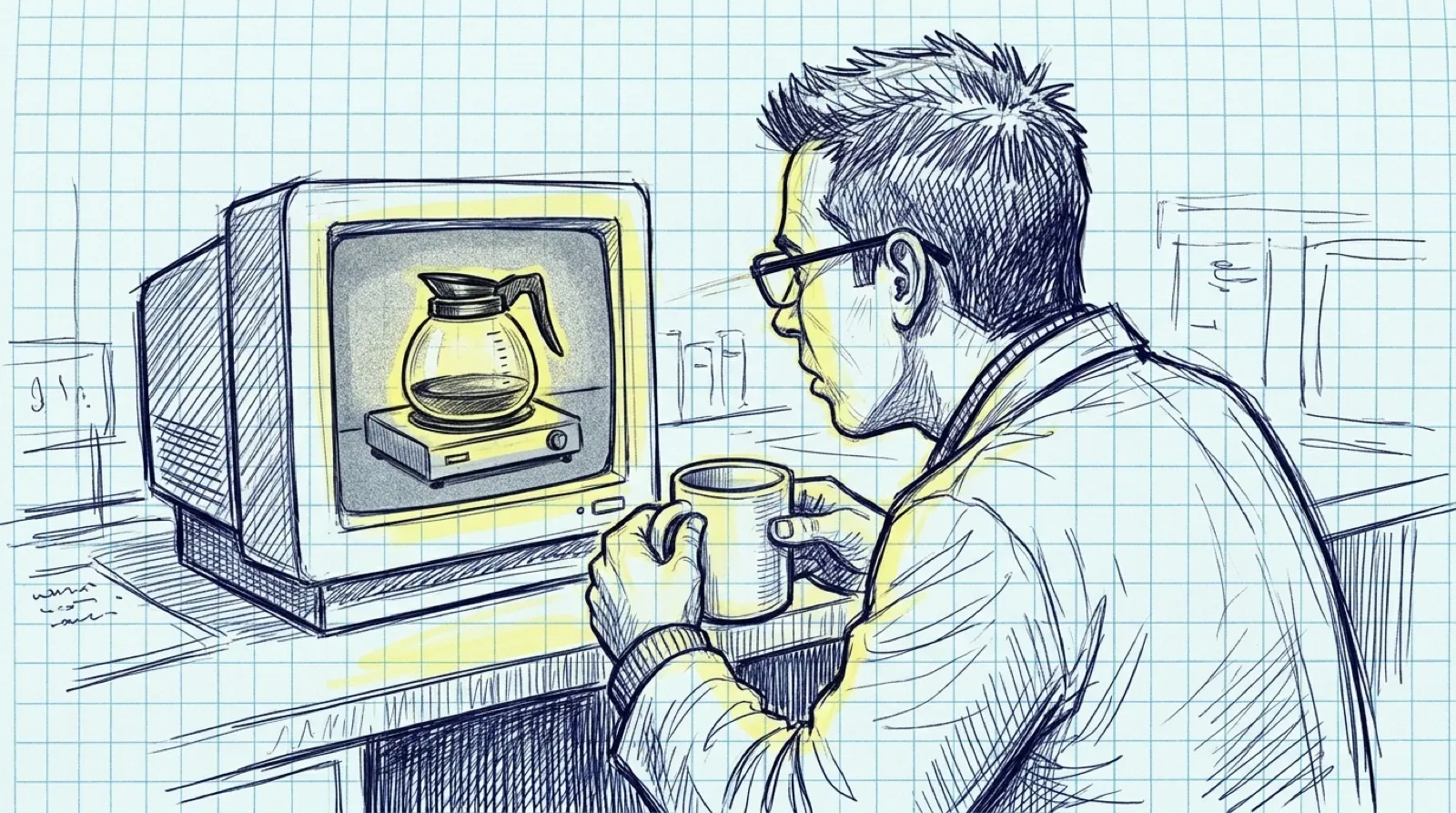
The problem was a flight of stairs. Stafford-Fraser’s group shared “one coffee filter machine between us, which lived in the corridor just outside the Trojan Room.” Some members of the coffee club worked floors away, and the walk “often proved fruitless if the all-night hackers of the Trojan Room had got there first.”
His fix was engineering, applied with a straight face. “This disruption to the progress of Computer Science research obviously caused us some distress,” he wrote, so the group built XCoffee. One of the lab’s test machines had a video frame grabber that nobody was using. A camera went on a retort stand, its cable ran under the floor to the Trojan Room, Paul Jardetzky wrote a server to capture frames, and Stafford-Fraser wrote the client: a small window on your screen showing a greyscale picture of the pot. It refreshed about three times a minute, which is plenty for coffee.
Then the frame grabber died, and the pot went dark for a while. Daniel Gordon and Martyn Johnson brought it back with a new grabber and, according to the lab’s timeline, Gordon wired it to answer web requests in November 1993. Their own page for it describes an Acorn Archimedes grabbing a frame every second and JPEG-encoding it, and a small lamp left “pointing at the coffee pot so you can see it at night.” It also warned visitors that, apart from the airfare, “you need to be a member of the coffee club before partaking.”
By Stafford-Fraser’s count, “hundreds of thousands of people have looked at the coffee pot.” The timeline logs the switch-off to the minute: 10 on 22 August 2001. That month the pot went to auction, and The Register reported that Spiegel Online, the website of the German news magazine, won it for £3,350. One catch: “The pot sold wasn’t even the original one, but it was the longest serving, having lasted 42 months in the job.” What happened to the 1991 pot, the one that started it, none of the accounts say.
The pattern repeats every decade: the most-copied idea in a lab is the one somebody built to dodge a chore. A shared resource plus a camera plus a lazy engineer is still how a lot of internal tools get started, from Slack bots that report whether the office kitchen has food to dashboards that show which test rig is free.
It also lasted ten years, longer than most products with an actual budget. Somewhere there’s an office camera running right now that started as a joke, and the people relying on it have no idea who set it up or what happens when its spare parts give out.