
AIanymovemotion-captureanimationopen-sourceblendergame-dev
anymove, an open-source mocap tool, animates a rigged 3D creature from one AI video that films it from two angles in one frame
Patch's Apache-licensed anymove has an AI video model film a creature from the front and side at once, reads every joint in both views and exports the fitted animation as a GLB, at about $0.26 a clip.
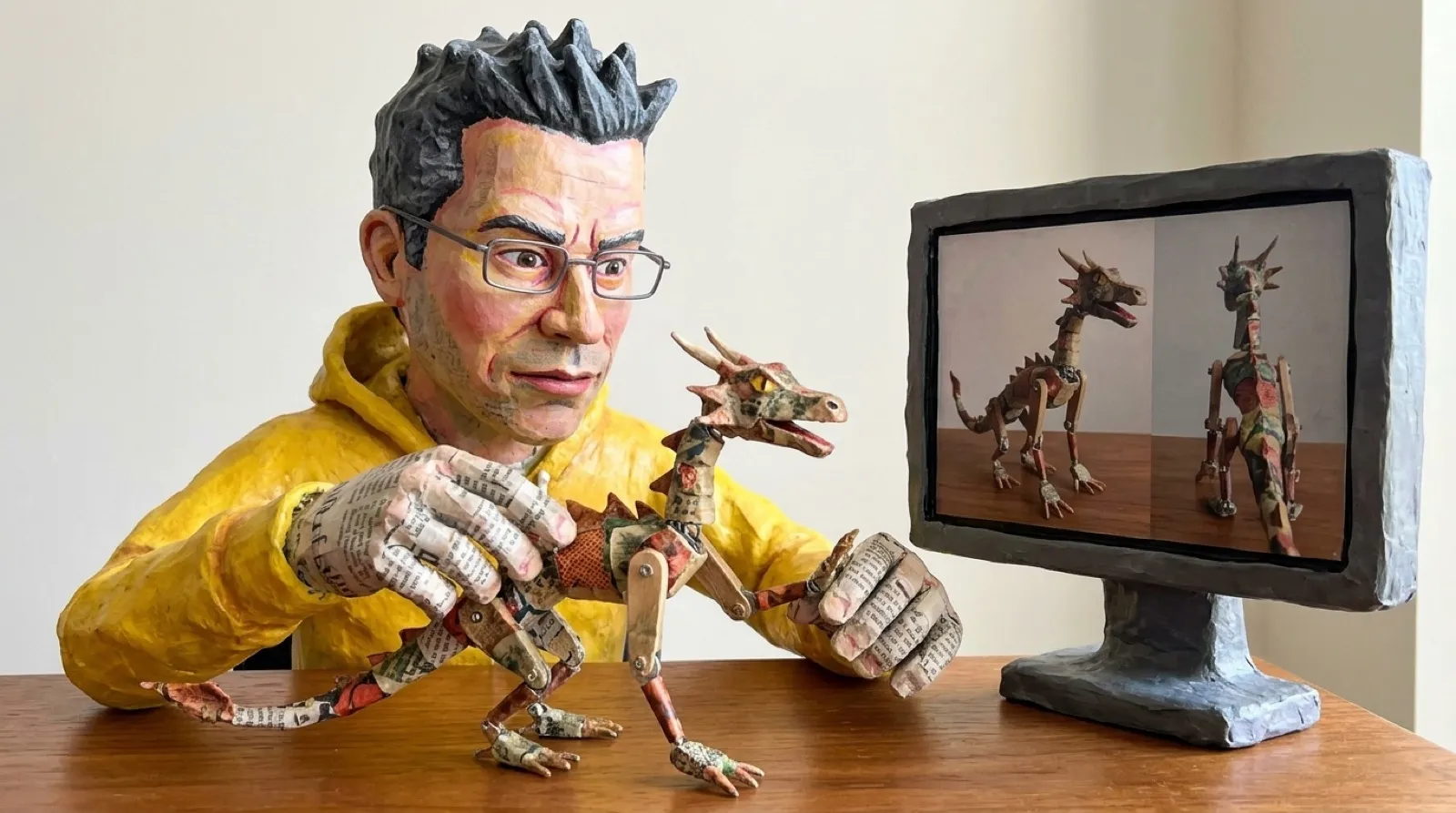
Motion capture for a person is a solved, expensive problem. You rent a suit and a stage. Motion capture for a dragon has always meant an animator keyframing it by hand, because nobody has a dragon to put in the suit.
anymove’s answer is to ask a video model for the footage. Patch’s README describes the setup plainly: “A video model films the creature from two cameras in one frame, front on the left and side on the right.” A joint reader trained on that one creature finds every joint in both halves. “A joint sits at the same height in both, so the pair pins it in 3D, and the rig is fitted to those joints frame by frame and exported as a GLB.”
That’s the whole idea, and it’s geometry anybody can picture. The repo puts it as standing the two views up “as walls at a right angle”: the front view gives you side to side, the side view gives you nose to tail, and both give you height.
You don’t get to skip the rig, though. The pipeline starts with a textured 3D model, and step two is a skeleton “placed on grid views, skinned in Blender.” The README’s limits section is blunt about it: “Skeletons are placed by hand.” Then you train a reader for that creature on 2,200 random poses, which Patch clocks at “about 25 min” to render and 17 to 20 minutes to train on one RTX 4090.
After that, each new move is cheap. A five-second two-camera clip from MiniMax H3 Max on fal runs “about $0.26,” and reading and fitting a clip takes “10 s / under a minute.” Out the other end comes a GLB at 24fps with “no hand edits.”
Credit where Patch gives it: “The method is @CanItCode’s,” from CanItCode’s video, and the MiniMax LoRA step was another creator’s idea. The repo, posted October 27, is Patch’s working version with Claude Code agent skills that walk you through each stage.
“Free” needs an asterisk. The code is Apache-2.0, but the clips and meshes come from paid hosted models, training a reader wants an NVIDIA card with 24GB, and Patch warns that MiniMax H3’s weights “carry a community licence” you should check “before shipping what you make with them.” A new move still costs less than lunch.
What nobody has shown yet is a long walk cycle. Every table row is a big single gesture (a roar, a pounce, a takeoff), and that’s exactly what the README says works best.
Dragons, finally, on a budget.