
Game Boy Advance vs. Game Boy Advance SP: screen lighting costs the built-in headphone jack
The folding model fixes after-dark play and changes the charging routine. A used unit’s exact display revision and included accessories still decide the deal.
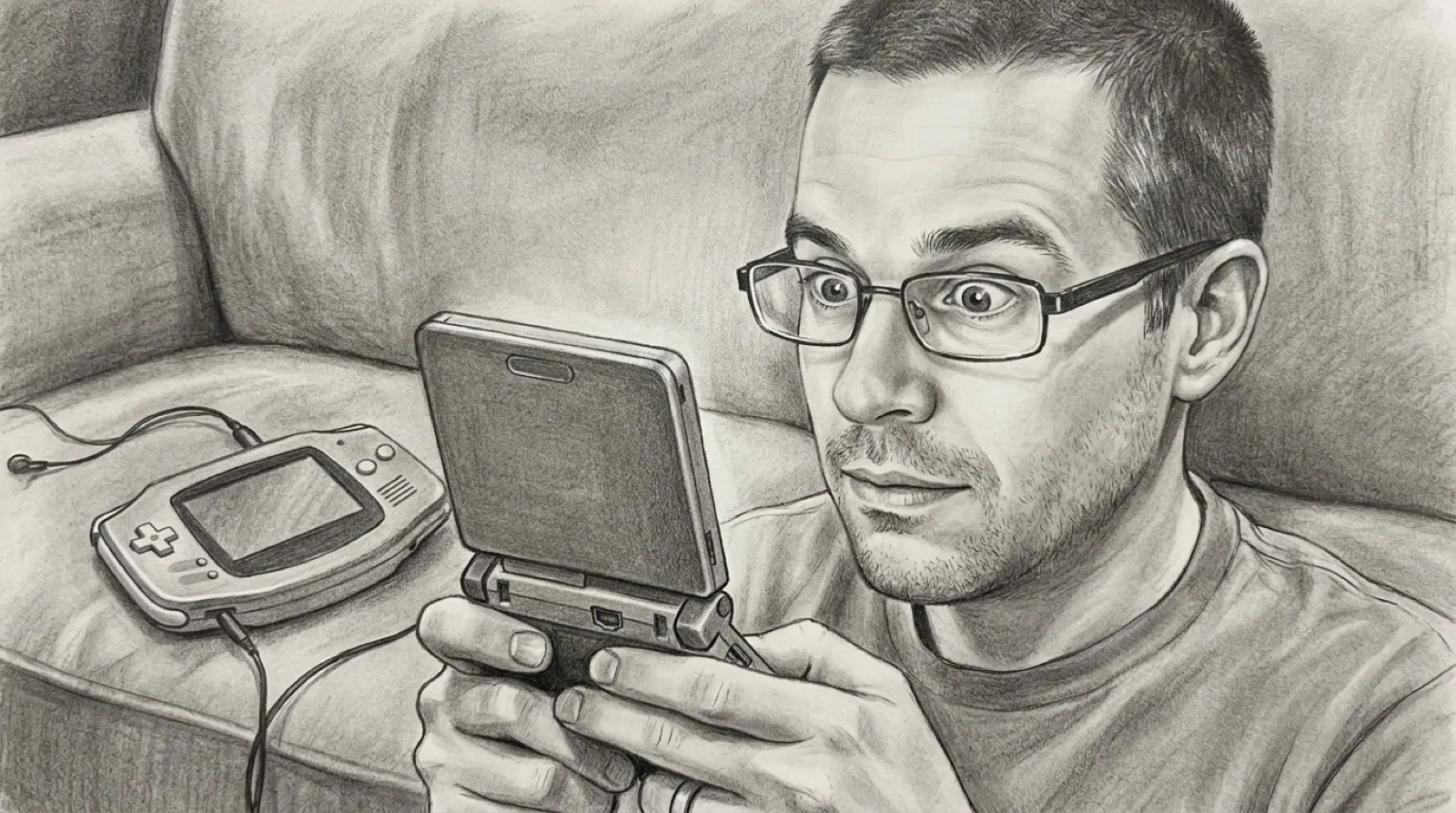
The Game Boy Advance SP lets the screen light up and makes the headphone jack disappear. Nintendo took a problem you could see and supplied one you could hear about later. The folding shell and rechargeable battery make this a useful redesign, with a small accessory-shaped footnote.
Nintendo’s original Game Boy Advance technical data lists two AA batteries, a headphone connection and a 240 by 160-pixel display. The SP technical page lists an integrated lithium-ion battery and switchable screen lighting, with the same resolution and the same 40.8 by 61.2-millimeter screen dimensions.
That makes the pixel arithmetic delightfully uneventful: 240 times 160 equals 38,400 pixels on either. Lighting helps you see the existing image. A folded lid helps carry the same game image around, with the illumination doing the work that a strategically placed lamp did for the original.
| Deciding detail | Original Game Boy Advance | Game Boy Advance SP, archived lit model |
|---|---|---|
| Power source | Two AA batteries | Integrated rechargeable lithium-ion battery |
| Screen lighting | Unlit stock display | Switchable light |
| Headphones | Built-in connection | Separate adapter required |
| Shape | Open horizontal body | Folding screen |
| Body dimensions | 82 × 144.5 × 24.5 mm | 84.6 × 82 × 24.3 mm, folded |
| Nintendo-listed playtime | About 15 hours | About 10 hours lit; 18 unlit |
Nintendo describes the headphone connection as available through an adapter, “available separately,” which is exactly the kind of phrase a buyer needs to notice before the console arrives and the headphones have nowhere to plug in. When you shop for a Game Boy Advance SP, the adapter belongs on the inventory list alongside the charger. A console-only listing leaves you looking for an adapter and a charger before the headphones and the rechargeable pack can provide their supposed convenience.
The original’s AAs and the SP’s rechargeable pack also create different habits. One takes replacement cells; the other expects a charged internal pack and an appropriate charger. These are historical specifications for factory hardware. They cannot establish the remaining capacity of the battery inside a particular used machine.
The SP history page sells the light as a way to keep playing after sundown. Its listed runtime changes when that light is on, so dividing 18 hours by the original’s 15 would compare two differently described workloads. Marketing already did enough gymnastics without help from a calculator.
Used listings add another wrinkle: the word SP alone does not identify the exact display revision or modifications. Nintendo’s page here describes a switchable-light model. It supplies no basis for treating every screen replacement as equivalent, or for grading a modern modified unit against the stock specification. A buyer needs photos and the model details before paying extra for somebody’s adjective.
Both designs keep the appeal of the same-resolution GBA library within reach. The SP’s strongest advantage is wonderfully ordinary: seeing the game without arranging your life around a lamp. The headphone adapter gets to come along too, assuming the seller can find it.
Headphones sold an extra step.