
Nintendo DS vs. DS Lite: 57 grams lighter, with four brightness levels
Both folding handhelds accept the same cartridge families. The useful buying questions concern the bag, the charger and the screen you will actually use.
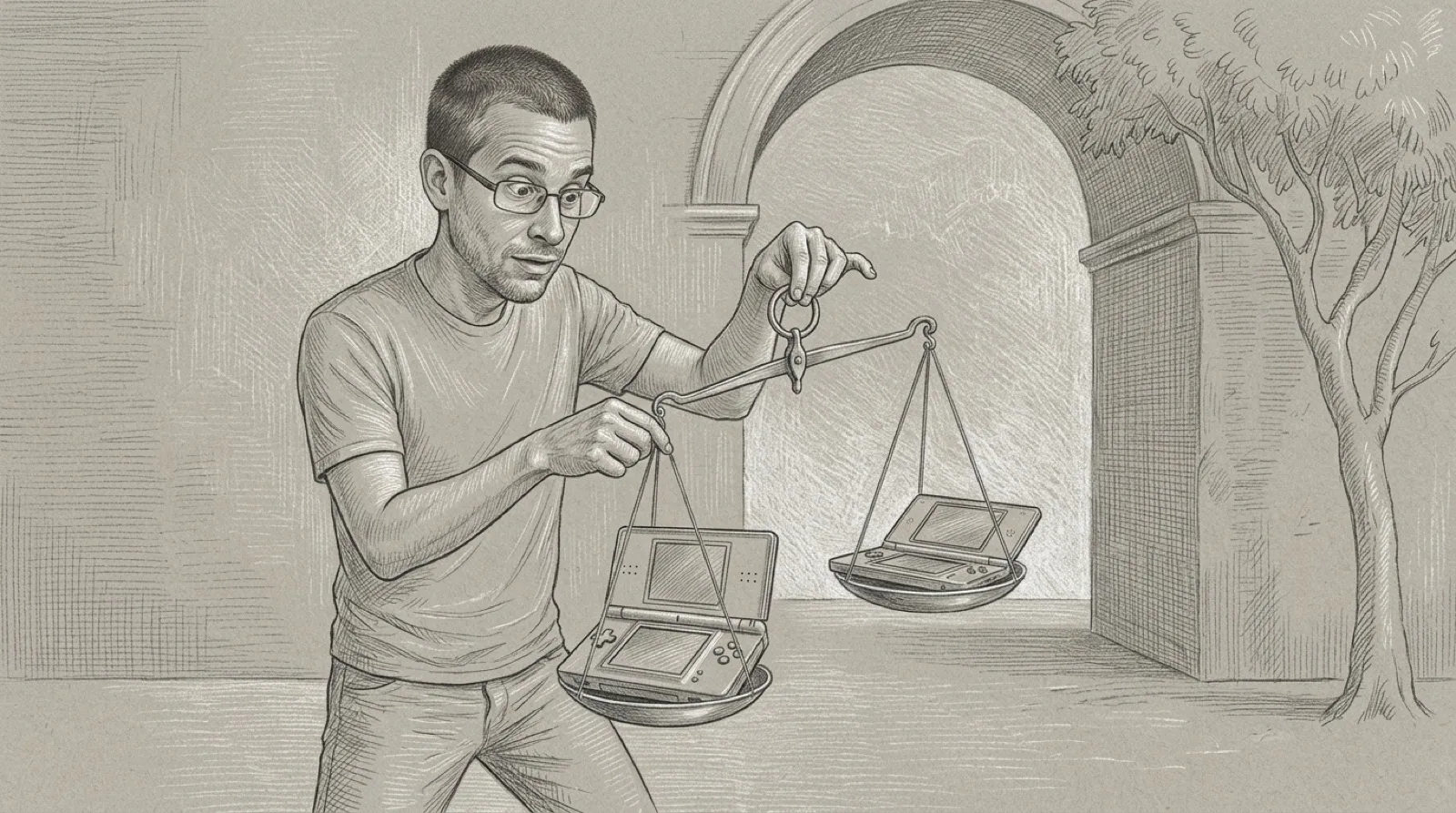
The Nintendo DS Lite earns the second half of its name on a scale. Nintendo lists the original DS at 275 grams and the Lite at 218 grams, with their listed accessories and batteries included. That is 57 grams less to hold above your face. That smaller mass is still attached to the same two-screen idea, which matters when the handheld is something you hold through a game session.
The original DS specification gives its folded body as 148.7 by 84.7 by 28.9 millimeters. The Lite’s specification brings those dimensions down to 133 by 73.9 by 21.5 millimeters. Subtracting the thicknesses gives 7.4 millimeters saved, before anybody tries to sell you a case twice as thick as the improvement.
Nintendo’s January 26, 2006 announcement also explains the name through the Japanese words “軽い” and “明るい”: light in weight and bright. The brighter part has a control attached: four illumination settings. Nintendo got two meanings for the price of one name, and the specifications put measurements beside both parts of the sales pitch.
| Deciding detail | Original Nintendo DS | Nintendo DS Lite |
|---|---|---|
| Listed weight | About 275 g | About 218 g |
| Folded thickness | 28.9 mm | 21.5 mm |
| Body width | 148.7 mm | 133 mm |
| Screen brightness adjustment | No four-level control listed | Four levels |
| Listed charging time | About 4 hours | About 3 hours |
| Listed battery range | About 6 to 10 hours | About 5 to 19 hours across brightness settings |
Both machines retain 3-inch screens and both list DS software and Game Boy Advance software. A purchase of the Nintendo DS Lite therefore changes the package around that library. The DS game you already own does not suddenly need a sequel purchase to acknowledge the slimmer shell (how refreshingly unambitious).
The battery figures need their settings kept attached. Nintendo lists approximately 15 to 19 hours for the Lite at minimum brightness and 5 to 8 at maximum brightness. Its original DS range is 6 to 10 hours, with software affecting both. Putting the Lite’s largest number beside the original’s smallest would make a spectacular chart and a lousy promise.
A seller’s machine also has a battery with a history the launch specification cannot know. A photographed startup screen establishes that it started up. It leaves the actual runtime, charge behavior and screen condition for the buyer to check. Twenty-year-old specifications remain useful; twenty-year-old batteries deserve individual attention.
Nintendo’s weight definitions also deserve a glance before the subtraction: the original includes its battery and stylus, while the Lite figure includes its battery, stylus and GBA connector cover. These are the company’s stated carrying configurations, without a case, charger or extra cartridges added.
The chargers are model-specific in Nintendo’s own lists, too. An original DS listing with its adapter and a Lite listing without one are different packages, even when the asking prices match. The box of spare cables gets another interview.
The Lite trims about 20.7% from Nintendo’s listed original weight: 57 divided by 275. A happy original-DS owner can keep playing the same cartridges. Someone squeezing a handheld into a bag gets a measurable improvement without rebuilding the shelf.
Same shelf. Smaller pocket problem.