
Nintendo DS vs. DSi: bigger 3.25-inch screens, but no Game Boy Advance slot
A handheld upgrade can strand an accessory as easily as an old cartridge. Nintendo’s compatibility notes give mixed collections a reason to inspect the bottom edge.
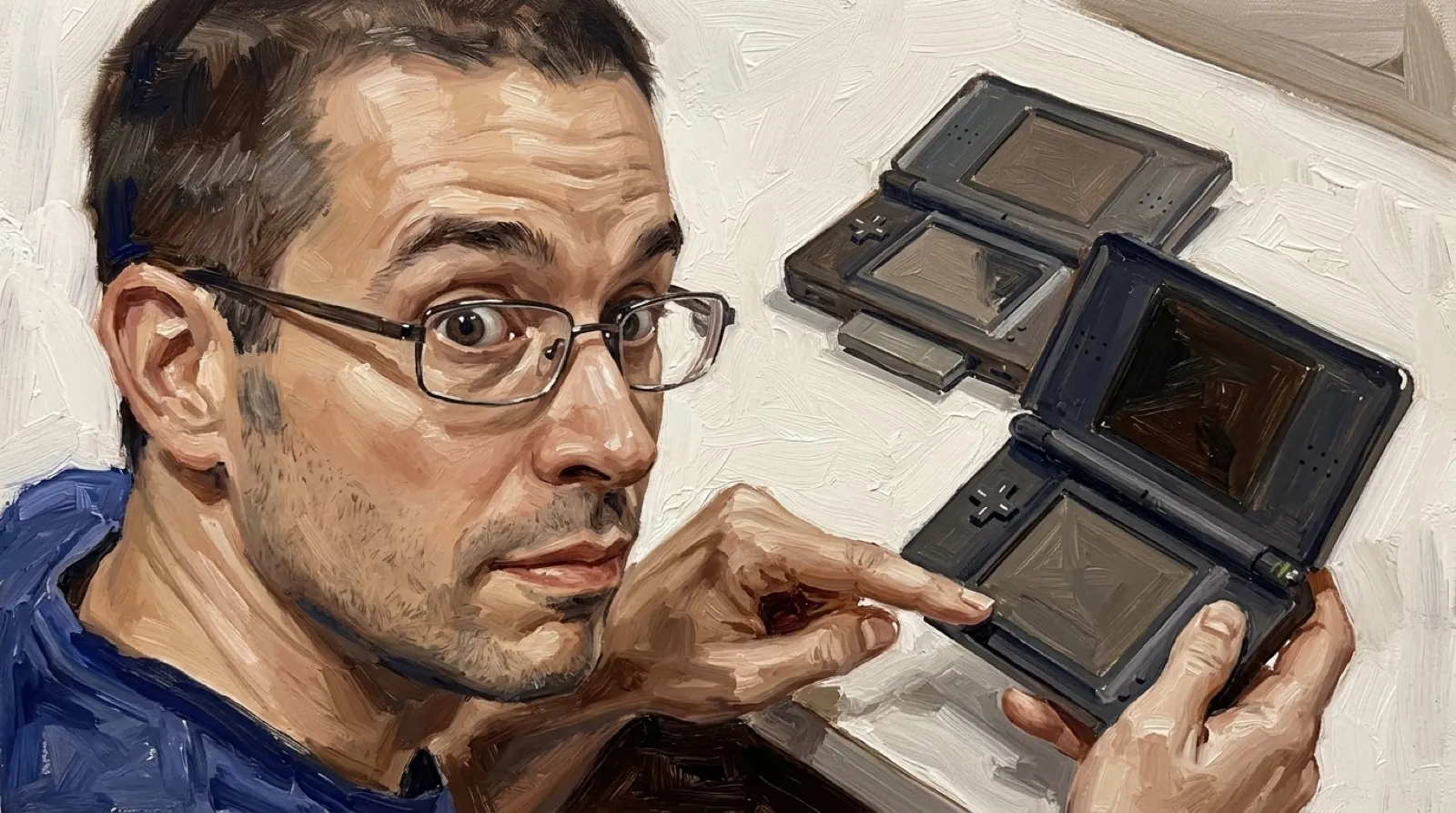
The missing hole can settle Nintendo DS versus DSi before either machine turns on. A Game Boy Advance cartridge needs the slot on the original DS. The DSi removes it. Put the wrong handheld beside your existing collection and part of the upgrade consists of discovering which things stay in the drawer.
The original DS specifications list both a DS card slot and a Game Boy Advance cartridge slot. Its screens measure 3 inches diagonally. The DSi’s 3.25-inch screens add a quarter inch per display, and Nintendo lists a lower weight: about 214 grams against the original’s approximately 275 grams.
Those figures describe a genuinely different object to carry, but screen diagonal establishes screen diagonal. It supplies no proof of higher resolution or faster games. A larger numeral in the display row can get very persuasive when a seller lets it do all the talking.
| Deciding detail | Original Nintendo DS | Nintendo DSi |
|---|---|---|
| Screen diagonal, each | 3 inches | 3.25 inches |
| Listed weight | About 275 g | About 214 g |
| Folded thickness | 28.9 mm | 18.9 mm |
| Game Boy Advance cartridge slot | Present | Absent |
| SD card slot | Not listed | Present |
| Listed software families | DS and GBA | DS, DSi-specific software and DSiWare |
Nintendo’s compatibility guidance identifies the missing Game Boy Advance slot as a limitation for DSi. That can also affect software whose box says DS. Some DS accessories use the older slot for their connection, so a matching label on the cartridge does not settle the entire setup.
Guitar Hero: On Tour is the wonderfully concrete example. Its accessory needs that connection. Bigger screens cannot reconnect the controller through enthusiasm. Nintendo says it removed the slot to keep the design “as slim as possible,” so the thinner case has a compatibility cost attached.
A Nintendo DSi makes more sense for someone specifically seeking its supported software and larger displays. Nintendo’s archived spec includes DSi-specific software and DSiWare. That historical software list still needs separating from what a used unit contains or what you can obtain today; an archived feature list cannot promise a currently operating download shop.
Nintendo also lists about two and a half hours to charge the DSi, against about four hours for the original DS. The DSi has five brightness levels with different runtime ranges; a quicker full charge still supplies no promise of longer play at an arbitrary setting.
The weight difference is 61 grams, calculated from Nintendo’s two listed figures. The folded thickness falls by 10 millimeters. Both help explain the physical appeal without requiring the older DS to become suddenly inadequate at playing the games it already played.
This is a useful reversal of the usual upgrade ritual. The first shopping question concerns the stuff you keep. Photos of the cartridge slots and the exact accessory tell you more about that decision than a glamour shot of the newer shell. The DSi can be the right choice; the old controller still needs somewhere to go.
The guitar needs its socket.