
IBM's early disk team used compressed air to keep the head from scraping data
RAMAC's breakthrough required mechanical clearance as well as quick positioning, a detail easily lost behind capacity comparisons.
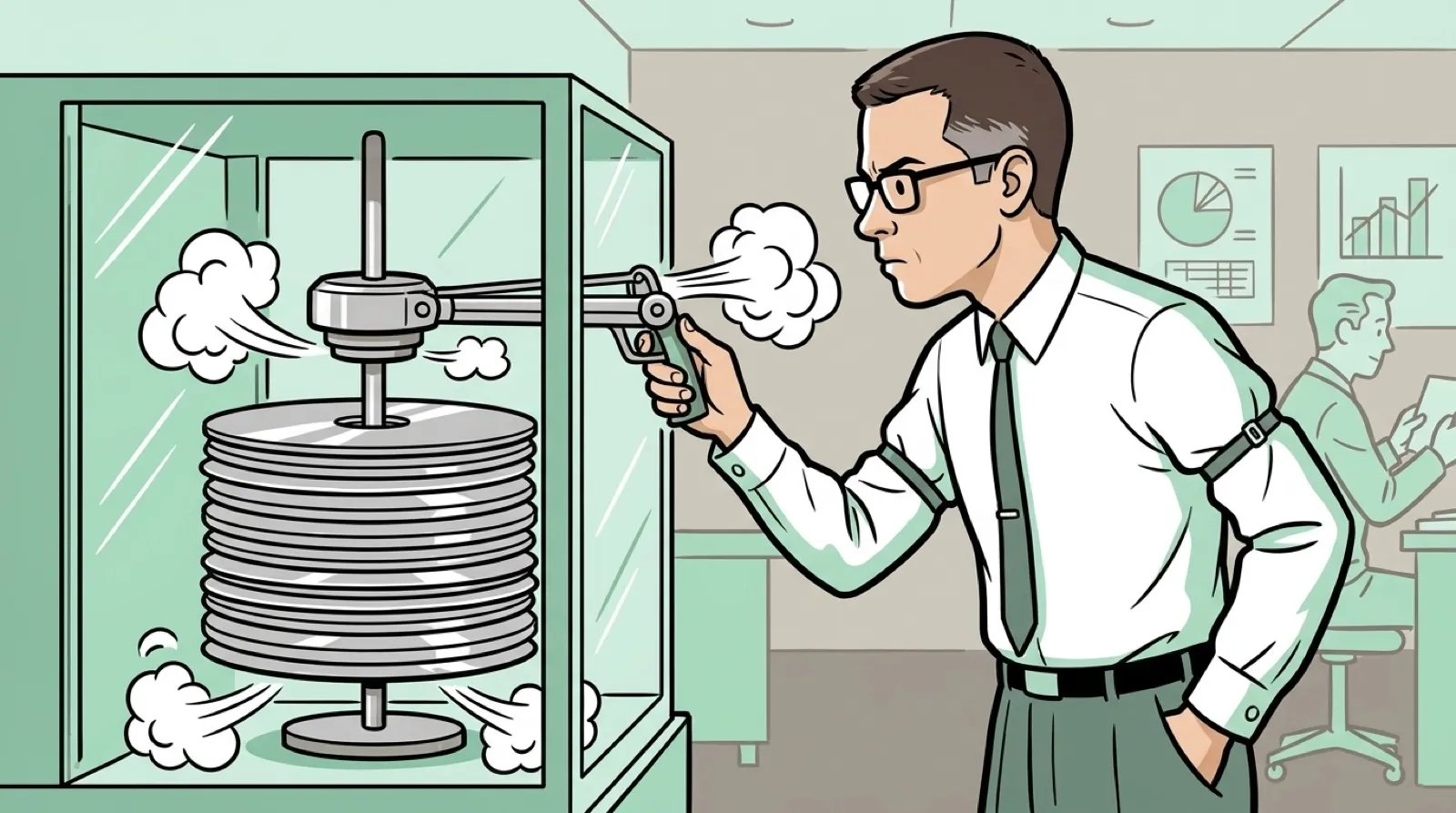
IBM had to get its disk-reading arm close enough to read the data and far enough away to leave the data there. Compressed air helped maintain that very particular relationship.
The company’s account of RAMAC describes engineers experimenting with rotating, magnetically coated aluminum disks. A reading mechanism needed to reach the recorded spots. Touching the surface could destroy information, which makes the record-player comparison useful right up to the point where you put the needle down.
The team tried compressed air to keep the mechanism hovering. IBM also describes disks warping during early high-speed trials and an attempt to stiffen them by gluing two together. Flatness and clearance were part of the storage problem. The data could be represented magnetically and still be lost to something as blunt as a mechanical collision.
Reynold Johnson recalled an ambitious positioning goal and a result of about “800 milliseconds,” in IBM’s history. That number concerns the movement the team was trying to achieve. It shouldn’t be turned into a universal promise for every operation or every disk drive with RAMAC in its name.
The physical challenge makes the achievement easier to appreciate than a tiny-by-modern-standards capacity number alone. A storage system must repeatedly put the right mechanism in the right place under operating conditions. Getting there quickly and getting there without damage belong to the same requirement, even if the sales brochure has room for only one of them.
That distinction is worth preserving when explaining disk history to someone whose storage appears as a silent rectangle on a laptop spec sheet. A familiar modern product can make the earlier engineering seem inevitable. The description of warped disks and an air-supported mechanism brings back the decisions that had to work before there could be a product.
For anyone building a moving mechanism, the interesting test is whether an accurate position also remains safe at speed. A drawing can show a gap. A running assembly has vibration and deflection, plus whatever the real materials decide to contribute. Giving the clearance a testable requirement is more informative than admiring how close the parts appear in a rendering.
There’s an easy pun about air-gapped storage here, and an equally easy way to confuse the term. This gap served a mechanical purpose. It kept a reading mechanism off a recording surface, rather than isolating a computer from a network. The distinction saves a lot of unnecessary security discussion at the lunch table.
A future storage mechanism could change the medium and the way information is addressed while inheriting the same basic obligation: read it repeatedly without ruining it. RAMAC’s team had a very literal way to test whether they’d succeeded. A scrape would have settled the question immediately.
The data needed breathing room.