
The Mac’s four-voice sound demo squeezed two values into each register
Andy Hertzfeld’s weekend account ends with editable waveforms, an oscilloscope, and a boss still hoping for music.
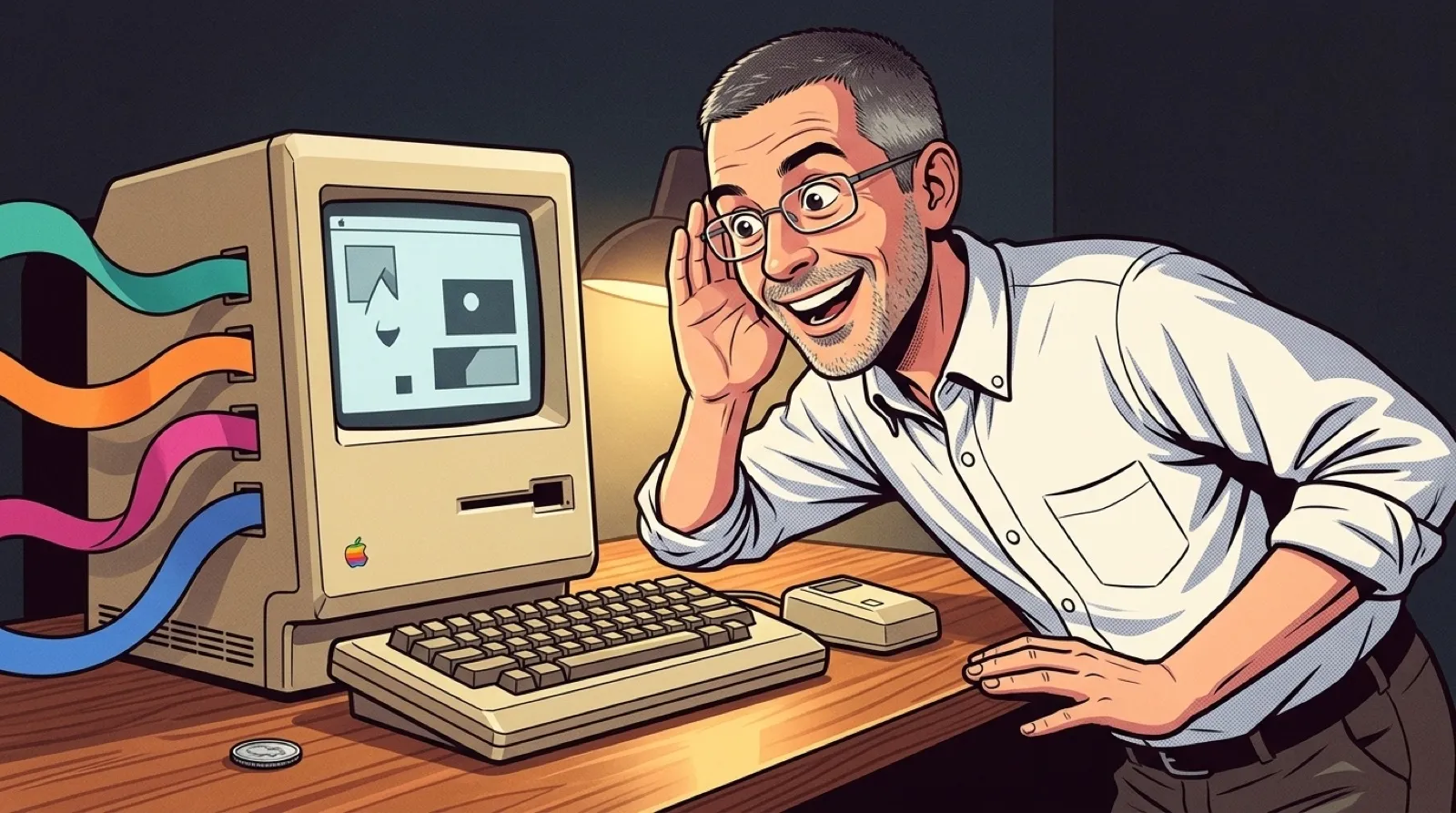
Steve Jobs wanted great sound by Monday or the Macintosh prototype’s amplifier was coming out. It was late Friday. The amplifier had cost an extra dollar, giving that weekend a truly spectacular exchange rate between saved components and human sleep.
Andy Hertzfeld tells the story from inside the room. Burrell Smith had promised four voices after redesigning the Mac’s board. Hertzfeld had plenty of other work and a basic sound diagnostic, but a square wave was unlikely to charm somebody threatening to remove the speaker’s supporting hardware.
Smith offered to buy meals while they worked through the weekend. The constraint was more specific than making a noise. The design could fetch audio during the display’s horizontal blanking intervals, when video data wasn’t needed. That provided a roughly 22 kHz sample rate, with a fresh sample budget every 44 microseconds.
The processor still had to calculate those samples. Hertzfeld’s initial loop managed two voices but four took too long. The result included audible glitches and a machine moving painfully slowly. A synthesizer that brings everything else to a halt is certainly making itself heard (management included).
Smith spotted memory accesses inside the calculation and pushed Hertzfeld toward registers. Those small storage locations inside the processor were much quicker to access than main memory. Keeping the values in registers resembles keeping the parts on the workbench; fetching each piece from a different cupboard takes longer.
There were only 16 registers, though. Each voice needed several values, and housekeeping needed room too. Hertzfeld reached three voices before running out. Late Saturday, he used the registers’ 32-bit width to hold two separate 16-bit values in some of them. The arithmetic fit, and so did the fourth voice.
At the maximum sample rate, generating a sample took about 22 microseconds. Against the 44-microsecond budget, that left approximately half the CPU for everything else. That’s a carefully attributed demonstration figure, rather than a general performance claim for every Mac audio application.
Sunday’s remaining job was making the achievement demonstrable. Their SoundLab interface let someone draw a waveform with the mouse and adjust the four voices’ frequencies. An oscilloscope showed the waveform from the audio output. A person could see their drawing emerge from the hardware, which is a much better demo than pointing at a completed checklist.
Jobs liked the visible waveform editing, Hertzfeld recalls, but still wanted high-quality music. The demo lacked envelope shaping and made eerie noises. Four voices had solved the deadline without solving the entire musical experience. The unpaid balance on that product ambition remained.
Hertzfeld later noted in a comment that lowering the sample rate gave more time per sample, and other software eventually achieved eight voices. That adds a useful unresolved choice to the weekend: maximum sample rate was only one possible bargain between sound quality, voice count, and processor time.
A dollar bought quite a weekend.