
Nintendo's NES security patent made the console and cartridge solve matching calculations together
The patent describes two cooperating processors that decide whether the main machine is allowed to run.
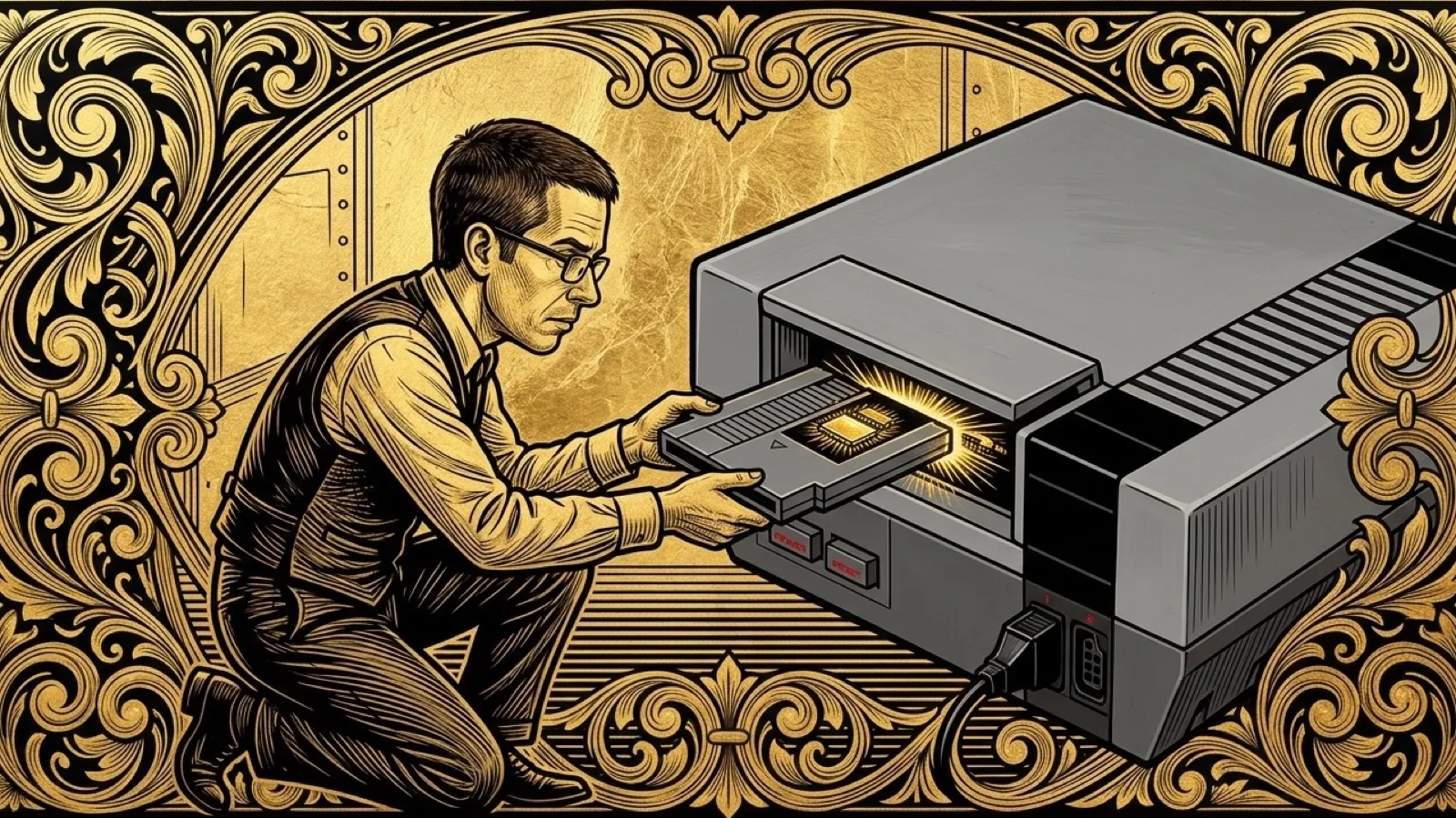
An NES cartridge can hold more than the game the console wants to run. Nintendo’s patent describes a second conversation: a key device alongside the software exchanging results with a lock device in the machine. Before the game gets the stage, two small circuits compare their homework.
The patent’s abstract describes duplicate semiconductor devices executing the same arithmetic operation in synchronization. The results are exchanged and compared. Agreement allows the main processor to operate; failure leaves it in reset. That is an active check involving two participants, rather than a label the console simply reads once and accepts.
The physical placement matters. One participant travels with the external software, while the other remains in the host. The document calls them key and lock devices, which gives a familiar picture of their roles. The key is not merely the cartridge’s shape: it has behavior the lock expects to observe.
The patent discusses external memory more broadly than one familiar game cartridge. It names ROM cartridges and floppy disks among its examples. That wider language is part of describing an invention’s possible arrangements. It should not be mistaken for evidence that every implementation or every Nintendo system shipped with exactly the same circuit.
The main processor’s reset state is a particularly useful detail. The check does not have to understand the story, graphics or quality of the game. It decides whether the machine will be enabled to execute it. The distinction puts authorization below the visible software, where a player experiences it simply as a machine that runs or refuses to cooperate.
A patent also has a narrower evidentiary role than a teardown. It explains what the applicant disclosed and claimed. Establishing the exact contents of a specific production cartridge would require evidence about that cartridge. The drawings and descriptions make the proposed mechanism clear without turning the document into an inventory of every released board.
For readers familiar with the Nintendo Entertainment System, the surprise is the extra computing work devoted to deciding whether computing can begin. The game processor is waiting on a conversation that is about permission rather than gameplay. A small supporting circuit can therefore determine the behavior of the much more visible machine.
The diagrams are worth following with those roles in mind. Trace the software’s path separately from the lock-and-key exchange, then find where reset is controlled. That gives the patent a concrete story without needing to reproduce its claims as legal advice. The important endpoint is an electrical decision: the host either proceeds with the program or remains disabled.
The game had to pass a quiz.