
AIopenjutsucomfyuiai-videoopen-sourcelocal-ai
Openjutsu Swaps the Person in Your Video for a Character Photo on Your Own GPU, a Free ComfyUI Take on Higgsfield's Genjutsu
Openjutsu is an MIT-licensed app that runs MiniMax H3, SAM 3.1 and Qwen3-VL through ComfyUI on a local NVIDIA card to replace the main person in a clip with your character, keeping the camera, cuts, motion and soundtrack.
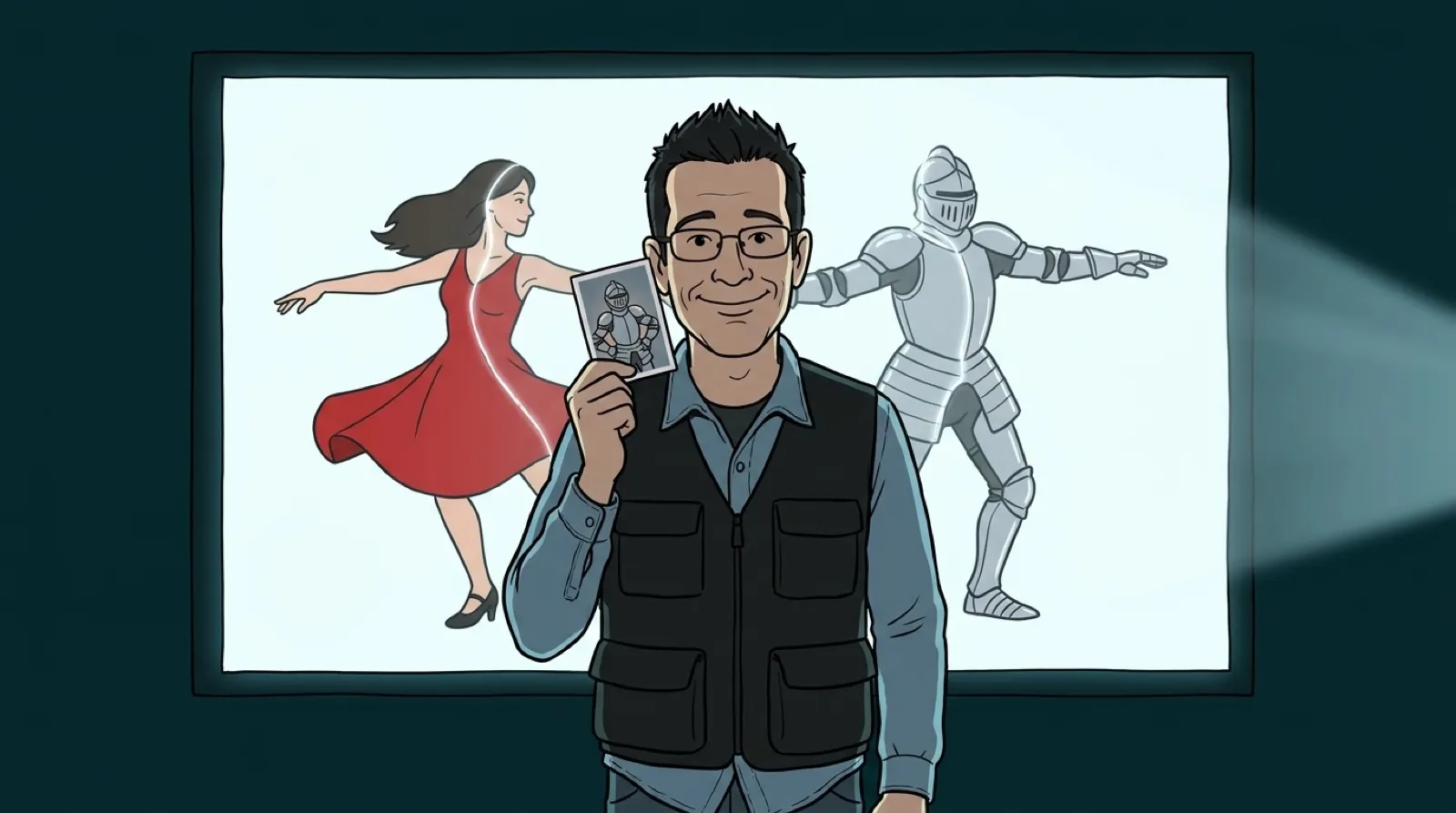
The repository appeared on GitHub on October 26 and passed 560 stars within days. Its developer, who goes by D3voz, describes it as “an open-source, local Higgsfield Genjutsu alternative built on ComfyUI and MiniMax H3, with FLUX.3 Klein relighting.” The front end is a web app; the work happens in a ComfyUI install you already run.
The README’s promise is about what stays the same. “The camera, cuts, motion and soundtrack stay.” Only the person changes. Three models split the job: “MiniMax H3 for the video, SAM 3.1 to track people, and Qwen3-VL 8B to describe the pictures and shots.”
The simple mode swaps one character for the main person. An advanced mode handles up to four characters at once. An object mode can change, remove or add a thing in the shot, or replace the background. A “from picture” mode with relighting offers seventeen looks, and two cleanup passes, one for faces and one for color, run after.
Openjutsu exists because of Higgsfield’s Genjutsu, which the company describes as “a new tool that rebuilds part of a clip without a full reshoot.” Here is how the two compare on the facts each side publishes:
| Openjutsu | Higgsfield Genjutsu | |
|---|---|---|
| Where it runs | Your own NVIDIA GPU, through ComfyUI | Higgsfield’s cloud |
| Cost per clip | Free app; you pay for the hardware and power | 15 seconds at 480p: 40 credits (about $2.00); 720p: 104 (about $5.20); 1080p: 144 (about $7.20) |
| Input | A video and a character photo | “one video between 4 and 30 seconds long” |
| App license | MIT | Commercial service |
Higgsfield notes its prices were “verified September 2026” and that “Credit costs may vary by generation settings.”
You’ll need real hardware. The README says the app was “Tested on an RTX 4060 Ti 16 GB with 64 GB of system RAM,” and it requires an NVIDIA GPU, ComfyUI 0.41.2 or newer and Node 22.6 or newer. Higher resolutions cost more time; the README puts 1080p at about 2.5 times slower than 736p.
The “open” part has a fine print section. The app’s own code is MIT, but “Model licences are separate.” The MiniMax H3 weights on Hugging Face are published under the “minimax-h3-community-license-agreement,” a custom license. The Fix faces step depends on InsightFace’s buffalo_l models, which the README says are “licensed for non-commercial research only,” and on YOLO weights under AGPL-3.0. And there’s a plain limit on what it can draw: “Mirrors and reflections do not work yet.”
A paid AI video feature getting a local, open-source copy within two months of its launch is becoming the normal pattern, and ComfyUI is usually where it lands, because the models are already wired in. That puts pressure on per-clip pricing for anyone with a capable graphics card. The open question for Openjutsu is the license on MiniMax H3 itself, which decides whether a free swap can end up in paid work at all.