
Retroqwertykeyboardstech-historytypewritertelegraph
The QWERTY Keyboard Grew Out of Telegraph Gear Built for Morse Code Operators, Kyoto Researchers Found
Koichi and Motoko Yasuoka traced the early Type-Writer's keyboard to a printing telegraph and its first buyers to Morse receivers, and called the story that QWERTY was meant to slow typists down "nonsense."
The first customer for Christopher Latham Sholes’s Type-Writer wasn’t a secretary. In November 1868, the machine went to Edward Payson Porter, who ran a school in Chicago that trained telegraph operators.
It had 28 keys, it “looked like a piano,” and the letters ran in alphabetical order, “A to N in left-to-right and O to Z in right-to-left.”
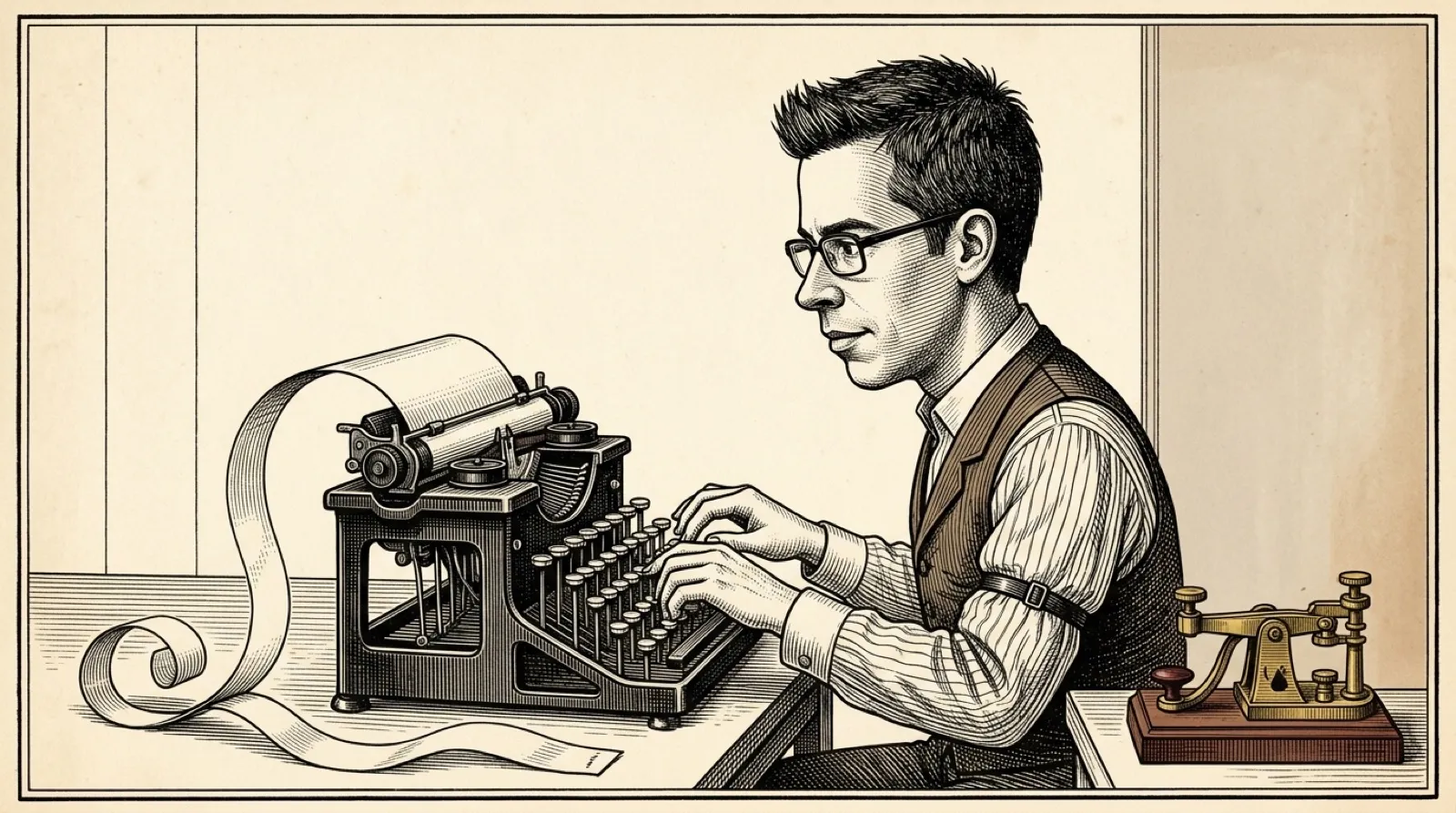
Porter’s students copied Morse code by ear. A sender tapped, the sounder clicked, and the receiver wrote it down as fast as it came. A machine that slowed them down would have been useless to the only people buying it.
The Yasuokas spell out that logic. “The speed of Morse receiver should be equal to the Morse sender, of course,” they write. “If Sholes really arranged the keyboard to slow down the operator, the operator became unable to catch up the Morse sender.”
Morse itself pushed letters around. In American Morse, Z is sent as four dots, “which is often confused with the digram SE, more frequently-used than Z.” A receiver often couldn’t tell which one was coming until the next letters arrived. “Thus S ought to be placed near by both Z and E on the keyboard for Morse receivers to type them quickly.” On a modern keyboard, S still sits next to both Z and E.
Sholes’s 1868 patent, US 79,265, says nothing about slowing anyone down. It describes keys “similar to the keyboard of a piano” and no letter layout at all. The arrangement Sholes did patent came a decade later, in US 207,559 in August 1878.
One demo turned into a speed contest. In the autumn of 1872, Porter showed the machine to Gen. Anson Stager, president of Western Union in Chicago. Stager began to send “very slowly, as if sure that Porter would be unable to ‘receive’ unless he did so.” Porter called out “Faster, General!” three times, until Stager stopped, rang for a page and said, “Send Smith down here.”
Not everyone was sold. When Sholes demonstrated it in New York in 1870, Thomas Edison, a partner of telegraph builder George Harrington, criticized it severely: “This typewriter proved a difficult thing to make commercial.” Remington released the Sholes & Glidden Type-Writer in April 1874.
Keyboard layouts outlive the machines they were made for. QWERTY’s Morse-driven quirks are still on phones that have never seen a telegraph, and the same thing will most likely happen to whatever shortcut keys today’s AI tools settle on: once millions of people learn them, changing them costs more than keeping them.
The Yasuokas don’t claim the telegraph explains every key. Their conclusion says the arrangement changed “first to receive telegraphs, then to thrash out a compromise between inventors and producers, and at last to evade old patents.”
Some of the trail is still missing. The paper rejects the legend that R moved up so salesmen could peck out TYPE WRITER from one row, since demos were done “by receiving Morse telegraph or by dictation.” But when the researchers rebuilt the 1870 keyboard from Sholes’s letters and patents, one detail wouldn’t fit: it was “nearly in alphabetical order, but U was next to O. It puzzled us.”