
AIai-agentsneuroscienceexin-therapeuticslab-automation
Exin Therapeutics' CEO Says an AI Agent Picked the Gene Therapy and Brain Coordinates for a Mouse Surgery, Then Wouldn't Let Him Override It
Gabriel Ocana-Santero says his startup's agent chose an epilepsy treatment from 19 candidates, steered a motorized rig to inject it into a mouse's brain, and refused to retry a blocked move even when he pushed it to.
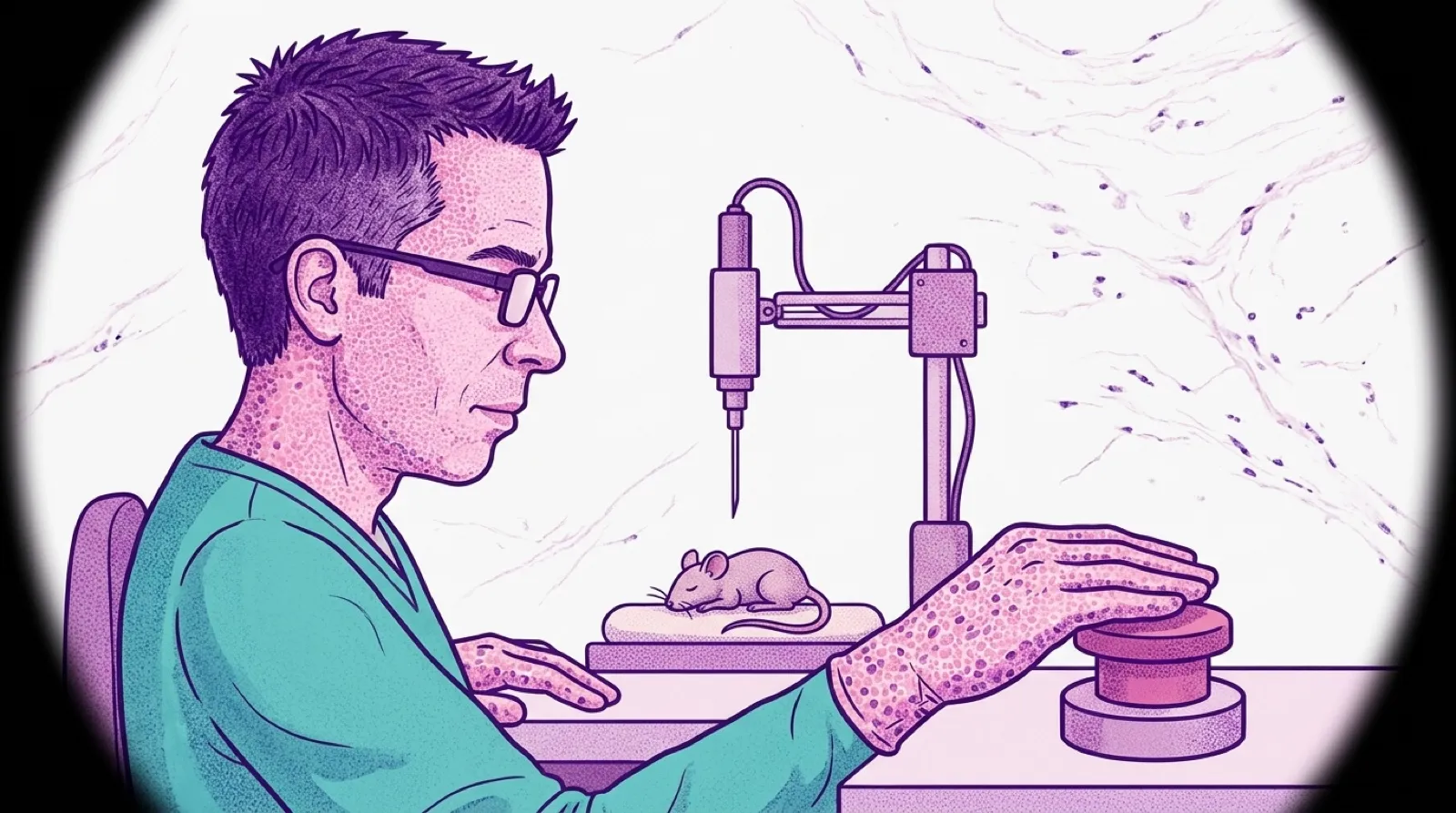
“Last night an AI agent performed brain surgery on a mouse,” Ocana-Santero (@OcanaSantero) wrote. His company, Exin Therapeutics, is a Y Combinator startup building agents for brain drug discovery, starting with epilepsy.
The setup was a spreadsheet and a goal. “We gave it 19 gene therapy vectors in a spreadsheet, a mouse model of epilepsy, access to a motorize surgery rig with cameras and one goal: reduce seizures,” he wrote. The rig is homemade, built on Arduino, with its camera and motors exposed to the agent through Exin’s own software.
He says the agent worked out what drives seizures in that model and picked a therapy that boosts GABA, the brain’s main brake pedal, aimed only at the neurons that make it. It chose the lateral entorhinal cortex as the target. It also looked at the substantia nigra, a common epilepsy target, and wrote it off because, in his summary, “in one study it failed to stop tonic-clonic seizures. Tonic-clonic being what we asked it to reduce.”
The coordinates came from three papers, averaged, each checked to make sure it measured depth from the brain’s surface the way the rig does. The agent landed on “3.90 mm behind bregma, 4.00 right, 4.30 down” and “injected 250 nanolitres over five minutes,” choosing motor speeds and wait times along the way. A human surgeon did the opening in the skull, which the agent “is not allowed to do yet for safety reasons.”
It narrated as it went. The agent pulled 32 frames from the rig camera during the session, and he quotes one from mid-injection: “37.5 of 250 nL so far, about 15 percent. No bleeding or backflow visible at the opening.”
@OcanaSantero's post on X
Then the safety rails Exin had built turned on Exin. After a disconnect, the rig computed a target 34 millimeters out on a 30-millimeter rig, and the move was refused. The agent’s call: “Nothing moved, the needle is still exactly at bregma zero. This looks like a Y axis calibration problem, not a bad plan value. I’m not retrying.” The team re-zeroed and got the same number. “That rules out a stale zero reference. I’m not trying a third time.”
The agent turned out to be right. Hand moves during an earlier pause had knocked the controller out of sync. “But I could see the problem and could not talk it into trying anyway, even though we had a living being under surgery,” Ocana-Santero wrote. Someone had to fix the code by hand while the mouse waited. (Not the kind of pause anyone wants with a needle in play.)
The model lineup has its own twist, and every model in it is Anthropic’s. By his account, Claude Opus 5.5 “refused immediately when detected bio.” Opus 5 ran a full dry run on water and graph paper, then stopped at the live surgery, reasoning that “Starting something I can’t finish on an anesthetized animal is worse than not starting.” Sonnet 5 ran the live surgery start to finish.
“Mouse recovered well!” he wrote. Whether the therapy reduced its seizures, the thread doesn’t say. He promises a technical report and a full write-up on Substack.
Lab-in-the-loop companies are going to keep handing agents more of the bench, and the first fights won’t be about whether an agent can hold a needle steady. They’ll be about who can say “go anyway” when its limits and the clock disagree, and whether a model maker’s refusal policy decides which experiments a startup can run at all.
The technical report is the next thing to watch: the seizure counts, the camera logs, and whether an independent lab can repeat any of it.