
Hardwaredouglas-engelbartmousepatentssricomputer-history
Douglas Engelbart's 1970 Computer Mouse Patent Called It an 'X-Y Position Indicator' and Said You Could Move It With Your Feet
US Patent 3,541,541, granted to Douglas Engelbart and Stanford Research Institute on November 17, 1970, describes the first mouse as a wheeled box that rolls across a desk, or, in its own words, 'even may be moved by the feet.'
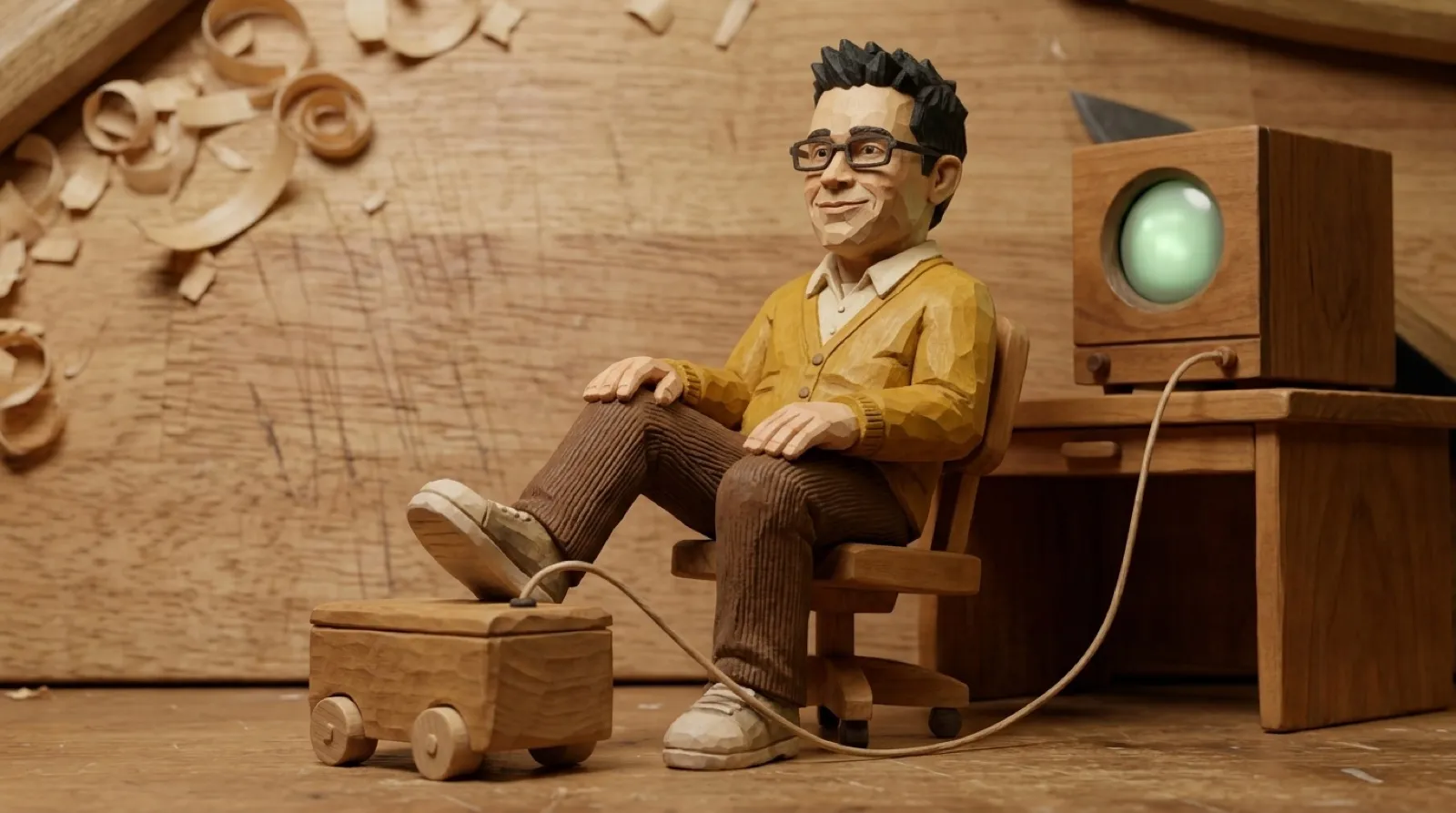
The line is tucked into a parenthesis. The patent describes a control that can be “moved over any surface, such as a desk top (or even may be moved by the feet).” Nobody followed up on the foot option, and every mouse you’ve ever owned went on the desk.
Engelbart filed on June 21, 1967, and the assignee was Stanford Research Institute, now SRI International. Inside the housing, two wheels sit at right angles to each other, and “each wheel is attached to a potentiometer or other means for indicating its rotation.” Roll the box left, one wheel turns. Roll it forward, the other does. The abstract says the wheels “operate rheostats to send signals along a wire to a computer which controls the CRT display,” and a cursor follows on the screen.
The thing it was built to beat was the light pen, which the patent calls a “light pencil.” Its complaint is practical: light pencils “generally require the human operator to hold the pencil against the CRT with one hand while changes are made,” so “the operator does not have both hands free to enter changes, as by typing them in.” Worse, “the light pencil often covers part of the area of the CRT display.” You were blocking the thing you were trying to point at.
The Engelbart team didn’t pick the mouse on a hunch. The Doug Engelbart Institute says the lab tested “a half dozen pointing devices for speed and accuracy,” including a light pen, a joystick, DEC’s Grafacon and a knee-operated control built in-house. A foot pedal and a head-mounted pointer were tried too, “neither of which made it into the final tests.” So the feet line in the patent wasn’t a joke. The team had actually been trying to steer computers with body parts other than hands.
Even the cord got redesigned. Engelbart recalled that on the first try “the cord got tangled when you moved your arm,” so they “turned it around so the tail came out the top.” The patent itself grumbles that on rival devices “a relatively thick cable trails behind it and limits the ease with which it can be moved.” As for the name, Engelbart said “no one can remember who started calling it a mouse.” The patent office never heard it.
What the patent doesn’t settle is why the feet made the final text at all, when the lab’s own foot pedal never reached its final tests.
The mouse’s next fight looks a lot like its first one. Light pens lost because they blocked the screen and tied up a hand. Touchscreens, styluses and hand-tracking headsets all put your arm back in front of the display, and the lab’s knee-and-foot experiments read less silly every year that accessibility controls lean on eyes, heads and switches. The interesting question is which of the devices that lost Engelbart’s 1960s test quietly comes back first.