
Hacks & Buildsesp32pcbhardware badgeshackathonsopen source
Hack the North's 1,750 Programmable ESP32 Badges Shipped Through Four Board Spins, a Capacitor in an Inductor's Slot and an NFC Chip That Couldn't Read
Nick Ficara's build log for Canada's biggest hackathon walks through every mistake between a $5-a-head pitch and 1,750 assembled badges at about $11.60 each, and how attendees then built 120 apps on them.
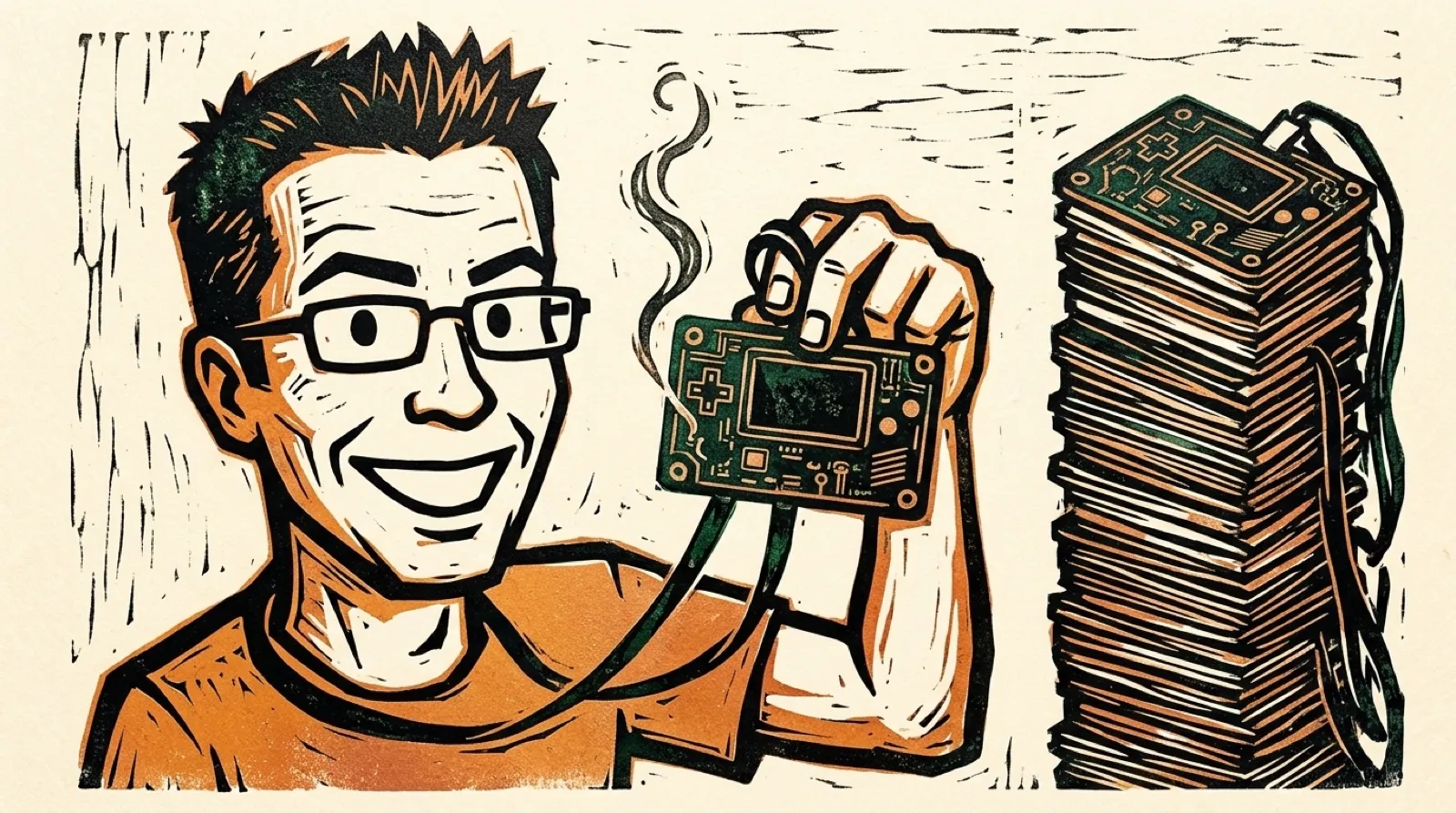
“On the Saturday, a team walked up to me holding four of them. They’d turned them into a working game of Among Us.” Eight months earlier, Ficara writes, “our badges were going to be made of cardstock too.”
The pitch to Hack the North’s organizers listed LEDs, a screen, a battery, buttons, audio, wireless features and silkscreen art, “all for $5 / head (boy was I naive).” It also had an exit: if the hardware went wrong, the team could fall back to blank, unassembled boards. “Without this safety net, I don’t think this project would have taken off.”
The capacitor in the inductor’s slot
The first spin was a hexagon (“Because HEXAGONS are the BESTAGONS”), ordered February 15. On USB power, it worked. “On battery power, nothing.” Ficara had labelled two capacitors “10u” for 10 microfarads, and the inductor L1 “10u” as well, “which tricked the part finder into giving me a 10uF capacitor in the place of a 10uH inductor.” The fix on that board was to short across the inductor’s spot.
The screen was the next surprise. To save “about five cents a badge,” the plan was to solder the display’s ribbon cable straight onto pads. Ten days in, the factory said the pins were too dense to solder. The connector “I should have used from the start happened to fit the pads I’d already laid out for the ribbon,” so the factory fit it there “for an extra $4.25 total.”
Then NFC. “NFC chips come in two roles,” he writes. A reader scans. A tag gets scanned. “The chip I’d picked was a tag. A phone could scan our badge, but the badge couldn’t scan anything itself.” A chip that could do both cost more than the budget allowed, so the second spin got a reader chip, and the badge-to-badge contact swap moved to “Bluetooth + accelerometer.”
Smoke, flipped chips and a toothbrush
The 50-board pilot run, ordered May 14, arrived dead. Two chips had been placed rotated. The factory had sent a layout to confirm, and “what the email didn’t mention was that two of those orientations had changed.” After a day of soldering, “three fully working, two working without NFC, and seven still dead.” Batteries put in backwards turned the board into “a smoke machine,” so production got a reverse-polarity FET. Before the full order, Ficara checked every rotation in the factory’s render and found “the brand-new FET, the one we’d added to stop the smoke, was rotated the wrong way.”
The production order went in June 30. Some of the rest reads like any small-batch hardware diary. Flux cleaning was done by hand, with “a toothbrush wrapped in a cleanroom wipe,” for $59.11. When 25 screens failed testing in August, he wrote: “Around 1,600 working boards on time is far more valuable to us than 1,750 perfect boards arriving late.”
The cost: “about $20,300 for 1,750 assembled boards, or roughly $11.60 per populated badge,” not counting R&D, batteries or spare screens. JLCPCB and EasyEDA partially sponsored the project, and he writes that where things went wrong, “the root cause was almost always on my end.”
The weekend numbers: 11,700 badge-bump connections, 40,000 sponsor table scans, and 420,000 on-screen bubbles popped, “about 240 per badge.” Teams built a multiplayer shooter, a Pokémon-style NFC game, a Tux Racer controller and “a badge-to-badge virus.”
Ficara closes with a dare to every other organizer: “beat us.” The factory, he writes, “is ultimately a web form, the parts are just rows in a table, and mistakes are expensive but survivable.” The badge-con crowd has known that for years. A $20,000, 1,750-unit run built by a handful of volunteers is what brings it to hackathons. The question for next season is whether other organizers pick up the dare, and whose first spin is a hexagon.