
The original floppy disk’s envelope cleaned it as well as covering it
Project Minnow began as an inexpensive way to deliver mainframe instructions. Its magnetic sheet needed a practical answer to ordinary dirt before it could travel.
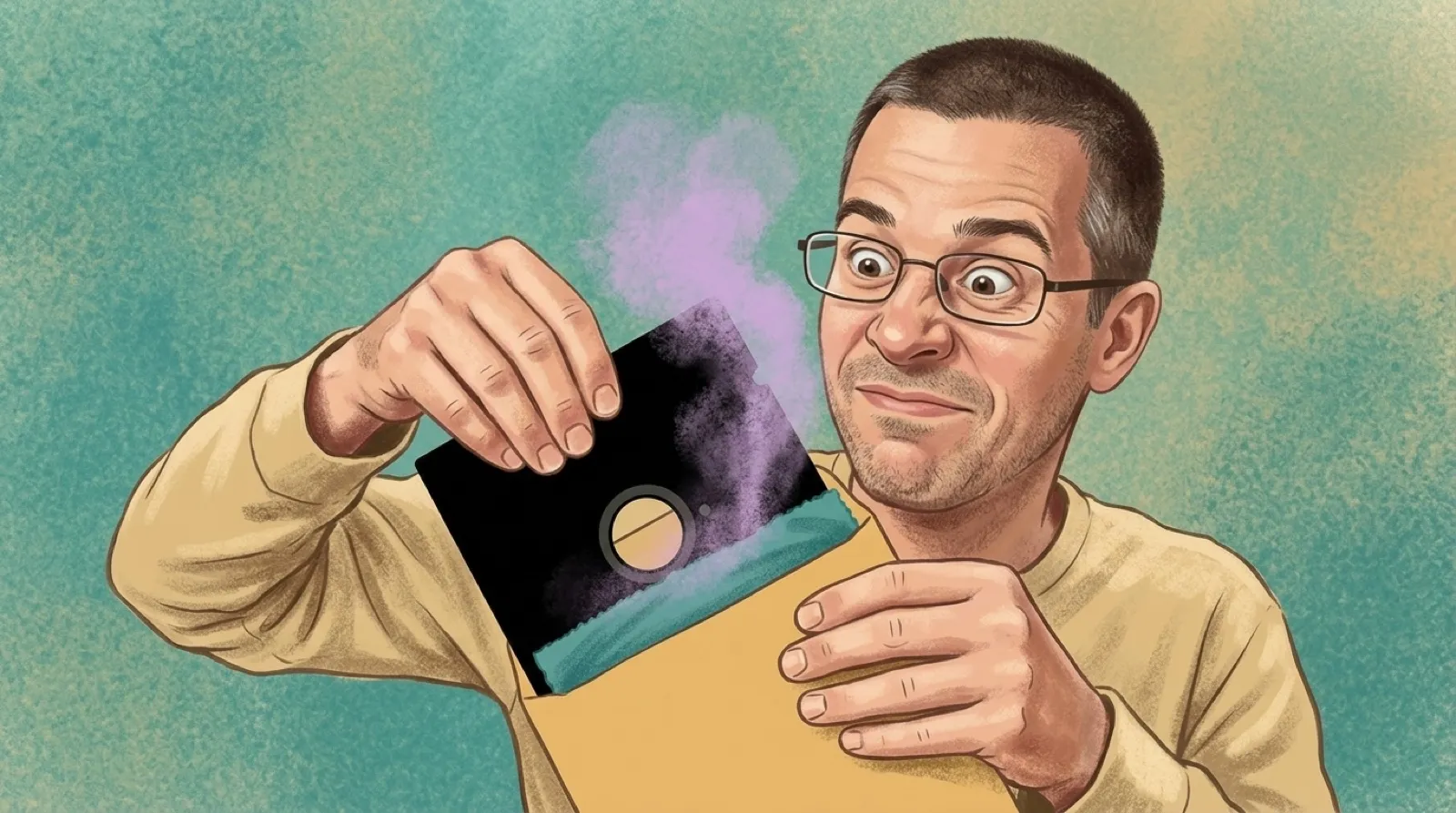
The floppy disk had housekeeping built into its envelope. IBM’s early flexible disks collected dirt easily, and the engineers answered with a lining that wiped dust away. Somewhere inside a machine entrusted with software updates, a very small cleaning job had to keep happening.
IBM’s history of the floppy traces the project to a San Jose team led by David L. Noble in 1967. Their brief concerned a reliable, inexpensive way to load instructions and software updates into mainframes. The computers already had hard drives. Getting instructions into them conveniently remained its own problem, with punched cards still part of the working environment.
The team initially considered magnetic tape. Project Minnow then moved to a flexible Mylar disk with a magnetic coating, spun on a spindle inside the drive. Its central hole let it rotate, while openings gave the drive heads access to the recording surface. The flexible sheet did the remembering; the envelope made it easier to keep that memory usable when somebody carried the disk to another machine or put it away between uses.
This account comes from IBM’s own historical page. It describes the dirt problem and the envelope’s wiping element, without supplying a measured failure-rate improvement or a detailed material recipe. The useful fact is the mechanical job inside the package. Turning that into a promise about restoring old disks would add a very different claim.
IBM began selling floppy drives in 1971 and received patents for the drive and disk in 1972. Its account gives the original 8-inch disk the capacity of 3,000 punched cards. That comparison also explains the appeal to an office with data already committed to paper: a single portable disk could replace a substantial stack.
Drive inventor Warren L. Dalziel recalled, “I had no idea how important it would become and how widespread.” The words are a useful brake on retrospective inevitability. This started with mainframe loading, well before the familiar ritual of carrying a disk between somebody’s home and office.
The envelope makes the wider story more interesting because portability involves handling. Software distributed by mail or sold in a store has to survive being touched, carried and put away. A lab demonstration can stay under careful supervision; a product eventually meets a desk drawer (dust included).
IBM describes the later progression through smaller disk formats and stronger cases, including the rigid housing around the familiar 3½-inch disk. The visible package changed with the medium’s daily life. Calling every outer layer packaging misses the part that actually touches the problem.
There is a gentle correction here for the way technology gets remembered. Capacity figures survive in charts. The humble feature that helps a device tolerate people often disappears from the retelling. In this case, the storage breakthrough came with a chore already assigned, and its worker stayed inside the envelope.
Dust had entered the chat. Mechanically.